Get Full Government Meeting Transcripts, Videos, & Alerts Forever!
Get email alerts on the Recidiviz And Case Management topic
No spam. Unsubscribe anytime.
Idaho DOC seeks ongoing funding for Recidiviz tools, transparency platforms
Summary
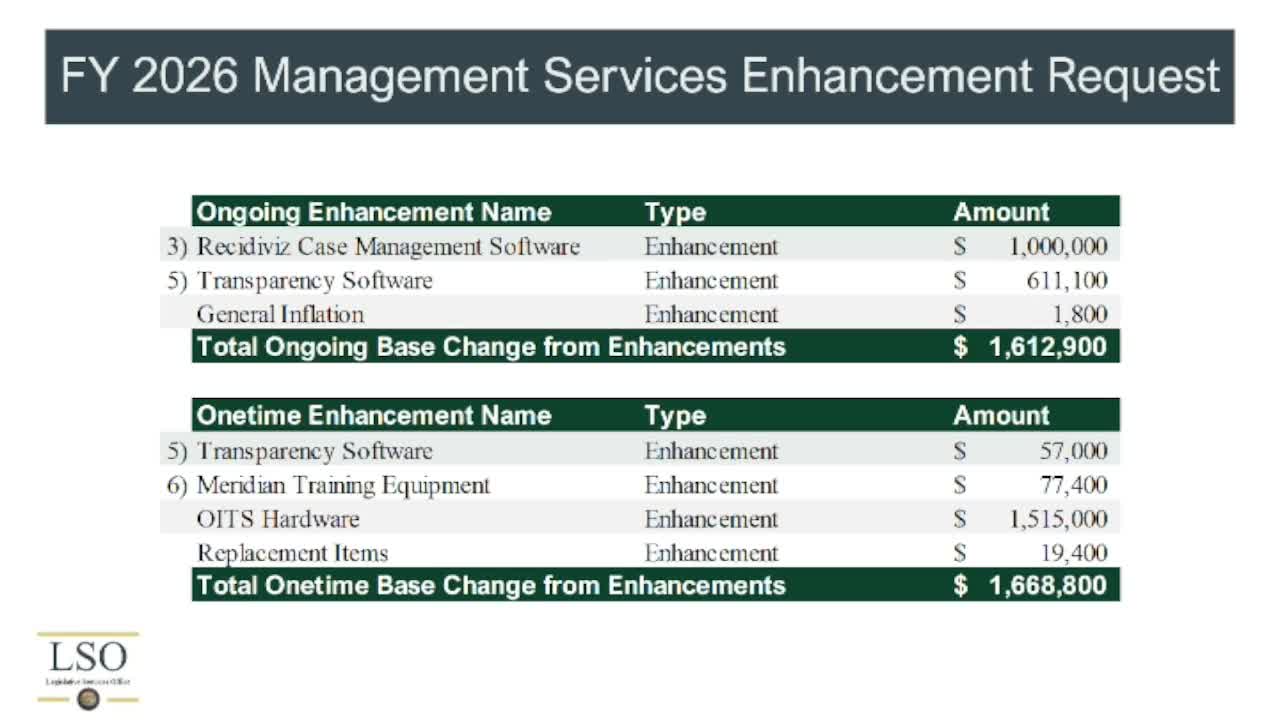
The Idaho Department of Correction asked the Joint Finance Preparations Committee to approve ongoing funding to expand its partnership with Recidiviz and to maintain transparency software that manages public records, inmate access to court materials and offender-management customizations.
The Idaho Department of Correction on Feb. 4 asked the Joint Finance Preparations Committee to approve ongoing general‑fund appropriations to continue and expand its data‑integration work with the nonprofit Recidiviz and to sustain several transparency software subscriptions.
Noah Peterson, budget and policy analyst for the Legislative Services Office, told the committee that Management Services seeks ongoing general‑fund support for a Recidiviz case‑management platform alongside other technology requests, including subscriptions that provide inmates access to court documents and software for handling public‑records requests.
Why it matters: The department said the tools are intended to automate administrative tasks, help parole and probation officers prioritize caseloads, and support case managers in prisons so staff can focus on higher‑value supervision and reentry work.
Director Josh Tewalt said Recidiviz is more than “software” and described it as a nonprofit that integrates outdated, disparate systems to surface operational data. “What Recidiviz is a nonprofit tech company … they create overlays … and automate a lot of processes that take a lot of staff time,” Tewalt told the committee, describing case‑triage dashboards used by probation and parole staff.
Tewalt said the platform also lets the department compare performance anonymously with other jurisdictions and that Recidiviz leverages private philanthropic matching funds. “Because they are a nonprofit, every penny we spend is leveraged against private philanthropic dollars,” he said, describing a matching model the department said multiplies the state’s investment.
Committee members pressed for measurable returns. Senator Cook asked whether there is hard data showing a return on investment; Noah Peterson and Tewalt said the committee does not yet have an analytic report in hand but offered to provide dashboards and outcome visualizations. Representative Tanner and others requested copies of dashboards and clarification about who controls and inputs the data. Tewalt said the department controls its data and that Recidiviz pulls information under data‑sharing agreements rather than altering primary records.
The management services request also includes ongoing subscriptions described in the department’s materials: a GovQA license to manage public‑records requests, LexisNexis access for inmate legal research, and continued customization of the department’s offender management system (Atlas) and an access‑to‑courts database. Peterson said GovQA, LexisNexis and Atlas components were included in the governor’s recommendations.
Budget context: the committee heard that prior Recidiviz appropriations were delivered as one‑time funds to build tools in 2021 and 2023. The current request would shift some development and maintenance to ongoing funding.
What’s next: Committee members asked the department to provide data extracts and dashboards showing how Recidiviz products are being used and any observed impacts on caseload outcomes. Tewalt said he would share visualizations and implementation details with the committee.