
Board of Horse Racing credits wagering, state funds for slow recovery; stewards pay change draws questions
Get AI-powered insights, summaries, and transcripts
Subscribe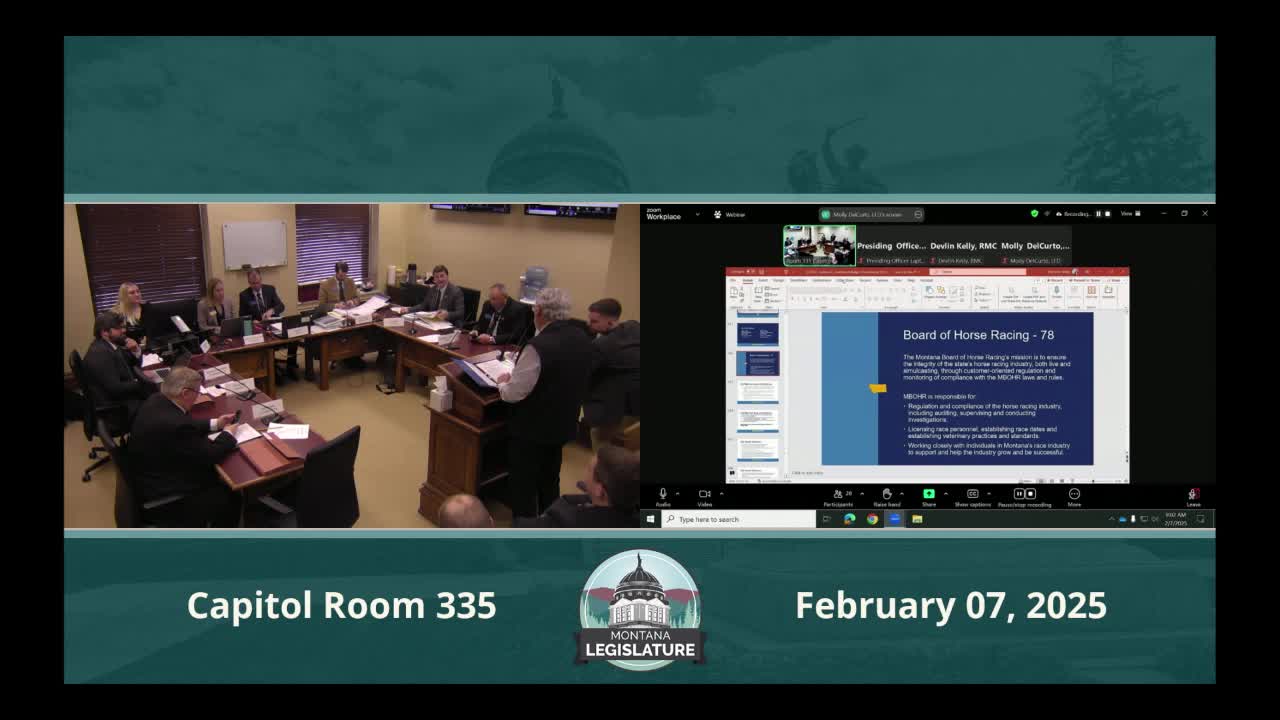
Summary
The Montana Board of Horse Racing told the Legislature—s appropriations subcommittee that advanced deposit wagering and recent general-fund support helped increase licensees and racing days, while committee members pressed agency staff on changes to how race officials are paid.
Gary Koepplin, executive secretary of the Montana Board of Horse Racing, told the Legislature—s Appropriations Subcommittee A that the state program is regaining ground after years of decline.
"The mission of the Board of Horse Racing is to ensure the integrity of the state of Montana's horse racing industry, both live and through simulcasting," Koepplin said, noting that attendance and other measures have improved: "Over 30,000 people attended live horse racing between Great Falls and Miles City," licensees rose 33% from 2023 to 2024, and pari-mutuel handle increased 8.5% between those years.
Koepplin said the board—s recovery strategy has three main elements: a Montana breeders incentive bonus, support for track infrastructure, and revenue from advanced deposit wagering (an online wagering model licensed to handle betting for Montanans). He told lawmakers the board used some recent general-fund dollars to fund the incentive program, infrastructure grants to Great Falls and Miles City, and purse increases to make Montana tracks more competitive.
Why it matters: the board said the mix of wagering revenue and one-time legislative funds brought visible increases in participation and licensing. Subcommittee members pressed agency officials about whether the board could be self-sustaining on state special revenue alone.
Questions on staffing and pay: Several legislators questioned the agency—s personnel costs after Koepplin said the board—s executive position is a two-year contract at about $36,000 and that race stewards have been paid through contracts or hourly wages depending on the season. Deputy Director Mandy Rambo, Department of Commerce, explained the change in pay practice.
"The industry standard in the horse racing industry is to pay stewards and racing staff by day," Deputy Director Mandy Rambo said. She told the committee the state—s payroll system requires hourly reporting and the department moved to contracting and, later, hourly pay to ensure accurate timesheet data and compliance with the Fair Labor Standards Act.
Committee follow-up: Legislators asked for more analysis of the board—s revenue sensitivity, including how much additional revenue would result from raising the 1% tax on pari-mutuel receipts that funds part of the board—s operations. Koepplin agreed to provide a numeric estimate to the committee. Senator Hey (during questioning) noted that the 1% tax is specified in "234304" and that any statutory change would require legislative action.
Ending: Committee staff and the board—s representatives agreed to follow up with more detailed revenue scenarios and clarifications about personnel budgeting for the next hearing.