Get Full Government Meeting Transcripts, Videos, & Alerts Forever!
Get email alerts on the Childcare Workforce topic
No spam. Unsubscribe anytime.
Committee hears extensive testimony on HB360 to boost child-care worker pay
Summary
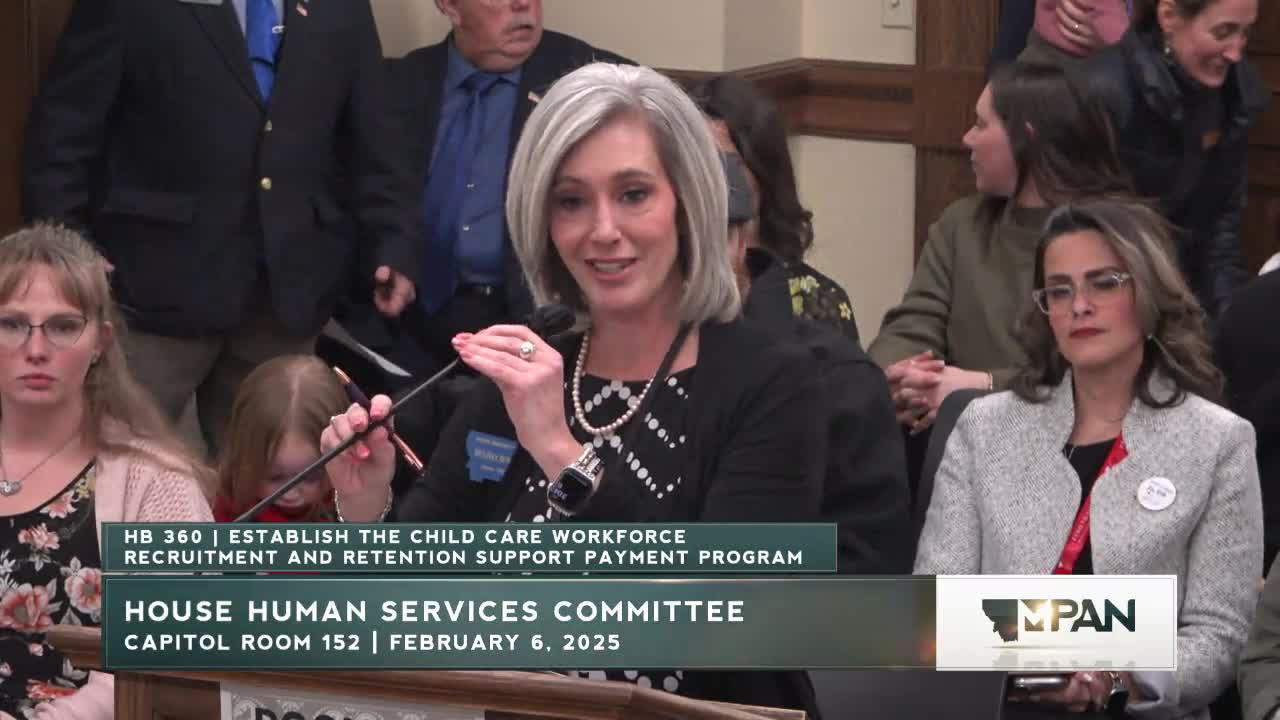
House Health and Human Services Committee members heard hours of testimony on House Bill 360, a proposal to create a state program that would deliver payments to licensed and registered child-care facilities to increase wages and benefits for early childhood workers, Representative Melissa Romano (House District 80) told the panel.
House Health and Human Services Committee members heard hours of testimony on House Bill 360, a proposal to create a state program that would deliver payments to licensed and registered child-care facilities to increase wages and benefits for early childhood workers, Representative Melissa Romano (House District 80) told the panel.
Romano, the bill's sponsor, said mounting workforce shortages and low pay have reduced capacity across the state. "Childcare is not just a service, it's vital to Montana's economy, our workforce and the healthy development of children," Romano said, and she told the committee that "66% of Montana children under the age of 6 have all of their household adults in the workforce."
Supporters said the primary goal of HB360 is to stabilize and expand access to child care by funding compensation for the workforce so providers can retain staff without passing large tuition increases on to families.
Testimony and evidence
Supporters — business owners, center directors, nonprofit and labor representatives, and parents from across Montana — described similar problems: chronic turnover, difficulty recruiting staff, and tuition that families already struggle to afford.
Grace Decker, who testified for Montana Advocates for Children, summarized the market failure: "The problem is this, childcare costs more to produce than families can afford to pay," she said, urging state support for providers so they can raise compensation without pricing out families.
Representatives of a range of providers described how federal one-time funding during the pandemic temporarily helped centers increase wages and stabilize staffing but left the field vulnerable after those funds expired. Krepps, executive director of Florence Crittenton Family Services, told the committee her organization doubled facility capacity but still operates below licensed capacity "because of staffing, not because of the facility." Mariel Boutin, executive director of Morning Star Learning Center, said raising wages reduced attrition at her center from 50% to 17% but that work remains "incomplete" without a stable funding stream.
Data and cost estimates cited to the committee included: - Turnover: witnesses repeatedly referenced a typical child-care turnover rate of about 34%. - Median wage: Romano said the median wage for a childcare worker in Montana in 2023 was about $13.99 per hour. - Supply gap: testimony stated Montana has roughly half the child-care slots needed for children ages 0–6 and about 34% of needed infant/toddler care. - Cost-of-care estimates: Zanna Berg of the Montana Budget and Policy Center cited the Montana Child Care Cost Model, saying the true cost of care is "closer to $27,000 a year at a center and $24,000 at a family program just for one child."
Funding proposal and rationale
Committee discussion touched repeatedly on the bill's proposed appropriation. Berg described an approach used to estimate an annual price tag of about $59 million: raise average wages from roughly $14 to a living-wage benchmark (about $20 per hour), convert that to a monthly supplement per full-time equivalent, and multiply by an estimate of just under 5,000 child-care employees statewide.
Several providers and advocates said that direct, ongoing compensation support is more effective at retaining staff than one-time grants because it makes the business model sustainable without leaving providers to pass costs to families.
Implementation and questions
Tracy Moseman, administrator for Early Childhood and Family Support at the Department of Public Health and Human Services (DPHHS), told the committee the agency would need staff to implement an ongoing program and would likely reimburse allowable expenses after reviewing invoices: "we would need a program manager who's actually reviewing invoices that are coming in from the facilities so that we can check for allowable expenses before we make payment and reimbursement," she said. Moseman also told members the department currently oversees about "a thousand facilities that are either licensed or registered in the state of Montana," noting licensing categories vary and that tribal-licensed facilities sometimes follow a separate process.
Committee members asked about eligibility (whether family home providers and tribally licensed programs would qualify), auditing or budget-approval mechanisms, and whether the state has models to follow. Witnesses and advocates pointed to Minnesota and Illinois as states with comparable programs; Berg cited early findings that Minnesota's compensation payments were widely reported by providers to help with retention and that prior stabilization grants in Minnesota raised wages in the range of roughly 9–12% in some samples.
Voices from rural and specialized communities
Several witnesses stressed rural and nontraditional-workforce needs. Jasmine Krotkov of the Montana Farmers Union said increased compensation is important to keep beginning farmers and ranchers in the state; Danny Hess of the Montana Community Action Network highlighted Head Start programs' vulnerability if wages and staffing are not addressed; and representatives of tribal communities described local challenges with scarcity and eligibility for different licensing systems.
No formal action taken
The committee did not take a final vote on HB360 during the hearing. Representative Romano closed by calling the bill "a critical measure to stabilize Montana's childcare system by addressing the workforce shortage head on" and urged committee members to support the measure as it moves forward.
What comes next
Committee members raised implementation questions for DPHHS and expressed interest in follow-up analysis on eligibility, oversight and how the program would interact with existing subsidy programs (Best Beginnings) and federal funding (CCDF and past ARPA stabilization grants). No formal amendments or votes were recorded at the hearing.