Get Full Government Meeting Transcripts, Videos, & Alerts Forever!
Get email alerts on the Wildlife Data Privacy topic
No spam. Unsubscribe anytime.
Committee debates amendment to limit sharing of recent wildlife GPS locations; equity and research uses at issue
Summary
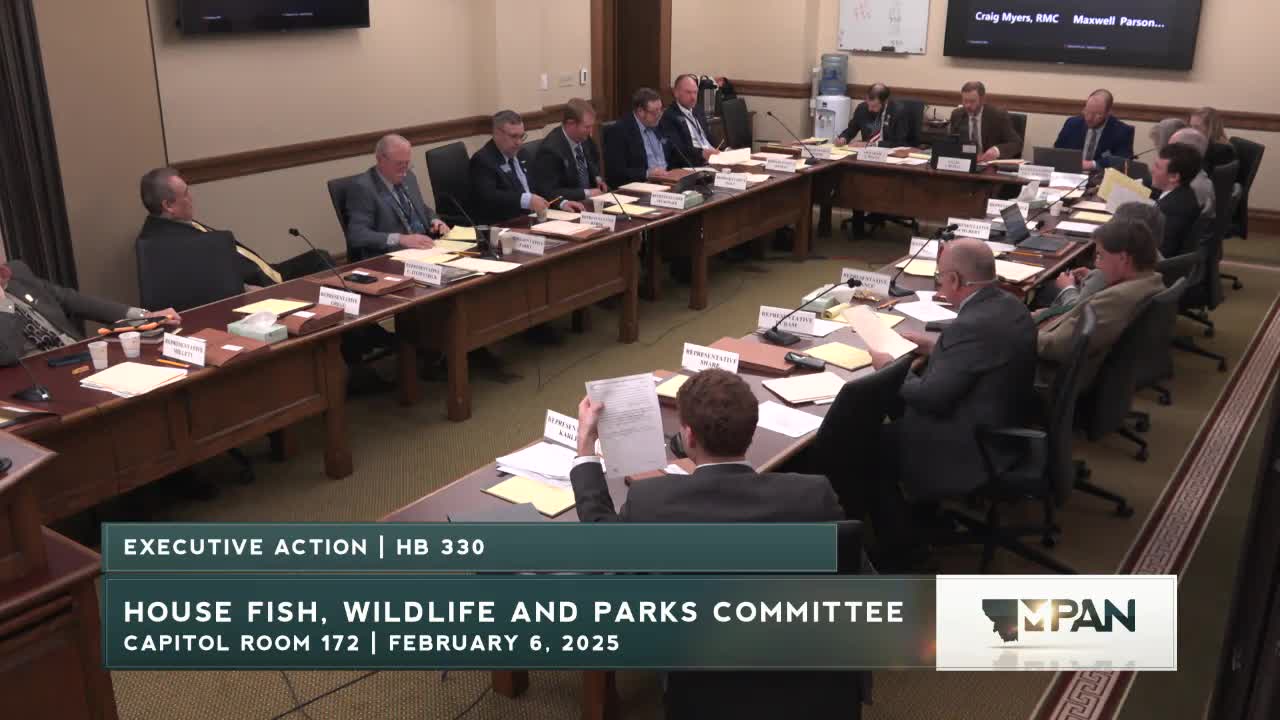
Committee members debated an amendment to House Bill 2-64 that would let Montana Fish, Wildlife and Parks share precise wildlife location data with research partners and agencies under data-sharing agreements while limiting release of coordinates within the most recent year.
Members of the House Fish, Wildlife and Parks Committee debated an amendment to House Bill 2-64 (amendment 264.1.0.1) that would clarify when Montana Fish, Wildlife and Parks (FWP) may share precise wildlife location data and telemetry information with research partners, other government agencies and entities under data-sharing agreements.
Representative Carlin, who moved the amendment, said the change would allow the department to share location data with research partners and other agencies such as the Department of Transportation under formal agreements that specify data elements and safeguards. Carlin said the amendment aimed to clarify sharing for collaborative conservation and infrastructure projects but that some committee members remained concerned about the risk of recent, exact GPS coordinates being used to target animals on private lands.
Representative Schubert voiced opposition to selective data-sharing carve-outs, arguing that freedom-of-information principles suggest information should be either broadly available or restricted, rather than selectively shared by government. He urged a no vote on the amendment, saying private citizens or researchers could be unfairly excluded from access.
Representative Konar countered that many states restrict access to near-real-time exact coordinates to protect fair chase and private landowners, and that the amendment preserves access for research partners and cooperating landowners who contribute funding or other collaboration. Konar emphasized that shared data under the amendment would be governed by agreements and that the amendment includes a buffer (a one-year limitation on providing exact coordinates within the most recent year) to reduce the risk that location data could be used to facilitate hunting or harassment of animals.
Committee members asked whether organizations such as the Yellowstone Coalition were seeking location data for research or tourism purposes and whether the proposed carve-out would allow those uses. Representative Maness asked if some requests were tourism-related rather than strictly research. The sponsor and others said the amendment targets collaborative research and agency partners and requires agreements rather than open, immediate public access to coordinates.
Representative Schubert and others expressed concern about an administrative body deciding which research groups receive access to sensitive data. Representative Konar and other supporters said the sharing would be limited to partners that add value (for example, by funding or collaborating on FWP projects) and that data-sharing agreements would set terms and limits, which could include temporal buffers or geographic granularity to prevent misuse.
The committee discussion included questions about the appropriate duration of any data-sharing agreement (the chair noted some members thought three years might be too long) and technical details of what coordinates and telemetry frequencies would be shared. Witnesses and committee members discussed legitimate uses such as designing wildlife crossings with MDT (Montana Department of Transportation) and other infrastructure planning that could require recent location data shared under contractual agreements.
At the point this transcript excerpt ends, the committee was still discussing the amendment; no committee vote on the amended provision was recorded in the provided excerpt.
Discussion points summarized: supporters framed the amendment as enabling collaborative research and infrastructure work while protecting animals and landowners through agreements and a temporal buffer; opponents argued the amendment would create unequal access and that public-interest requests could be unfairly excluded. The committee raised follow-up questions about the length of agreement terms, the exact data elements to be shared, and whether tourism-related requests would be treated the same as research access.
No final committee action on the amendment was recorded in the excerpt provided.