Get Full Government Meeting Transcripts, Videos, & Alerts Forever!
Get email alerts on the State Budget Taxation topic
No spam. Unsubscribe anytime.
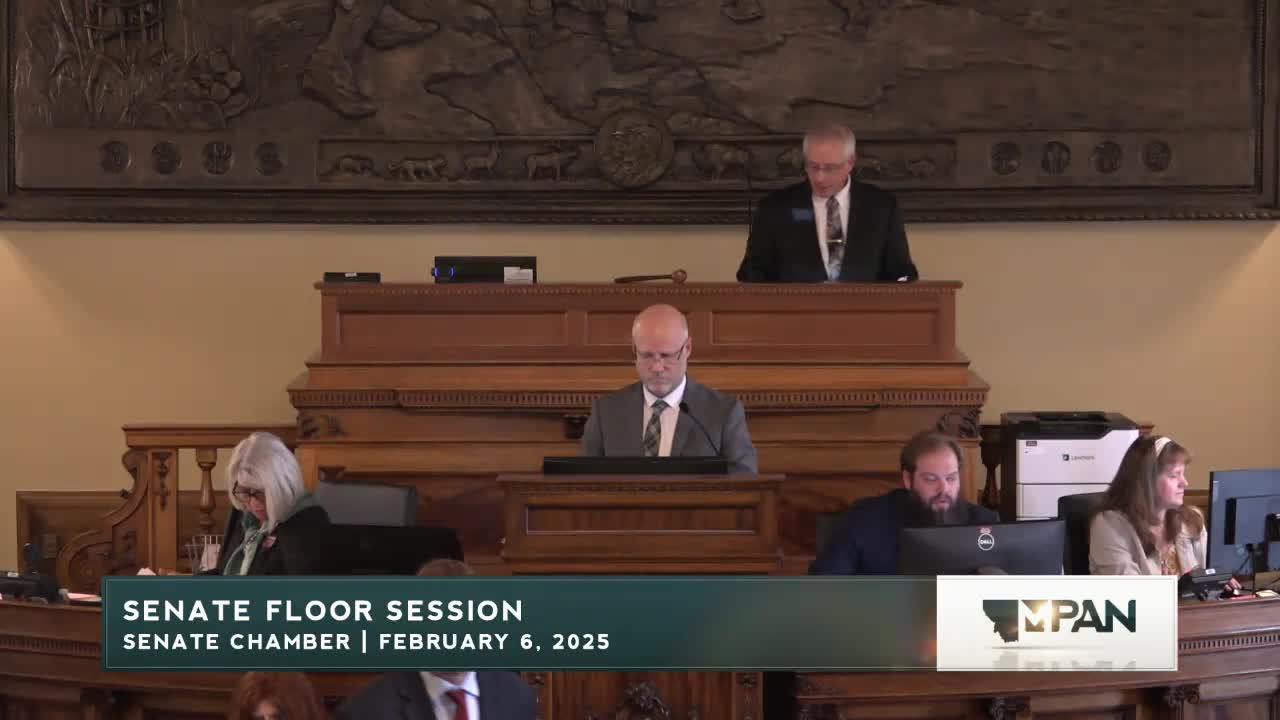
Montana Senate advances suite of bills on second reading; impact-fee change draws sharp debate
Summary
On Feb. 6, 2025, the Montana Senate on second reading approved multiple bills addressing education tax credits, zoning amendments, statutes of limitation, impact fees and minor-in-possession tracking; a GOP-led resolution on federal fiscal policy also passed after extended debate.
HELENA — The Montana Senate on Feb. 6, 2025, on second reading recommended passage of a package of bills covering education tax credits, local zoning procedures, statutes of limitation for construction claims, employee holidays for legislative staff, and rules for tracking minors in possession of intoxicating substances. Lawmakers also approved a resolution urging federal action on fiscal and monetary policy after an extended floor debate.
Senators approved Senate Bill 159, sponsored by Senator Greg Emmerich, a bill that would revise state finance laws tied to the coal severance tax trust fund and alter limits on existing educational tax credit programs. Senator Emmerich told the chamber the measure is “designed to take … $100 million … back into that fund” to grow the corpus’ earnings and use half of the proceeds to raise aggregate limits for education tax credits; the committee voted 39 aye, 11 nay and the bill passed second reading.
The chamber also passed a measure to shorten the statutory notice period for text amendments to county zoning regulations. Senate Bill 175, moved by Senator John Mandeville, would allow counties to use a shorter notice and hearing process for limited text changes to zoning (reducing the current 45‑day twice‑published notice cycle to a 15‑day notice for those text changes). The vote on second reading was 48 aye, 1 nay.
Senate Bill 143, sponsored by Senator Greg Hertz and described as a housing task force product, would shorten certain statutes of limitation for construction-related claims from 10 years to six years to lower insurance costs for multifamily projects; it passed second reading, 43 aye, 6 nay.
Senate Bill 133, also from Senator Hertz and described as an effort to rein in housing costs, drew the most sustained floor opposition. The bill removes a local administrative fee for impact fees, requires impact fees not increase by more than a measure of inflation tied to construction input costs, and preserves the five facility categories already allowed under the State’s impact-fee law. Senator Hertz said the measure “does not end impact fees” but limits administrative charges and ties fee growth to inflation. Senator Alan Pope, who said he sits on the Local Government Committee, urged defeat and argued the change would “threaten the fragile economics of our growing communities” by shifting infrastructure costs to existing taxpayers. The vote on second reading was 31 aye, 19 nay; the bill passed.
On public-staffing and benefits, the Senate approved Senate Bill 87, from Senator Harvey, to remove general election day from the list of legislative holidays and replace it with a floating holiday for qualified legislative employees; the tally was recorded as 48 senators voting aye.
A bill aimed at clarifying reporting and data collection for minors in possession offenses, Senate Bill 132, was advanced on second reading. Majority Leader Sen. Steve McGillivray said the bill would allow the judiciary to track possession and attempts-to-purchase offenses for marijuana and alcohol separately so the Legislature can get better data; the vote was 38 aye, 11 nay.
The chamber also approved Senate Joint Resolution 9, a nonbinding resolution urging Congress and other national leaders to address federal fiscal and monetary policy, on a 44‑aye, 6‑nay vote after a lengthy debate about debt, inflation and priorities. Sponsor Majority Leader McGillivray described the resolution as a bipartisan appeal to “stop it” and to prompt federal leaders to reduce deficit spending.
Other bills on second reading that were recommended for passage with minimal floor discussion included Senate Bill 75 (technical changes for statutory sunsets; sponsor Sen. Vinton; unanimous recorded aye votes) and Senate Bill 159 (education/coal severance trust changes; sponsor Sen. Emmerich). The Senate also sent a joint resolution urging passage of the Safer Banking Act of 2023 to committee recommendation; that resolution was moved on the floor by Senator Cashmere and supported as a way to clarify banking rules for legal cannabis businesses.
A newly introduced bill on physician aid in dying (Senate Bill 136, sponsor Senator Glipp) was read and discussed on the floor. Glipp noted existing Montana statutes and the 2009 Montana Supreme Court decision known as Baxter left the policy choice to the Legislature; he framed SB 136 as a bill to treat “consent to physician aid in dying” within the criminal statutes. Floor discussion reviewed the Baxter decision and examples from other jurisdictions; a second‑reading vote was not recorded in the provided transcript excerpt.
Votes at a glance (second reading outcomes recorded in transcript): • SB 159 (Emmerich) — Do pass recommended; 39 aye, 11 nay — approved on second reading. • SB 175 (Mandeville) — Do pass recommended; 48 aye, 1 nay — approved on second reading. • SB 143 (Hertz) — Do pass recommended; 43 aye, 6 nay — approved on second reading. • SB 75 (Vinton) — Do pass recommended; 49 aye — approved on second reading. • SB 87 (Harvey) — Do pass recommended; 48 aye — approved on second reading. • SB 133 (Hertz) — Do pass recommended; 31 aye, 19 nay — approved on second reading. • SB 132 (McGillivray) — Do pass recommended; 38 aye, 11 nay — approved on second reading. • SJR 9 (McGillivray) — Do pass recommended; 44 aye, 6 nay — approved on second reading.
What it means: The bills that moved forward affect a cross-section of state policy: education tax credit funding and coal severance trust earnings (SB 159); local government zoning procedures (SB 175); housing-related legal and fee structures (SBs 143 and 133); personnel policy for legislative employees (SB 87); data collection for juvenile possession cases (SB 132); and a state-level message to Congress about deficit spending (SJR 9). SB 133, the impact‑fee change, saw clear floor opposition over concerns about local government capacity to finance needed infrastructure.
The Senate will continue to process these measures through the remainder of the 2025 session; many of the bills are referred to finance or other committees for fiscal analysis or further amendment before final passage could become law.