Get Full Government Meeting Transcripts, Videos, & Alerts Forever!
Get email alerts on the Income Tax Brackets topic
No spam. Unsubscribe anytime.
Senator proposes raising top-bracket thresholds to lower taxes for middle earners; opponents warn of large revenue loss
Summary
Sen. Mike Yackawich told the Senate Taxation Committee that Senate Bill 203 would raise the Montana taxable‑income thresholds that trigger higher income tax rates, producing modest savings for many middle‑income households. Opponents and analyses say the proposal would reduce long‑term revenue and disproportionately benefit higher earners.
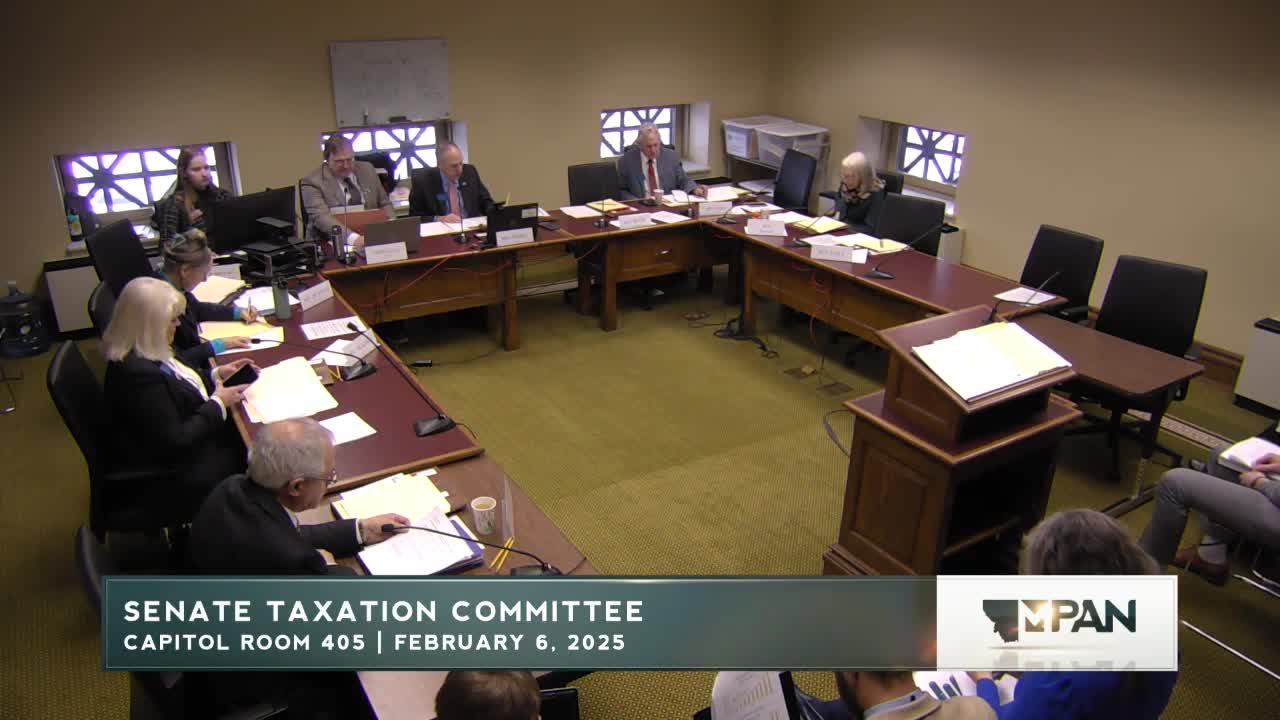
Sen. Mike Yackawich, a Billings Republican, told the Senate Taxation Committee on the morning of the hearing that Senate Bill 203 would raise the Montana taxable‑income thresholds that move taxpayers into higher rates, shifting more income into the 4.7 percent bracket.
"Senate Bill 2203 ... is an act revising income tax brackets to lower income taxes," Sen. Yackawich said as he opened the hearing, explaining the bill would raise the starting point for the top personal income tax rate from $21,100 to $100,000 for single filers, with adjusted multiples for joint and head‑of‑household filers.
The bill, which Yackawich repeatedly framed as targeting middle‑income households he called "millennials," would broaden the share of taxpayers taxed primarily at 4.7 percent. Yackawich offered illustrative savings: a married couple with $150,000 federal adjusted gross income could save about $933 under his calculations, which he said equates to about a 14 percent reduction in state income tax liability for that scenario.
Why it matters
Proponents said the bill returns surplus revenue to taxpayers and concentrates relief on middle earners who face housing and child‑rearing costs.
"We're standing in support of this bill," Bob Story of the Montana Taxpayers Association told the committee, adding that the association supports the concept of returning revenue even if it has reservations about each bill's method.
Opponents told the committee the bill would create a lasting reduction in state revenue and would primarily benefit higher earners. "Senate Bill 203 will be a sustained large loss of income tax revenue," Rose Bender of the Montana Budget and Policy Center said, arguing the reduction would weaken the state's ability to fund schools, health care and childcare. Bender cited an outside analysis — the Institute on Taxation and Economic Policy — saying roughly 68 percent of the tax cuts would flow to the richest 20 percent of Montana taxpayers.
Other community organizations opposing the bill included the Montana Coalition Against Domestic and Sexual Violence and student‑led groups that argued the state should instead invest surplus funds in housing, education and services that primarily benefit lower and middle‑income Montanans.
Implementation and fiscal details
Department of Revenue staff described implementation tasks the department would face if the bill took effect midyear. Jake Ford, bureau chief for the Department of Revenue’s Income and Withholding Taxes Bureau, told the committee the department would need to change withholding tables or run an education campaign to encourage taxpayers to file new withholding forms (MW‑4) to realize benefits in the same tax year.
"In order to receive the benefit in the current year, they would have to adjust that withholding," Ford said, describing outreach and webinars the department uses to educate employers and employees about withholding options.
Sam Schaeffer of the Legislative Fiscal Division walked lawmakers through charts showing how raising the 4.7 percent bracket threshold changes which deciles of filers pay that rate, using calendar‑year 2023 returns as the baseline data. Schaeffer’s presentation assumed taxpayers take the federal standard deduction and modeled effects by income decile for single and joint filers.
Questions from lawmakers focused on distributional effects and on whether the state should target lower‑income households through credits such as an expanded earned income tax credit rather than broader bracket shifts. Rose Bender said targeted credits — including child tax credits and an enhanced earned income tax credit — would better direct benefits to low‑income families.
Process and next steps
No committee vote was taken at the conclusion of the hearing; the sponsor reserved closing remarks and the hearing record was closed that day. The bill will return if committee leadership schedules a subsequent executive action.
Ending
Sen. Yackawich closed by reiterating his intent to provide tax relief for middle‑income households and said he planned to return for a closing argument if the bill advanced. For now, the hearing record reflects competing priorities: proponents pressing for tax relief and opponents warning of durable reductions in state revenue and an outcome that may skew benefits toward higher‑income taxpayers.