Get Full Government Meeting Transcripts, Videos, & Alerts Forever!
Get email alerts on the Housing Vouchers Arpa topic
No spam. Unsubscribe anytime.
Housing officials warn of HUD funding shortfalls for vouchers, outline ARPA and housing trust investments
Summary
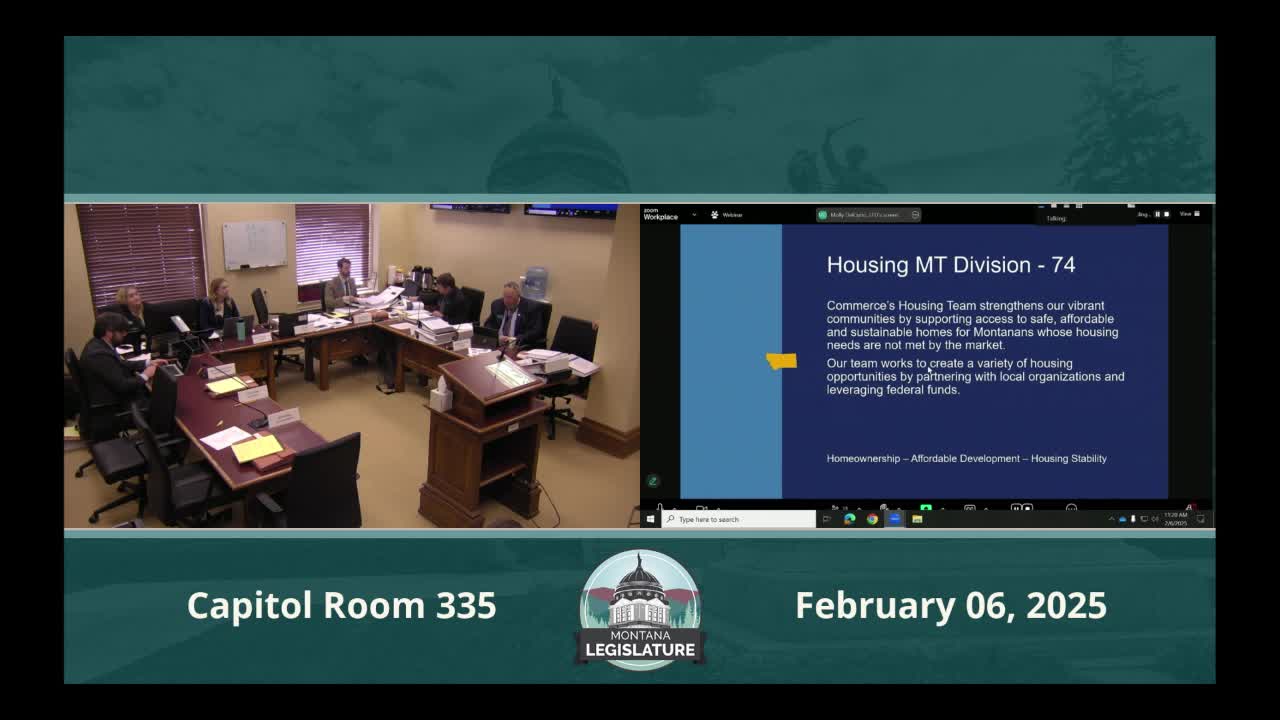
Housing Division Administrator Cheryl Cohen told the appropriations subcommittee that reduced federal disbursements required closing new Section 8 voucher issuances and drawing down reserves; she summarized Board of Housing activities, ARPA-funded gap financing, homeowner assistance demand, and recent HOME and HTF awards.
Cheryl Cohen, Housing Division Administrator and executive director of the administratively attached Montana Board of Housing, told the Section A Subcommittee of Appropriations that Commerce's rental assistance programs are under pressure after the U.S. Department of Housing and Urban Development reduced disbursements, triggering a pause on new voucher issuances and a drawdown of Commerce's HUD-held reserves.
Cohen said the statewide Housing Choice Voucher (Section 8) wait list was closed and voucher issuances were paused effective Aug. 15 because HUD disbursements were lower than expected. Commerce drew between $300,000 and $500,000 per month from HUD-held reserves to cover housing assistance payments; HUD required two offsets to those reserves in 2024 that reduced the balance further. At the December snapshot in the agency presentation, Commerce reported roughly $170,000 remaining in HUD-held reserves, less than 1% of federal budget authority; in 2023 Commerce's rental assistance programs paid nearly $47 million to landlords and in 2024 paid over $51 million.
Cohen said Commerce is using cash-management tools and monthly reconciliation with HUD to avoid a deeper shortfall. She added the department submitted a renter survey intended to update HUD fair market rent calculations; Commerce's analysis found rents in nonmetro Montana averaged $374 per month higher than HUD's current fair market rent calculation, a finding submitted to HUD for review.
Cohen also reviewed Board of Housing activity: the board issued multifamily conduit bonds of roughly $115 million in fiscal 2024 and allocated federal low-income housing tax credits that will produce and rehabilitate hundreds of rental homes. She summarized House Bill 819-related authority (the board may administer up to $65 million from the coal trust fund for multifamily loans) and said that, to date, 16 projects have been awarded Coal Trust loans, six of which have closed.
On ARPA-related housing actions, Cohen said Montana used emergency rental assistance (MIRA 1 and MIRA 2) to provide more than $84 million in rent, utility and internet assistance and that a reallocation by Treasury reduced available funds by $46.5 million. Unobligated MIRA funds were applied to seven projects that pair with other federal housing programs. The state's Homeowner Assistance Fund (HAF) was reported as expending roughly $12 million through the most recent quarter; demand for a home-repairs subprogram exceeded initial estimates and the department temporarily paused new applications because of high interest.
Cohen closed by summarizing ARPA gap financing: the governor approved $15 million in state ARPA funds to fill cost increases in pipeline affordable housing projects; Commerce contracted those dollars to 11 nonprofit developers and has expended the allocation. Committee members asked for more detail on voucher shortfall management and the housing repair application pause; Cohen and program staff said they would provide details and continue monthly reconciliation with HUD. No committee votes were taken.