Get Full Government Meeting Transcripts, Videos, & Alerts Forever!
Get email alerts on the Department Administration Indirect Costs topic
No spam. Unsubscribe anytime.
Montana Department of Commerce outlines structure and explains indirect cost adjustments as budget hearing opens
Summary
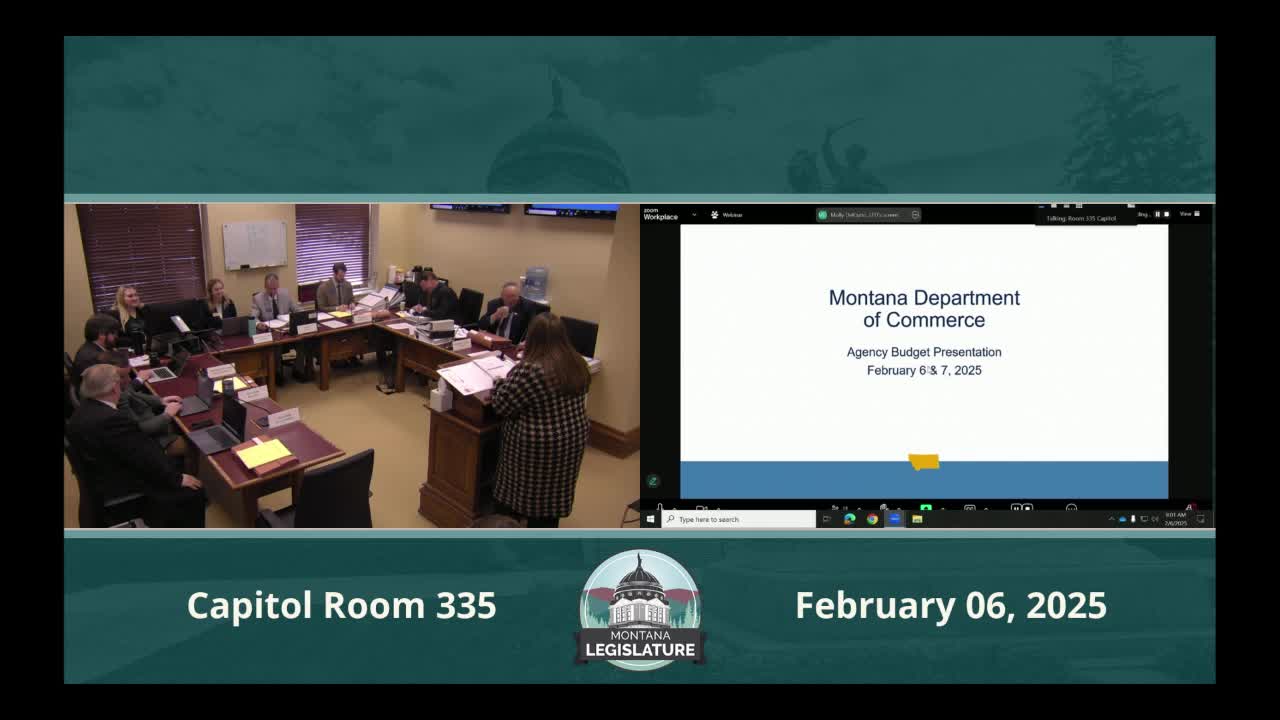
Deputy Director Mandy Rambo presented an agency overview to the Section A Subcommittee of Appropriations, describing Commerce and addressed questions about the Board of Investments splitting administrative services and how $644,000 in prior service charges will affect department budgets.
Deputy Director Mandy Rambo, representing the Montana Department of Commerce, gave the committee an agency overview at the Section A Subcommittee of Appropriations meeting, describing Commerce's mission, four divisions (BrandMT, Business MT, Community MT and Housing MT), and ten attached boards and agencies. Rambo said Commerce's work includes tourism marketing, business attraction, community infrastructure grants, and housing programs administered with both state and federal funds.
The presentation summarized Commerce's organizational structure and funding sources and set the stage for follow-up budget questions about how the department charges other agencies for centralized services such as payroll, human resources, legal, IT and finance. Senator Steve Ellsworth asked how Commerce oversees the Board of Investments, which is administratively attached to the department. Rambo replied that oversight differs by attached agency and that Board of Investments (BOI) provides some functions internally while relying on director's office services for others.
The committee focused on a recent change in which BOI reduced its use of Commerce-provided services, decreasing billed support by roughly $644,000. Senator Ellsworth asked why that reduction had not translated into a like reduction in Commerce's budget. Rambo explained that Commerce's support functions are allocated across many units and attached entities through an indirect rate; staff and workload do not shrink immediately when a partner takes services in-house. She told the committee that savings realized by BOI are borne instead by Commerce's other attached boards, entities and divisions through higher indirect allocations and that reductions in staff would likely occur only by attrition to avoid costly layoffs and severance liabilities.
Budget manager Craig Woods, joining the discussion, said BOI's separation had been reflected in prior accounting and that a $500,000 House Bill 2 appropriation tied to Big Sky Economic Development funding had been adjusted to account for two modified positions. Rambo and Woods said Commerce reviews indirect rate and cost allocations on a biennial basis and negotiates indirect rates with federal partners when required for federal grant administration.
Committee members also asked about specific implementation details. Rambo said Commerce had provided a follow-up email with more detailed calculations and that the department intends to reallocate duties where possible during staff turnover. She warned that cutting centralized positions to match a single agency's departure is not straightforward because those positions provide services across the department and nine other attached entities.
The discussion did not produce any committee action or vote; it was framed as budget and oversight follow-up. Rambo said Commerce would provide additional written information about the BOI separation and the department's indirect rate methodology to the committee.