Get Full Government Meeting Transcripts, Videos, & Alerts Forever!
Get email alerts on the Taxes Property Mill Levies topic
No spam. Unsubscribe anytime.
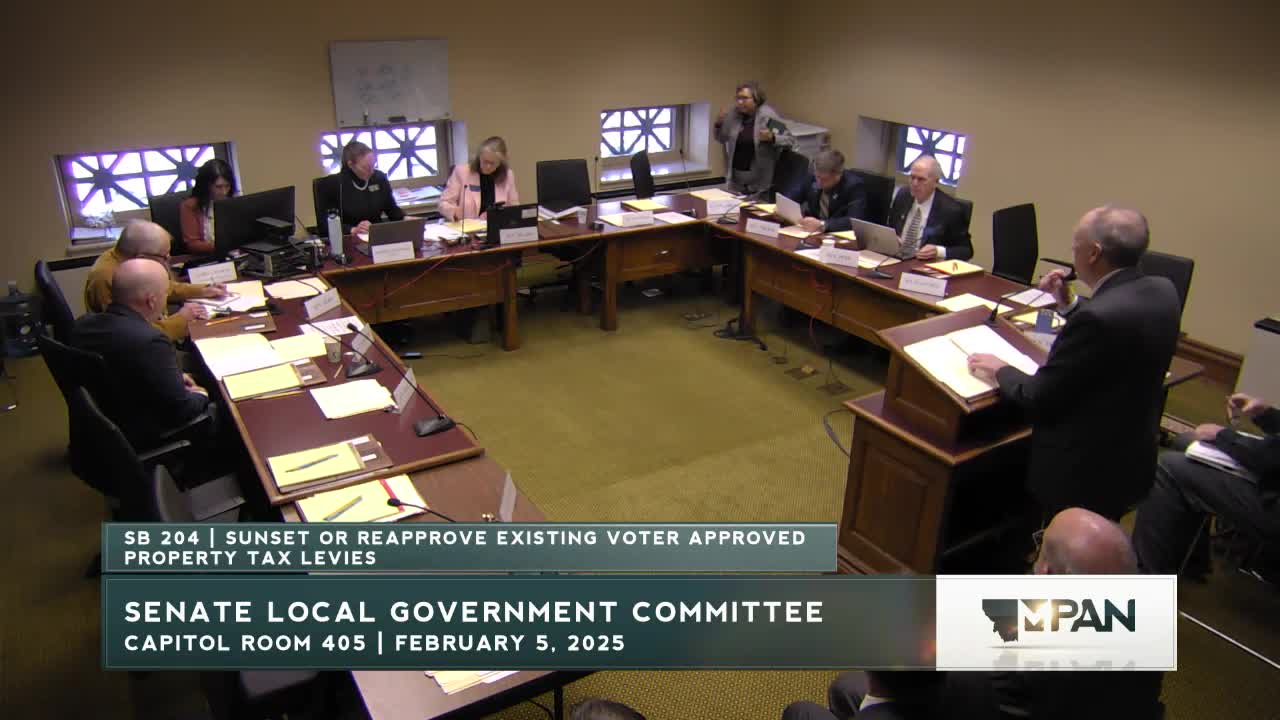
Montana hearing draws widespread opposition to bill that would automatically sunset voted mill levies
Summary
Senate Bill 204, introduced by Sen. Greg Hertz, would limit the duration of previously voted mill levies and require periodic voter reapproval. Dozens of local officials, fire chiefs, school associations and transit leaders told the Senate Local Government Committee the change would destabilize public safety, schools and infrastructure funding.
Senator Greg Hertz, sponsor of Senate Bill 204, told the Senate Local Government Committee the bill came from the Property Tax Task Force and would “give voters the opportunity to reconsider mill levies that they voted on previously.” He said the measure staggers sunsets so levies approved more than five years ago would be placed on a review path over several election cycles rather than all at once.
The proposal drew broad opposition in a four‑hour hearing. Fire chiefs, county and city managers, school officials and other local leaders warned automatic sunsets and frequent reauthorizations would create recurring funding uncertainty, complicate long‑term capital planning and jeopardize frontline services.
Proponents of the current system said voters already have mechanisms to rescind a levy and that many levies were passed as permanent commitments that communities relied on for decades. Opponents described specific local impacts — from planned fire‑station builds to teacher pay and transit service — and urged the committee to reject or substantially amend the bill.
“Having a 10‑year sunset on a mill levy breaks that planning,” said Stuart Fuller, a 24‑year trustee of the West Valley Volunteer Fire Rescue District, describing a truck purchase exceeding $500,000 and a 25‑ to 30‑year replacement cycle. “We cannot sustain this volunteer fire department without adequate funding for equipment.”
Joel Gaertig of the Montana State Firefighters Association said frequent reapprovals would “be a nightmare,” risking layoffs, “brownouts” of stations and broken replacement plans. Missoula City Fire Chief Gordie Hughes said a levy that passed with 63% approval would have failed under arbitrary sunset rules and that layoffs could be required if revenue vanished.
Public‑school groups likewise objected. Deborah Silk, associate executive director and general counsel for the Montana School Boards Association, said the bill threatens about $200,000,000 in previously voted over‑base school levies and raised a constitutional concern under Article II, Section 31, arguing that retroactively nullifying perpetual levies could impair existing contractual obligations. Paul Taylor of the Office of Public Instruction told the committee the bill would require additional statute changes to avoid conflicts in law.
Transit and other services warned of planning and federal‑grant risks. Sebastian Strauss, treasurer and incoming board chair of Missoula’s Mountain Line, said voter‑approved levies make up “nearly 70% of our annual budget” and that buses costing over $1 million each require stable local matches to secure federal funding.
City and county managers from Kalispell, Helena, Belgrade, Billings and Bozeman, as well as the Montana Association of Counties, urged defeat. Kalispell City Manager Doug Russell said the bill “attempts to change” clear, permanent ballot language passed by voters and “does not allow for long term planning.” Helena City Manager Tim Burton called it the “Public Safety Reduction Act.”
Witnesses across sectors echoed three common concerns: (1) frequent reauthorization cycles would increase election costs and “voter fatigue,” (2) uncertainty would impair hiring and retention for police, fire and school staff, and (3) long‑term capital financing (stations, buses, road maintenance) depends on predictable, multi‑decade revenue streams.
Senator Hertz responded that the bill “turns control back to the voters” and that many levies in decades past were not perpetual; he said he would provide information on how a local electorate may repeal or alter a levy and noted he may pursue clarifying amendments.
The committee took no final vote during the hearing. The record includes extensive testimony from municipal officials, firefighters, school groups and other stakeholders; senators asked staff to provide statutory references and the sponsor promised to supply additional details on repeal procedures and possible technical amendments.