Get Full Government Meeting Transcripts, Videos, & Alerts Forever!
Get email alerts on the Military Pay topic
No spam. Unsubscribe anytime.
Bill would remove 15-day cap on double pay for Montana National Guard on state active duty
Summary
House Bill 72 would allow Montana National Guard members serving on state active duty to receive pay at twice the federal equivalent without the current 15-day limit; backers say it reduces administrative burden, creates parity with other emergency responders and gives flexibility during extended incidents such as wildfires.
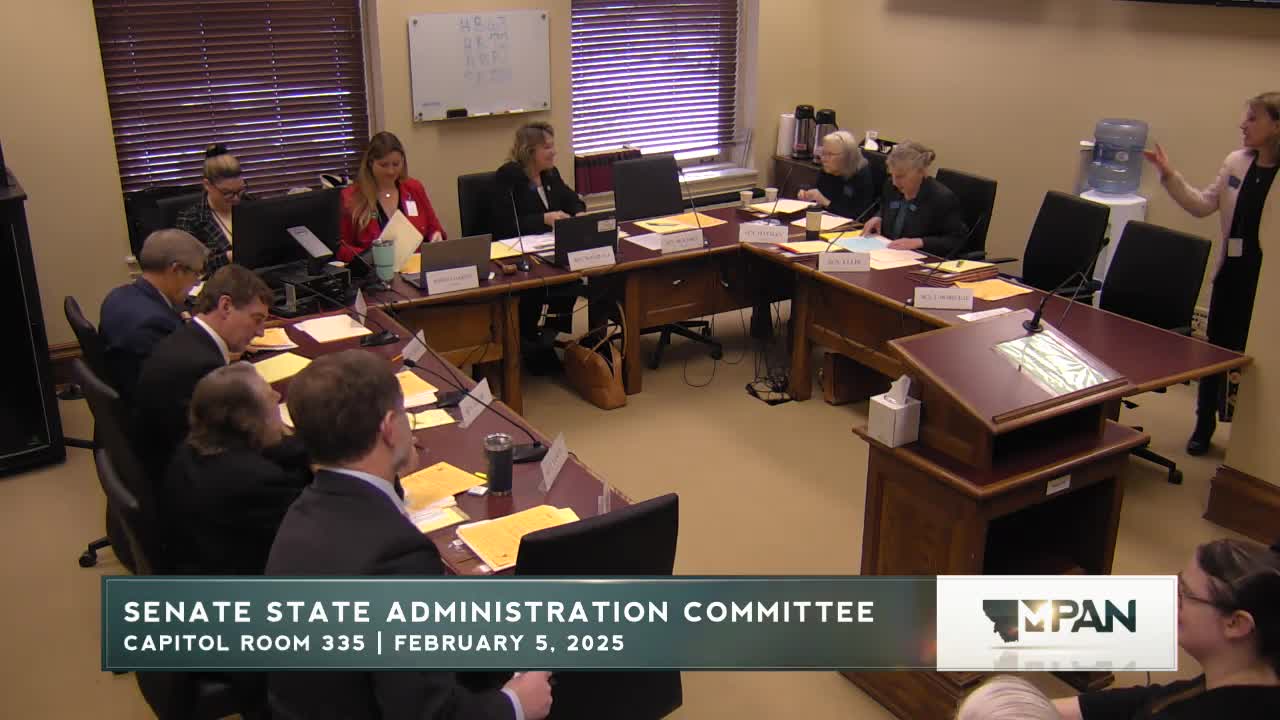
Representative Brad Barker, sponsor of House Bill 72, told the Senate State Administration Committee the measure would remove a 15‑day limitation that currently restricts a doubled pay rate for Montana National Guard members on state active duty.
Major General J. Peter Ronek, the adjutant general and director of the Department of Military Affairs, testified the bill would amend MCA section 10‑1‑502 to allow listed guard members on state active duty to receive pay at twice the rate for an enlisted member of a corresponding grade for the entire period of state active duty rather than being limited to the first 15 days. “Limiting the 15 day cap will reduce administrative burden by eliminating the need to bring members of the guard on and off state active duty,” Ronek told the committee, adding the change would give the governor and adjutant general greater flexibility for longer emergency responses.
Proponents argued the change would create parity with other emergency workers. Ronek said DNRC firefighters are “roughly paid 19 to $22 an hour” and cited an example that an E‑5 sergeant with six years of service currently equates to about $15 an hour on an 8‑hour workday; he noted many wildfire responses run 10–12 hour days and that military members do not currently receive overtime. Dennis Stoner, speaking for officers and enlisted members of the National Guard, and Duane Cunningham of the American Legion also supported the bill.
Lieutenant Colonel Todd Wayne of the Montana National Guard’s legal office and Janae Grappo, chief financial officer for the Department of Military Affairs, appeared as informational witnesses to answer technical or fiscal questions. Committee members asked whether the change would save money and increase flexibility; Ronek said it would do both by reducing administrative turnover and training costs associated with rotating large numbers of personnel on and off state duty.
Representative Barker closed by urging the committee to pass the bill. The hearing record includes proponents and informational witnesses but no committee vote or formal action recorded in the transcript.
Clarifying details in testimony: the statutory reference was given as MCA 10‑1‑502; proponents described DNRC firefighter pay as about $19–$22 per hour and an example E‑5 enlisted pay of roughly $15 per hour based on an 8‑hour day; typical wildfire shifts were described as 10–12 hours, which proponents said reduces hourly equivalence when overtime is not available to military members.