Get Full Government Meeting Transcripts, Videos, & Alerts Forever!
Get email alerts on the Public Service Commission Restructuring topic
No spam. Unsubscribe anytime.
Proposal to reshape Montana Public Service Commission draws sharp debate over rates and accountability
Summary
Representative Larry Brewster’s HB 363 would change the PSC to three appointed and two elected commissioners, create congressional-district seats and lengthen terms; business groups backed the measure while current PSC leaders, consumer advocates and former commissioners warned it risks higher rates and gives utilities too much influence.
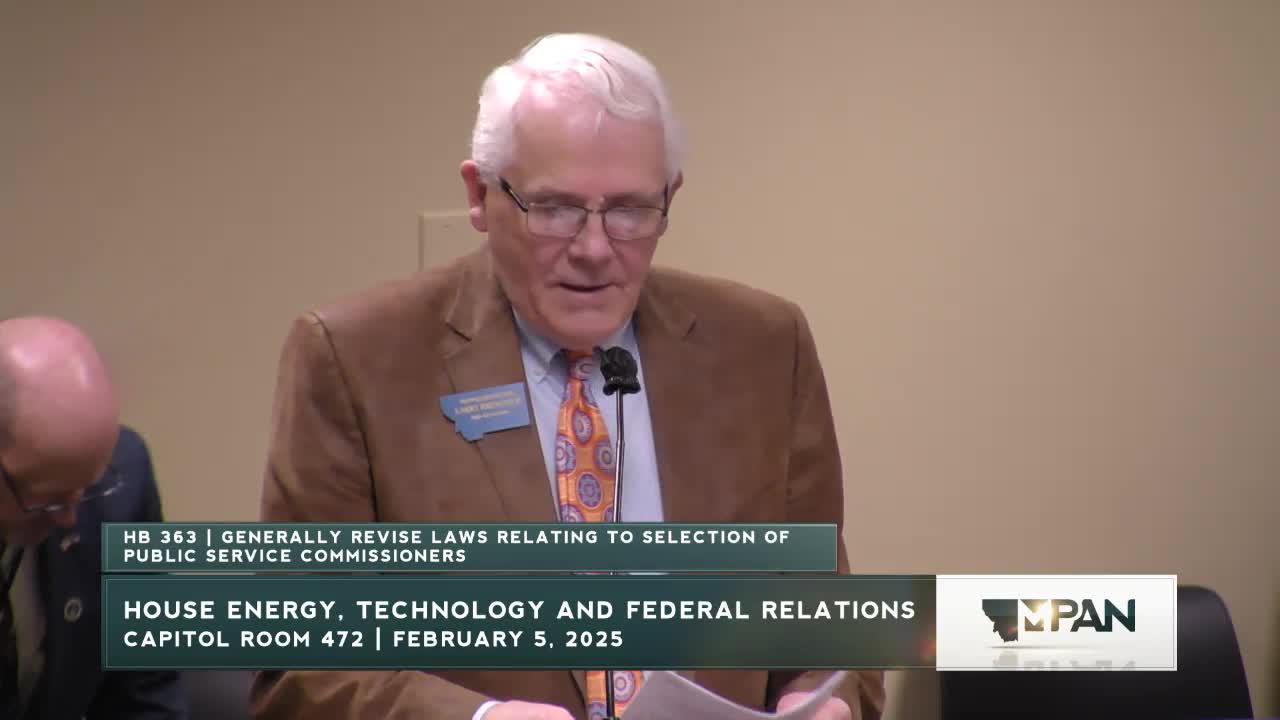
Representative Larry Brewster, sponsor and Republican from House District 43, presented House Bill 363 to the House Energy Committee, proposing a hybrid composition for the Montana Public Service Commission (PSC): three appointed commissioners confirmed by the Senate and two elected commissioners representing congressional districts. The bill also proposes six-year terms, a transition plan for current commissioners and a process for governor appointment with Senate confirmation.
Brewster said the measure aims to add experience and business and financial expertise to the PSC, arguing that long-term infrastructure and generation investments require technical understanding. "I start the bill, then you guys own it," he told committee members, adding he viewed the draft as a template to be refined by amendments.
The hearing drew extensive opposition from current PSC leaders, consumer advocates, former commissioners and other opponents who warned the bill would favor utilities over ratepayers. Brad Molnar, president of the Montana Public Service Commission, urged the committee to reject the change, saying states with appointed commissions tend to have higher electricity costs and arguing elected commissioners are accountable to residents. Molnar said the agency recently disallowed $35 million in utility spending in a rate case and said, "rate payers served by electric commissioners ... are the clear winners."
Roxy Reller of the Northern Plains Resource Council, which represents more than 3,000 members, said the PSC is an important consumer backstop and warned that reducing the number of elected commissioners "will lead to energy policy that goes against the foundational democratic principles we hold dear." Former commissioner and state lawmaker Roger Koopman criticized provisions that would let regulated utilities suggest appointment candidates and objected to prescriptive qualification lists for appointees.
Business groups including the Montana Chamber of Commerce supported the proposal. Todd O’Hare, the chamber’s president and CEO, said long-term investments in electrical generation require a predictable regulatory environment and "a public service commission that functions as a place to make those investments is going to be critical."
Commissioner testimony and committee questioning focused on tradeoffs between technical expertise, local accountability, large rate cases and political influence. Commissioners and witnesses repeatedly discussed a recent Northwestern Energy rate case: the utility initially sought about a 28% increase, a settlement and commission action produced an effective 24% increase spread over multiple years, and parties noted that roughly 40% of the increase reflected pass-through costs the commission cannot deny.
Opponents also raised campaign finance concerns and the practical effects of reassigning districts to match congressional districts. Sponsor Brewster said he would accept amendments and encouraged committee members to offer refinements.
The committee concluded the hearing on HB 363 with no recorded vote. Multiple committee members asked for further work and possible amendments; no formal change to the bill was recorded in the hearing transcript.