Get Full Government Meeting Transcripts, Videos, & Alerts Forever!
Get email alerts on the Judicial Candidate Conduct topic
No spam. Unsubscribe anytime.
Committee considers HB 169 to loosen limits on judges’ political activity and endorsements
Summary
House Bill 169 would permit judges and judicial candidates to attend partisan events and accept endorsements; sponsors said the change reflects Montana community norms and reduces overbroad restrictions, opponents argued it risks eroding impartiality and current canons already prohibit problematic conduct.
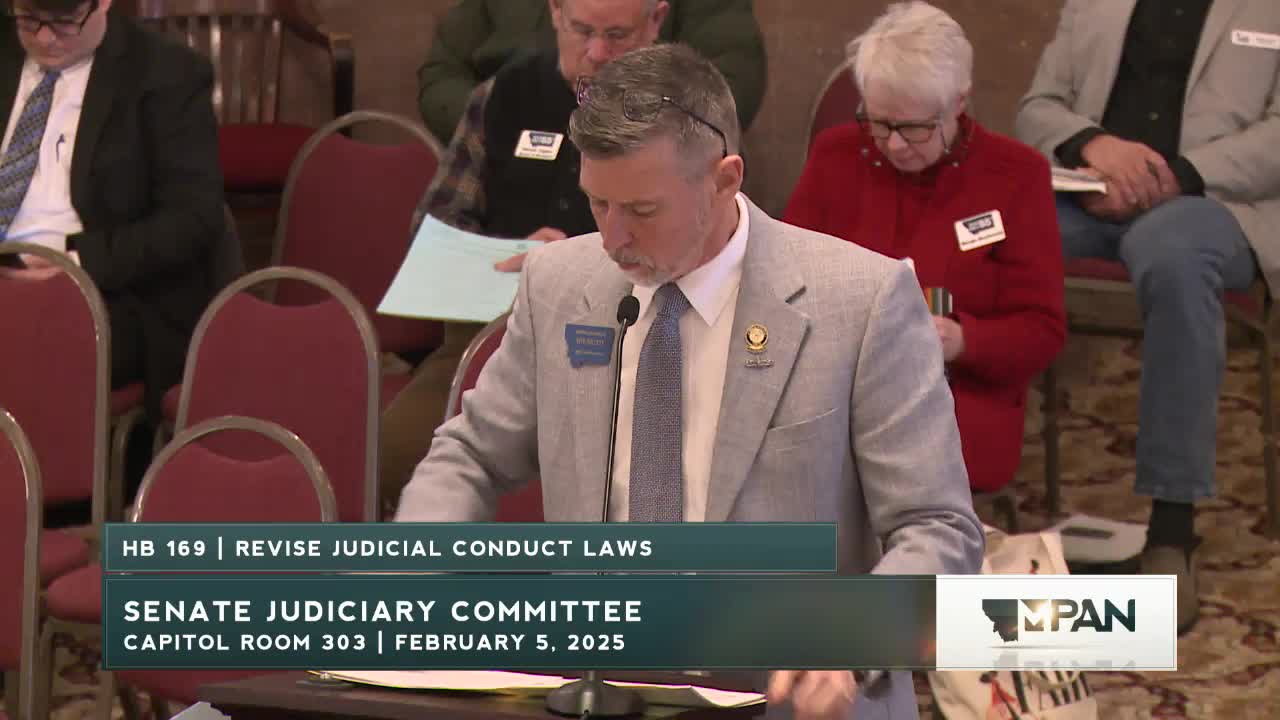
The Senate Judiciary Committee heard House Bill 169, authored by Representative Tom Millett, which would allow sitting judges and judicial candidates greater latitude to attend partisan events and to seek or accept endorsements from political organizations or holders of nonjudicial partisan office, depending on whether candidates run partisan or nonpartisan races.
Millett said the bill is short and intended to address specific restrictions in the Montana Code of Judicial Conduct. He read a passage from a sitting Supreme Court justice’s dissenting remarks criticizing the current rule that bars judges from attending or purchasing tickets to partisan events; Millett said the restriction “reflect[s] the reality of Montana culture, particularly within our many small and rural communities.” He described scenarios in which judges or candidates would historically attend community political events without implying an endorsement.
Opponents who testified earlier in the session on related bills similarly expressed concern that HB 169 would invite partisan influence into the judiciary and weaken public trust. Witnesses and committee members referenced the existing Montana Code of Judicial Conduct and noted that some restrictions already exist to prevent conflicts. Committee discussion centered on the effect of allowing endorsements and attendance at partisan events, whether the change would be limited by existing canons, and the risk of public perception shifting toward partisan judging.
Representative Millett said the bill grew from conversations in local communities and a belief that some current restrictions are overly broad; he urged the committee to consider the measure as a way to make judicial candidates more accessible to voters. The committee did not take a vote during the recorded hearing.