Get Full Government Meeting Transcripts, Videos, & Alerts Forever!
Get email alerts on the Judicial Oversight Leadership topic
No spam. Unsubscribe anytime.
Committee considers bill to bar judges from serving as presiding officer of Judicial Standards Commission
Summary
House Bill 36 would change the Judicial Standards Commission’s rules so a sitting judge could not serve as the commission’s presiding officer; sponsors said the change reduces supervisory conflicts, opponents said it unnecessarily restricts qualified members and undermines judicial independence.
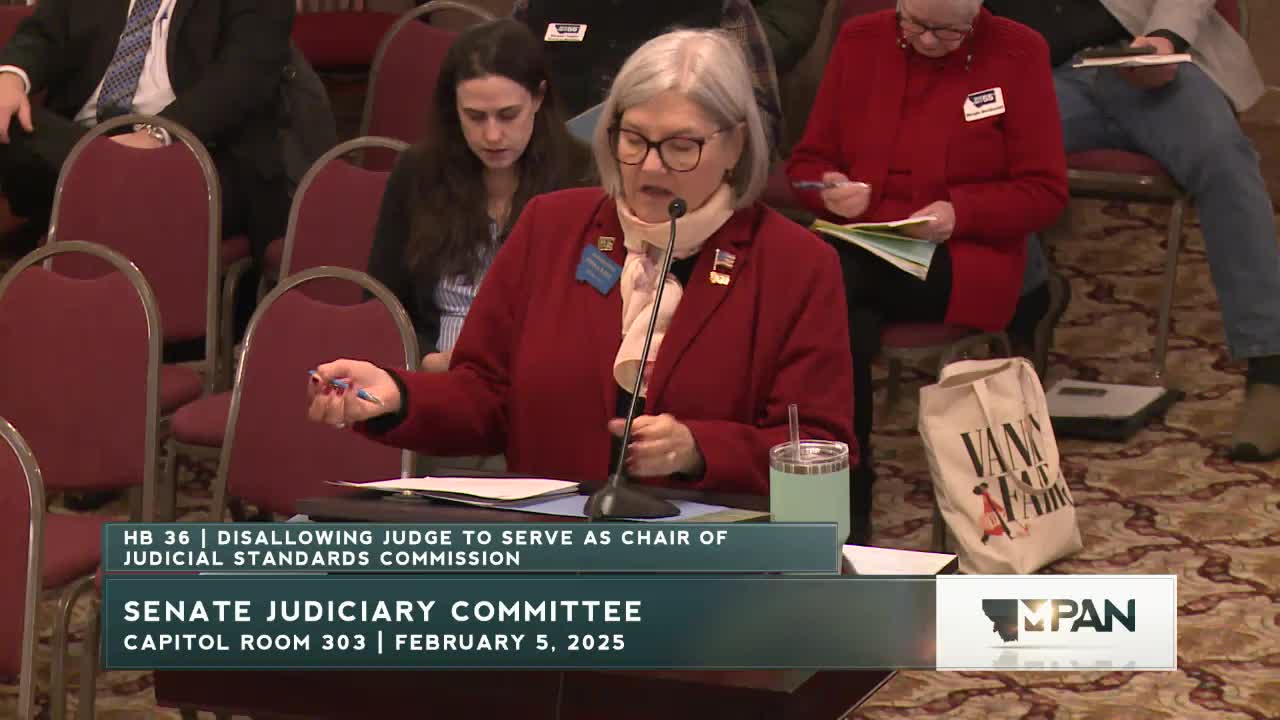
The Senate Judiciary Committee heard House Bill 36, which would prevent a judge from serving as the presiding officer of the Judicial Standards Commission while leaving judges eligible to serve as commission members. Representative Fiona Nave, sponsor of the bill, said the change would “remove potential conflicts between the members of the JSC who are charged with investigating complaints against judges and having some of those same members supervised by those judges.”
Proponents included Darren Gaub of the State Freedom Caucus Network and Bart Crabtree, who reiterated support for a package of bills aimed at addressing perceived conflicts in judicial oversight. Opponents — including John Marshall, Natasha Jones of ABOTA and Sharon Haugen of the League of Women Voters of Montana — argued the bill would disqualify qualified judges from leadership roles and encroach on judicial independence. Marshall described the bill as a “who’s on first” approach he opposed.
Informational testimony came from Dave McAlpin, court administrator, who said the legislative audit did not specifically recommend prohibiting judges from serving as presiding officer and characterized the audit’s overall view of the commission as reasonable. Committee members pressed on the factual basis for the change: sponsor Nave said the bill grew from work of the Senate select committee on judicial oversight and reform and from testimony that the Supreme Court had been involved in drafting the commission’s rules and that commission leadership could create the appearance of supervisory influence. Nave said the bill’s purpose is to preserve judges’ ability to serve on the commission while reducing “undue influence.”
Representative Nave closed by saying the bills aim to ‘‘release judges from any undue influence’’ and again urged a do-pass recommendation. The committee took no vote during the recorded hearing.