Get Full Government Meeting Transcripts, Videos, & Alerts Forever!
Get email alerts on the Income Tax topic
No spam. Unsubscribe anytime.
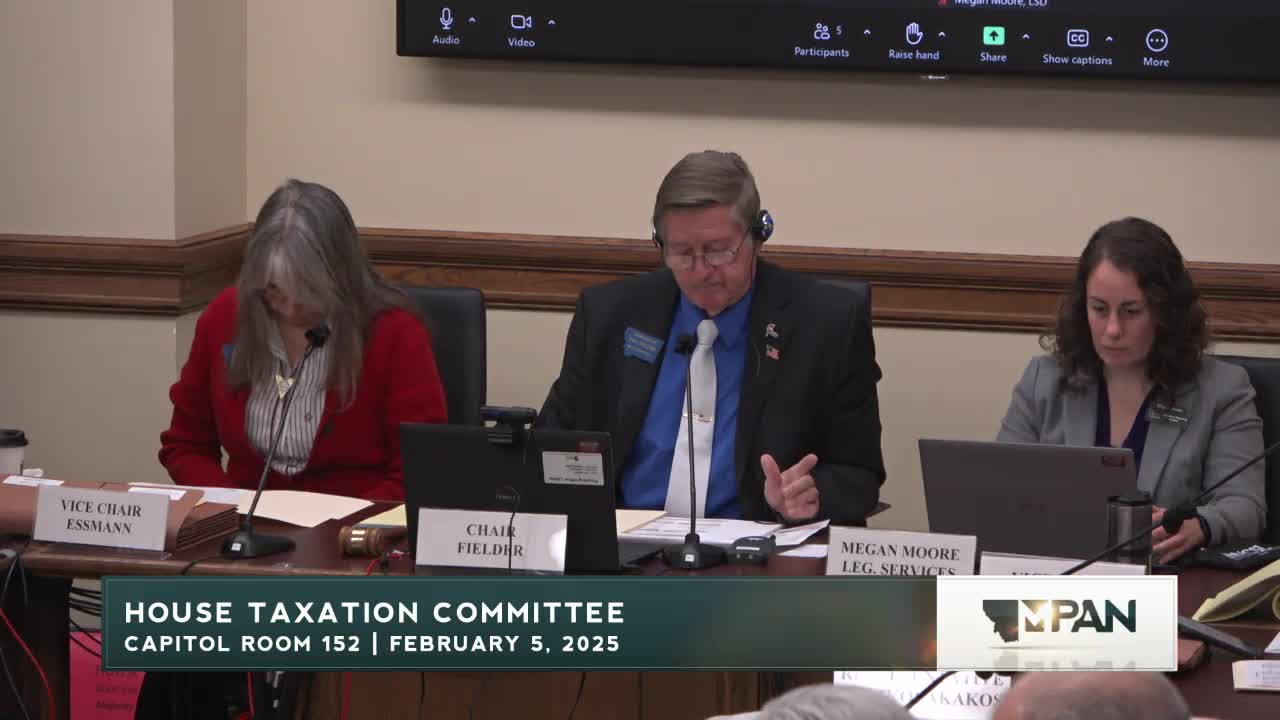
Montana committee hears debate on House Bill 337 to cut income tax rates
Summary
House Taxation Committee heard testimony for and against House Bill 337, which would lower Montana income tax brackets and expand deduction thresholds; opponents warned the cuts would disproportionately benefit the wealthy and reduce long-term revenue, while the sponsor said the change would produce broad tax relief.
Representative Brandon Lehr, sponsor of House Bill 337, told the House Taxation Committee the bill would lower both income tax brackets and increase the income thresholds for the lower rate.
"We are going to try to lower both brackets of the income tax," said Representative Brandon Lehr, representing House District 33, describing a phased implementation that would reduce the top rate by a half percentage point over two fiscal years and raise the income thresholds for the lower bracket to $100,000 for individuals and $200,000 for married couples when fully implemented in 2027. "Every resident of the state of Montana will get an income tax break."
Opponents, including Rose Bender of the Montana Budget and Policy Center and Amanda Curtis, president of the Montana Federation of Public Employees, urged the committee to reject the measure. Rose Bender cited an outside analysis and said the benefits would flow mostly to higher-income Montanans: "73 percent of the tax cuts in House Bill 337 will go to the richest 20% of Montanans," and "the wealthiest 1% will get over $7,000 on average in annual tax cuts while those near the median receive on average about $131." She also warned the bill would reduce the state tax base and harm funding for services.
Amanda Curtis, president of the Montana Federation of Public Employees, said the organization opposes the bill because it "supports a tax system that is fair and adequately funds the services that we all provide," adding that she and her members provide education, law enforcement and health services across Montana and that large, sustained revenue cuts would put those services at risk.
A representative of a coalition opposing the bill raised concerns about impacts to criminal justice advocacy programs, and Jake Ford, a bureau chief at the Montana Department of Revenue, identified himself as an informational witness who could answer administrative questions about implementation. Ford told the committee he had not reviewed the long-term fiscal analysis, while Representative Lehr said a fiscal document showed the bill would be "roughly $300,000,000" when fully implemented over the biennium. Opponents cited an Institute on Taxation and Economic Policy analysis estimating the bill would cost "more than $200,000,000 each year."
Committee members asked whether the fiscal effects had been fully analyzed and how the reduction would affect structural balance in future biennia; Representative Lehr said he believed continued economic growth would help offset revenue reductions, while opponents emphasized the volatility of income-tax-driven revenue and the risk to services.
No executive action or vote was taken during the hearing.