Get Full Government Meeting Transcripts, Videos, & Alerts Forever!
Get email alerts on the Board Of Public Education Budget topic
No spam. Unsubscribe anytime.
Board of Public Education tells appropriations panel it remains tiny but duties have expanded
Summary
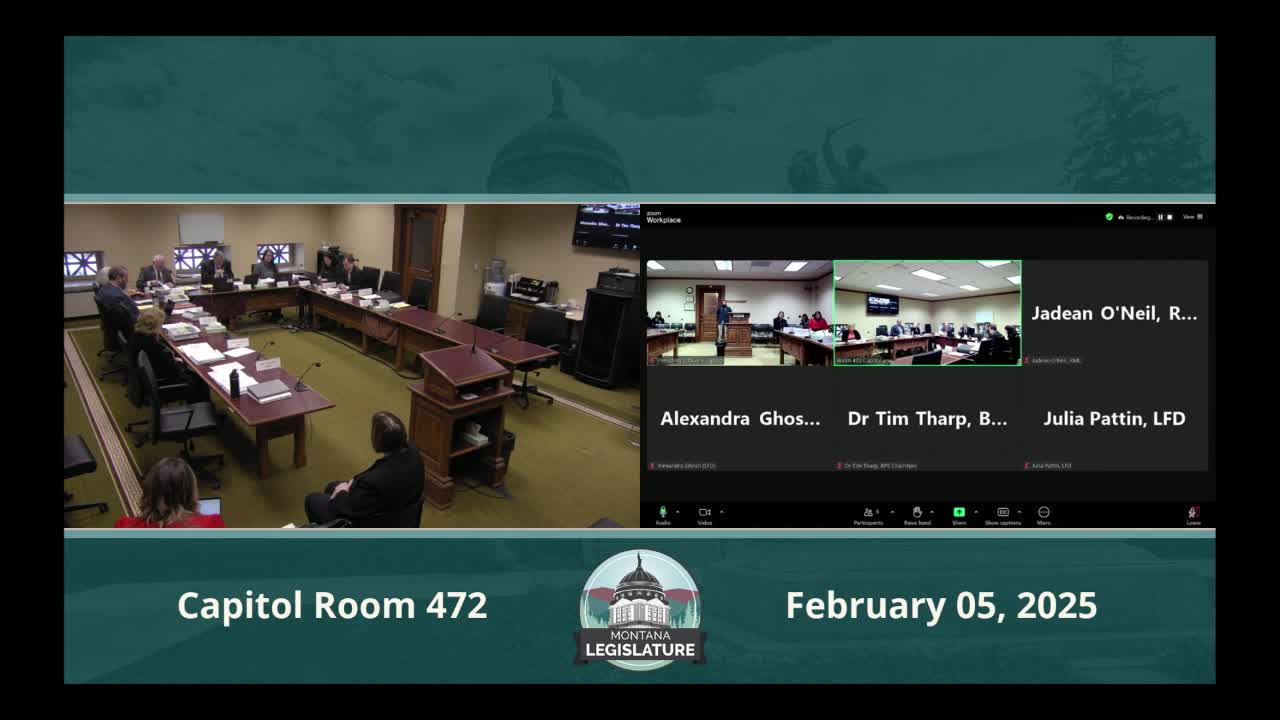
Chair Tim Tharp and the Board of Public Education told the Joint Appropriations Subcommittee on Education that the board’s budget for the 2027 biennium remains small even as its responsibilities have grown.
Chair Tim Tharp and the Board of Public Education told the Joint Appropriations Subcommittee on Education that the board’s budget for the 2027 biennium remains small even as its responsibilities have grown.
“Again, the duties and work of the Montana Board of Public Education has grown significantly in the last several years,” said Tim Tharp, chairman of the Montana Board of Public Education, during a committee hearing. Alexandra, the committee’s budget analyst, told the panel that the board’s total biennial authority is roughly $1.1 million and that the agency is now 100 percent general fund supported following the elimination of a small state special revenue authority enacted in 2023.
The nut of the presentation: the board is funded and staffed at a very small scale but has been assigned new, time‑intensive duties by the Legislature. Alexandra said, “the Board of Public Education is the smallest agency in Montana with 3 positions budgeted,” and described a present‑law adjustment of about $11,000 for personal services and a roughly $11,500 per year reduction in state special authority tied to House Bill 403 from the 2023 session.
Budget details and workload Alexandra summarized line items in the fiscal tables, saying the board’s modified FY2024 budget was about $582,000 and that operating expenses were underspent (about 44 percent expended, or roughly $138,000). She noted a hiring and turnover event tied to implementation of the charter school program: the board created a modified position for charter implementation, hired a program officer at about $78,000, and that person resigned in December. The analyst said once the position is filled and fully operational, expenditures should more closely match budgeted amounts.
Executive director McCall Flynn, identified as the board’s executive director, said the board is small — herself and two other staff — but has constitutional authority under Article 10, Section 9 to “exercise general supervision over the public school system.” Flynn said, “Our mission is to really supervise, serve, maintain, and strengthen Montana's system of public schools,” and described advisory councils the board uses to carry out new tasks, including an early literacy advisory council formed after the 2023 session.
Charter schools and oversight Board member Madeline Quinlan described the board’s work standing up the new public charter school process under legislation from the 2023 session. “We approved 19 charter school applications in January of 2024, of which 17 began operations in the fall of ’24,” Quinlan said. She said the board interviewed 25 applicant teams in the first round and that in a later application round the board interviewed 11 (one withdrew) and approved five additional applications to begin upcoming operations. Quinlan said the board developed application criteria, has required site visits, and is grappling with questions about how to define “innovation” and distinguish a charter school from a program of an existing district.
Capacity concerns and next steps Committee members repeatedly pressed the board about staff capacity. Chair Beatty and other members said they were concerned the tiny agency may lack the staff and analytic capacity to monitor and evaluate the programs it has been asked to implement. Beatty said he expected strong partnership and follow‑through from the Office of Public Instruction (OPI) for data and evaluation support. Flynn said some work (for example, councils and rulemaking) has been absorbable without adding a permanent FTE, but she also said the board is prepared to request a full‑time position in the next session if ongoing needs require it. Flynn said she plans to re‑post the modified charter implementation position after the legislative session.
Licensure, litigation and the Community Choice School Commission Senator Fuller asked whether litigation defense costs for licensure cases are personal services or fixed costs; Flynn said those costs are in fixed costs and that the board pays the Agency Legal Services Bureau directly. On the Community Choice School Commission created by House Bill 562, Flynn said the commission is administratively attached to the Board of Public Education and is funded through donations held in a non‑budgeted state account. She said the commission is in partial litigation that prevents it from opening schools and that an oral hearing is scheduled for Feb. 26; the Department of Justice is handling the state’s suit. Nancy Hall, board budget office staff, told the committee the commission’s funds are not part of the board’s HB2 budget and that the commission’s hired staff would be state employees paid from donated funds.
What the committee heard and what remains open Committee budget analyst numbers presented a modest net reduction in the board’s biennial appropriations (roughly 4 percent lower than the FY2025 base when the state special authority is removed). Lawmakers asked for clearer, actionable program data — particularly around charter schools and the early literacy targeted intervention program — and Chair Beatty and members said they expect the board and OPI to cooperate on evaluation and reporting.
No formal committee action or vote occurred during the hearing. Board staff said they will continue program work, re‑post the charter implementation position after session, and may request additional FTE authority in a future session if workload proves persistent.
Ending The panel heard no motions and took no votes on the board’s budget at the hearing. Committee members said they will expect more information on program evaluation, the status of the Community Choice School litigation, and any revised staffing requests as the session and agency planning continue.