Get Full Government Meeting Transcripts, Videos, & Alerts Forever!
Get email alerts on the Public Safety Training topic
No spam. Unsubscribe anytime.
Attorney General asks Legislature for $10 million indoor range at Montana Law Enforcement Academy
Summary
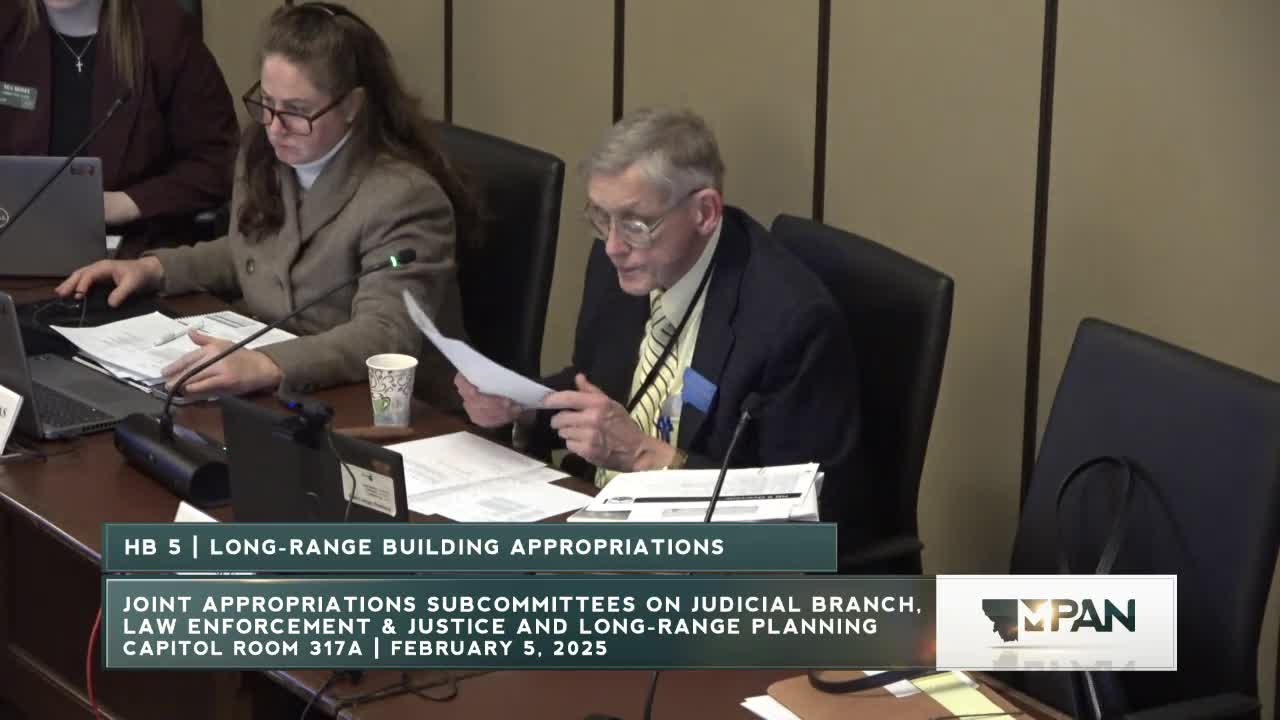
Attorney General Austin Knudson told the joint subcommittees D and F that the Montana Law Enforcement Academy needs an on-site, indoor firing range and requested a $10 million appropriation in House Bill 5; agency and contractor witnesses described the project's scope and ancillary maintenance requests for Department of Justice facilities.
Attorney General Austin Knudson told the joint subcommittees D and F that the Department of Justice is requesting a $10 million appropriation in House Bill 5 to build an indoor firing range at the Montana Law Enforcement Academy in Helena. Knudson said the academy trains “every single law enforcement officer in the state of Montana” and is currently forced to rent a small outdoor range from the city of Helena, which creates scheduling and weather-related problems for firearms training.
Knudson told the committee, “we are in desperate, desperate need of a firearms training facility.” Joel Wenland, executive director of the Montana Law Enforcement Academy, said the state “does not own and operate their own range” and urged the committee to fund on-site capacity so the academy can teach basic and advanced firearm skills year-round.
The department and A&E division staff described the planned facility in greater detail. Presenters said the indoor range would be roughly 12,000 to 15,000 square feet, include 15 shooting lanes and a 50‑yard course, skid pad and moving-target capability, and feature specialty systems such as ballistic paneling, bullet catch systems, sound deadening baffles and an HVAC system sized for lead mitigation and filtration. Witnesses and the department framed HVAC and lead mitigation as the largest single cost drivers for an indoor range.
A&E staff (architecture and engineering) and DOJ planning staff also presented smaller facility requests for the department in House Bill 5. Those included MR 12, a $2,350,000 campus heating‑system upgrade for the Boulder highway patrol campus and the nearby intensive behavioral center; MR 44, a roughly $300,000 request to add air conditioning to an upper-floor training space at the Law Enforcement Academy; and a memorandum in committee materials noting a Military Affairs statewide indoor‑range remediation proposal (MR 48) for $2,450,000 to remediate existing indoor ranges at multiple sites.
Committee members asked whether DOJ had coordinated with the Department of Military Affairs on a joint range. Knudson said he was not aware of coordination and that prior access to some military ranges had become limited by federal policy changes. Committee members discussed possible shared use or fee‑for‑service arrangements; Wenland said the academy intends to make space available to other agencies and to charge user fees for out‑of‑state or other users to offset operating costs.
Witnesses from training and law enforcement associations testified in support of the request, saying an academy range would improve safety and training consistency for sheriff deputies, municipal officers and tribal law enforcement. The committee received questions about detailed plans and procurements; A&E staff said vendors had provided cost ranges but that full design packages would require paid vendor work. No committee vote occurred during the hearing on the DOJ requests.
The department invited legislators to tour the academy; a tour was scheduled for the next day. The committee and staff also discussed bundling and procurement strategies for range and remediation projects, and committee members noted they expected construction bids and final project scopes to be provided in later budget work sessions.