Get Full Government Meeting Transcripts, Videos, & Alerts Forever!
Get email alerts on the Personhood Constitutional Amendment topic
No spam. Unsubscribe anytime.
Montana committee hears hours of testimony on proposed personhood constitutional amendment
Summary
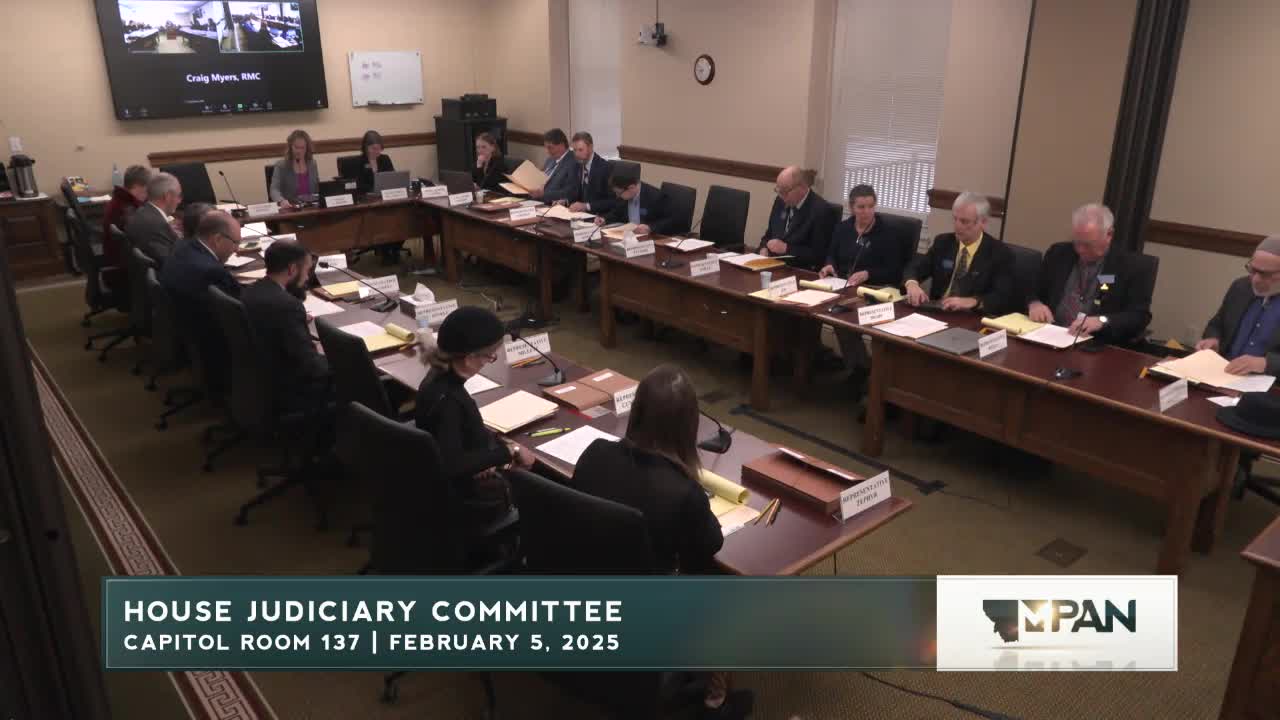
The Montana House Judiciary Committee heard several hours of in-person and remote testimony for and against House Bill 316, a proposed constitutional amendment that would define “person” to begin at fertilization; opponents warned of consequences for IVF, medical care and existing voter-approved protections.
Representative Lee Deming, sponsor of House Bill 316, opened the hearing by asking the committee to amend Article II of the Montana Constitution so the word “person” would “apply to all members of mankind at any stage of development, beginning at the stage of fertilization or conception.”
The bill would add language to Article II declaring that “the word person applies to all members of mankind at any stage of development, beginning at the stage of fertilization or conception, regardless of age, health, level, functioning, or condition of dependency.” Deming described his intent as consistency “from conception to natural death.”
Proponents told the committee the change is a scientific and moral clarification. Derek A. Stryker, chief legal counsel for the Montana Family Foundation, said “a new and unique human life begins at fertilization” and urged the committee to give the measure a “do pass.” Annie Bucacek, president of the Montana Pro-Life Coalition, and multiple other in-person and remote witnesses offered personal and religious testimony that a fertilized egg should be treated as a person under law. Erin Laws, who testified for the Montana Medical Freedom Alliance, said “the fetus has inherent rights and protections similar to born individuals.” Several proponents cited scientific claims about fertilization and the genetic uniqueness of a zygote.
Opponents argued the amendment would have broad and harmful legal and medical consequences. Anne Angus testified that “access to in vitro fertilization, IVF, will be dramatically impacted,” and said she could be unable to use embryos she already has if the measure became law. Dan Norris said the bill “appears to directly conflict with Article 2, Part 2, Section 36 of the Montana Constitution,” referring to the voter-approved CI-128 ballot measure that protects reproductive medical decisions; he urged the committee to revise the draft or reject it.
Medical and provider witnesses warned of chilling effects on health care. Ella Smith, reading for Blue Mountain Clinic, said states with comparable legal changes have seen patients denied life‑saving care and doctors criminalized. Martha Fuller, president and CEO of Planned Parenthood Advocates of Montana, told the committee the amendment could “undermine medical decision making” and limit access to contraception, IVF and reproductive health services. Ms. Fuller said “this is not needed, nor is it safe, and it's dangerous policy.”
Speakers described specific legal and clinical concerns: that the language could be read to require hospitals to maintain life support contrary to advance directives, to restrict miscarriage management, and to create civil or criminal liability for providers. Beth Brennaman of the Montana Coalition Against Domestic and Sexual Violence said she was “very concerned about section 3” of the draft, which on its face limits causes of action against pregnant women in narrow circumstances and could have unintended criminal-law consequences that harm people seeking care.
Multiple speakers cited the recent ballot initiative CI-128, approved by voters in November 2024, which they said protects the right to make private reproductive decisions; Christopher Coburn, who led the CI-128 campaign, told the committee the electorate “sent a clear message in November” and urged members to respect that outcome.
Committee members questioned witnesses and the sponsor about legal interpretation and practical effects. Representative Overstreet asked Derek A. Stryker whether a later‑enacted provision controls over an earlier one; Stryker replied, “yes. The latter enacted provision would control.” Representative Steffman asked the sponsor, Representative Deming, about religious motivations; Deming said he was presenting a legal argument even though his views also come from personal faith. Representatives also pressed on concrete consequences for IVF, prison and medical care scenarios.
Representative Deming closed by comparing the amendment’s aims to protecting vulnerable lives and said he was “trying to be consistent from conception to natural death.” The committee did not take an immediate vote; the hearing closed after several hours of testimony.