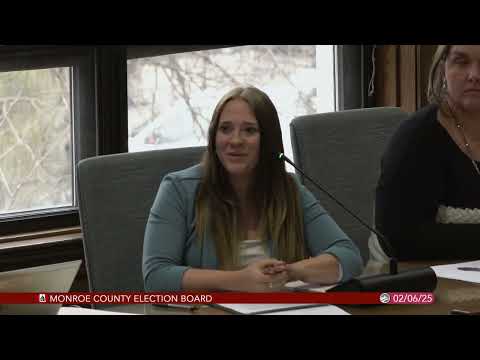
Monroe County board hears vote-center study, public commenters split over costs and access
Summary
The Monroe County Election Board received a final study report from its Vote Center Study Committee for review at the March meeting and heard mixed public comment: some poll workers and local party leaders backed move centers for access and efficiency, while a Republican board member said he would oppose implementation citing cost concerns.
The Monroe County Election Board on Feb. 6 reviewed a completed Vote Center Study Committee report due to be shared with the board at its March 6 meeting and heard competing public comment over whether the county should move to vote centers.
The committee "has completed its report and submitted it to Molly Turner King for review," the board was told; board members were told the committee expects to receive the county attorney's feedback and finalize the report for the March meeting. The board did not vote on the plan; one member said ahead of that report that he would oppose any vote-center proposal.
Why it matters: vote centers change where and how voters cast ballots countywide, affect staffing and equipment needs, and can shift election operating costs. Supporters said centers would increase access and ease for voters who show up at any site; opponents warned of up-front capital costs and of creating new operational burdens for a paper-ballot county.
Clerk's office survey and staff report: Election Central staff reported they sent 420 post-election surveys to poll workers and had received 138 responses as of the previous day. Respondents commonly asked for more lead time for recruitment, some recommended half-day shifts, and several asked for longer training and de-escalation instruction. The clerk's report said several poll workers requested that Monroe County move to a vote center model because some voters incorrectly went to the wrong precinct and ended up casting provisional ballots; staff noted 18 additional provisional ballots on the provisional ballot day related to precinct confusion.
Public comment split: John (surname not specified), a Republican member of the election board and a long-time county GOP treasurer, said he had already decided to oppose the vote center plan because of cost concerns and uncertainty over future property-tax revenue. He told the board that county clerks and officials in other counties told him vote centers require the ability to print ballots for each precinct at each site and that, in his view, Monroe County's paper-ballot process would need new equipment; he estimated a potential cost of "$600,000 to $700,000" based on his discussions. He concluded, "My vote is no."
By contrast, David Henry, a Monroe County resident and the outgoing chairman of the Monroe County Democratic Party, urged the board to await the committee's written report and analysis before ruling out vote centers. Henry said he was "perplexed" by a preemptive rejection and argued that more than 60 Indiana counties already use vote centers and that the model can produce efficiencies and broader voter access.
Other speakers echoed both positions. Poll-worker Cheryl Langdon described firsthand poll-worker experiences and said her training did not feel inadequate; she offered local perspective on voter education and turnout. Chief Deputy Laura Wert reminded the board that paper-ballot counties can operate vote centers using a ballot-on-demand process similar to existing early voting workflows.
Next steps and timeline: committee members told the board they expect to deliver a finalized report for the board's March 6 meeting after receiving feedback from the county attorney. The board did not take formal action on the vote-center plan at the Feb. 6 meeting; a final, unanimous approval by the election board will be required if the committee's plan is to be implemented.
Context: The clerk's earlier legislative update at the meeting referenced several bills under consideration in the Indiana legislature that could change primary voting rules, identification requirements, early voting days, and local referendum timing. One study bill (House Bill 1633) is examining scheduling of local elections and requiring counties to use vote centers; Election Central staff said they would prefer a voluntary, locally planned transition rather than a state mandate.
Looking ahead: The board will receive the Vote Center Study Committee's report at its March 6 meeting for review and potential action. Until the committee's written recommendations are available, board members and the public will continue to debate the tradeoffs between upfront investment and potential long-term efficiencies or increased voter access.
AI generated
The text on this page is AI generated. Summaries, highlights, analysis, and video transcripts are all produced from the original source material.
AI can make mistakes, so if you spot one, and we will fix it for everyone.
Note: the source content is unaltered by us. Any content source we link to, be it a video, an audio recording, or a document, is presented exactly as its publisher released it. That publisher is usually a government body, sometimes an individual official or another organisation.