Get Full Government Meeting Transcripts, Videos, & Alerts Forever!
Get email alerts on the State It Funding topic
No spam. Unsubscribe anytime.
State CIO outlines SITSD role, proprietary funding model and agency charges
Summary
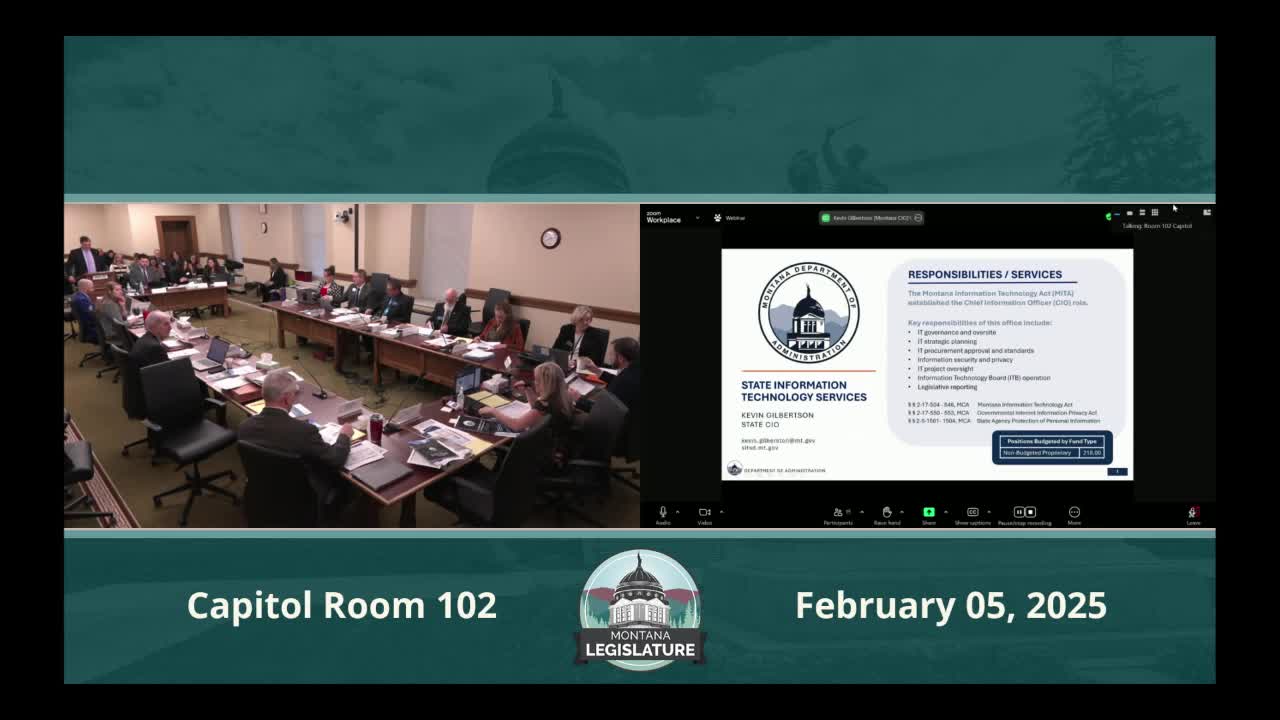
State Chief Information Officer Kevin Gilbertson told lawmakers SITSD runs centralized state IT infrastructure, digital services and security while agencies keep their business applications.
State Chief Information Officer Kevin Gilbertson told a legislative subcommittee that the state’s Information Technology Services Division (SITSD) manages centralized infrastructure, enterprise applications and statewide cybersecurity while agencies continue to control the business applications that run their programs.
"There’s actually only two IT roles that are identified in statute in all of the states," Gilbertson said, summarizing the statutory basis for the state CIO role and the chief information security officer. He described SITSD’s five teams that handle digital transformation, infrastructure, information security, operations and a technology office for shared services. "We have centralized infrastructure ... our data center is centralized and that is completely managed by my organization," he said.
DPHHS staff explained how SITSD is financed. The division operates on a proprietary model: SITSD purchases services (for example, software licenses and hosting) and charges state agencies on a usage and enterprise-rate basis rather than receiving a direct appropriation. "The request for 2025 is just under $20,000,000," a DPHHS presenter said of the department’s planned transfers to SITSD, describing it as an increase of roughly $5 million per year over base. The department’s materials later showed about $20 million per year in program 9 charges for 2026–27.
Gilbertson described three types of SITSD charges: pass-through costs (the division pays a vendor and bills agencies), enterprise rates (for services such as email and security), and usage-based charges (for example, per-mailbox or per-service fees). He said the proprietary model allows agencies to charge expenses to the correct funding source (general, state special, federal) and that many states use similar models. "We base rates based on what agencies tell us they will buy," Gilbertson said.
Committee members raised concerns about incentives under the proprietary model and the potential lack of pressure to reduce rates because agencies cannot easily shop services elsewhere. Gilbertson said SITSD’s cashflow is sensitive to agencies’ buy-in and that the division currently carries negative working capital measured in days; he also said SITSD seeks to keep working capital within policy limits when possible.
The presentation included a breakdown of recent SITSD rate changes and program-level charges, and DPHHS offered to provide more detailed, agency-specific numbers on request. Lawmakers asked SITSD and DPHHS for more precise accounting (for example, the department-wide share of enterprise charges and how vendor price increases translate to agency bills). Gilbertson said SITSD is beginning to pilot an ROI/prioritization method to compare projects across agencies rather than leaving prioritization to each agency alone.
Ending
Lawmakers asked for follow-up information on how SITSD sets rates and which costs are considered enterprise versus agency-specific. The committee asked for (1) an itemized estimate of DPHHS payments to SITSD for the current and upcoming biennium, and (2) any ROI or prioritization output SITSD has produced for the department’s 2025 House Bill 10 requests.