Get Full Government Meeting Transcripts, Videos, & Alerts Forever!
Get email alerts on the Education High School topic
No spam. Unsubscribe anytime.
Orting High School presents academic targets, new curricula and behavior program at board work session
Summary
Teachers, students and administrators summarized four school goals including academic proficiency targets using I-Ready and CFAs, a pilot of Carnegie Learning in math, special-education curriculum changes and the CARDS Way behavior initiative; presenters described classroom practices, community partnerships and early data on progress.
Orting High School teachers, students and administrators outlined academic targets, curriculum pilots and programs to boost student engagement and behavior at an Orting School District board work session.
The high school presentation centered on four goals: raise proficiency in ELA and math, increase student voice, strengthen community connections through the “CARDS Way” behavior program, and accelerate growth for students with Individualized Education Programs (IEPs). School leaders described use of diagnostic testing, classroom-level common formative assessments and new curricular materials to reach those aims.
Kirsten McCarroll, choir director at Orting High School and Orting Middle School, introduced the evening’s presentations. The high school’s leadership said Goal 1 aims to increase proficiency on grade-level standards in ELA and math. The presentation cited a specific target: by spring 2025 the school intends to move an additional 24 tenth-graders — of about 220 in the grade cohort — to proficiency as measured by I-Ready diagnostics, Orting High School common formative assessments (CFAs) and other school progress measures.
English department chair Miss Riemitz (department chair, long-time English teacher) described priority standards teachers selected for ninth- and tenth-grade instruction, and said the school is using I-Ready diagnostics three times a year alongside teacher-created CFAs to monitor growth. She and other English teachers have added rotating grammar and vocabulary instruction and more frequent “quick writes” to increase students’ writing practice. Student Justin McKinney described how the course has affected him: “English, it affects all parts of your life.”
In math, Bethany Walker, a high school math teacher, said the district is piloting the Carnegie Learning curriculum and pairing it with I-Ready diagnostics. Walker said Carnegie Learning emphasizes critical-thinking tasks, collaborative “gallery walk” activities and nonpermanent vertical surfaces (whiteboard markers) to encourage student discussion and error analysis. The pilot also uses Carnegie’s online “MyPath” lessons to provide individualized, adaptive practice tied to each student’s diagnostic profile.
Teachers said the combination of I-Ready diagnostics, targeted CFAs and adaptive lesson paths lets them identify specific prerequisite skill gaps and create short-term goals with students. The math team described work that asks students to explain reasoning and to perform error-analysis — classroom practices the teachers and administrators tied to better performance on computer-based state assessments.
School staff also outlined changes for students with greater needs. Special-education staff said they are implementing Unique Learning Systems (ULS) as a year-long curriculum for life-skills classes and using I-Ready (and an iReady Pro variant for more basic levels) for progress monitoring. A transition teacher described expanded community employment and volunteer partnerships (examples named: Anytime Fitness, UPS, Clean Food Farm, Rainbow Connection, the post office and local city offices) and said students are practicing independent-living and financial-readiness skills such as using debit cards, PINs and reading pay stubs.
Administrators highlighted family and community engagement efforts tied to Goal 2: seasonal athletic parent meetings, FAFSA assistance nights, CTSO events and outreach around the athletics code of conduct. Athletic director Mr. Pauley (presenter) said the district will circulate an updated athletic code and collect parent input through in-person meetings and an email/QR-code survey.
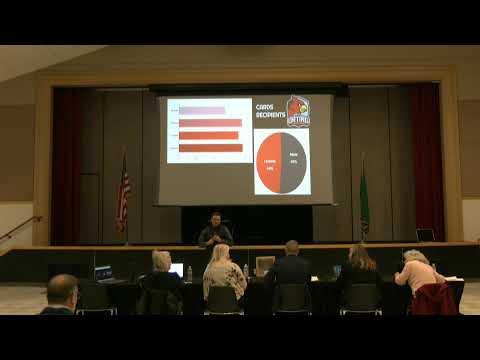
Goal 3 — the CARDS Way behavior initiative — seeks to reduce unkind or exclusionary student-to-student behaviors. School leaders said the program sets shared values and gives positive recognition (CARDS Way cards and small rewards) to students who demonstrate those values. The presenters reported that, by midyear, formal referrals tied to the targeted behaviors had fallen compared with the prior year: school staff cited about 32 such referrals last year and reported six so far at midyear. Principal Carlson (presenter) invited student Bryce and his mother Melinda to describe the program’s effect; Melinda said receiving CARDS recognition changed how her son saw himself and that “it made a difference in his life,” and Bryce said the cards and public acknowledgement helped him feel more connected at school.
Student programs and community partnerships featured in the presentation included FFA (Future Farmers of America). Senior and chapter reporter Paige Anderson described student-led livestock and small-animal projects, and presenters said the FFA program has about 25 pigs placed with community hosts for the Junior Livestock Auction this year. Paige said the chapter’s activities have provided scholarship and national competition opportunities for students.
School leaders emphasized that teachers, diagnostic data and community partners are being used together to set individual goals and monitor progress. They noted early indicators of success — diagnostic progress, increased student participation in special-education science activities, and growing family turnout at school events — but made no claim that final proficiency targets have been met.
No formal board vote was taken on the academic or program items during the work session; board materials reviewed at the start of the meeting included a first reading of nondiscrimination and related policies, which the board moved to a second reading. Presenters said parents, staff and students will continue to be involved as curricula, the athletics code and CARDS Way implementation proceed.