
Board discusses strategic-plan goals: 5% target to move students from Level 1, CTE expansion and work-session schedule
Get AI-powered insights, summaries, and transcripts
Sign Up Free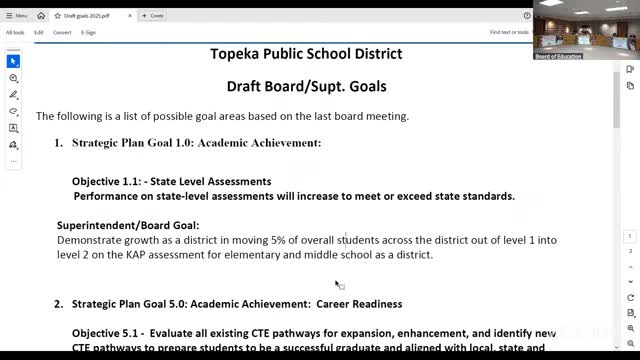
Summary
Trustees reviewed draft board goals tied to the district strategic plan, including a target to move 5% of students out of lowest assessment level, adding a CTE pathway, measuring mental-health supports, and scheduling policy and work sessions (cell phones, bilingual program, safety, absenteeism, technology).
Topeka Public Schools trustees spent a substantial portion of their meeting reviewing draft goals aligned to the district strategic plan and asked staff to return with measurable baselines and implementation detail.
Superintendent Dr. Anderson presented draft, measurable targets the board had discussed previously and asked whether the proposed metrics captured the board’s intent. For academic achievement the draft target was to move 5% of students out of Level 1 on state-related assessments, a change board members debated as both meaningful and attainable given high student mobility at several East Topeka schools.
“Now in this goal, we reference level 1 because that’s really what you all talked about at this time,” Dr. Anderson said while reviewing the proposed wording.
Board members asked for clarity on how the 5% was derived and whether it would be statistically meaningful. Dr. Kemp (assessment staff) explained that a 5% district-level change can represent a substantial number of students and that small percentage shifts in district indicators can be significant when multiplied across the student population.
Trustees also discussed secondary goals tied to career and technical education (CTE): adding one new CTE pathway next year and increasing CTE enrollment by 10% across the district. Staff said they would present pathway details and enrollment baselines to allow the board to track progress.
On student well-being, the board supported a proposal to implement an assessment tool (the Student Risk Screening Scale was referenced) to measure the impact of mental-health mentors and other mental-health services, and set a draft goal of decreasing internalizing and externalizing risk indicators by 5%.
Recruitment and retention of staff — especially bilingual personnel — was another board priority. The draft target presented was a 5% increase in bilingual staff and the adoption of five actionable steps from personnel surveys to improve recruitment and retention. Trustees also asked that the compensation study underway produce three actionable items to consider.
Several specific work-session topics were scheduled or proposed for deeper discussion: a policy-focused session on cell phones (proposed for April), bilingual/dual-language program review (including a Gomez & Gomez consultation scheduled for Feb. 28), safety and parking-lot security cameras, absenteeism, technology (including Windows 11 rollout and cybersecurity), early childhood/preschool funding, and accreditation steps. Board members asked staff to bring data baselines, midyear checkpoints and implementation plans to future sessions so the board can track progress year-to-year.
Several board members stressed the need to ground decisions in data; staff said screening tools, survey instruments and district assessments are already in use and that summary reports and baselines would be provided to the board in follow-up.