Get Full Government Meeting Transcripts, Videos, & Alerts Forever!
Get email alerts on the Elections topic
No spam. Unsubscribe anytime.
Lehigh students tell Northampton County Council long lines and broken machines blocked voting; urge more machines, campus access and outreach
Summary
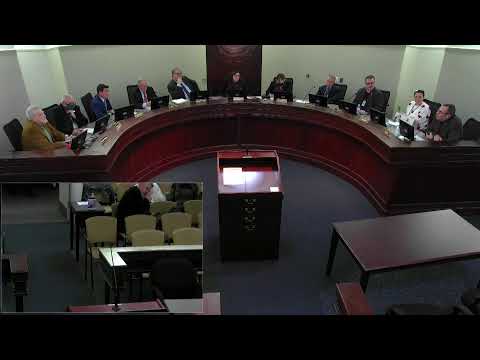
At the Feb. 6 Northampton County Council meeting, a group of Lehigh University students told the council that long lines and equipment problems at several polling places on Election Day prevented some people from voting and created an accessibility problem for students and working residents.
At the Feb. 6 Northampton County Council meeting, a group of Lehigh University students told the council that long lines and equipment problems at several polling places on Election Day prevented some people from voting and created an accessibility problem for students and working residents.
The students said wait times at the Banana Factory and Broglen Middle School stretched to several hours and that some voting machines were unavailable or went down. "I personally waited in the line for about 5 hours before I was finally able to cast my vote," said Bailey Baker, identifying herself as a Lehigh student. "Many people waited too long. Many people didn't get to vote because of the really hours long wait."
The testimony matters because students and other residents described practical barriers that, speakers said, reduced turnout. "I use the term voter suppression very deliberately," said Tommy Parisi, a Bethlehem resident and Lehigh student. "Egregiously long lines and failing voting machines and arbitrarily restrictive processes are things that disincentivize voting." Speakers proposed fixes that county officials could pursue without changing state law: increase the number of machines at high-turnout sites, add accessible early-voting or ballot drop-off locations close to campus, place a polling location on campus and adopt mobile voter-outreach programs similar to one cited in Montgomery County.
Students described consistent patterns: limited machines at high-turnout sites, volunteer efforts to keep people in line, and friends who waited from midday until late evening. "If there is a potential for 7,000 students to vote, simply two machines doesn't make sense," Bailey Baker said. Anna Sullivan said she waited about three hours at Broglen Middle School and later joined friends who had been in line since noon; she described lines around the building and volunteers handing out food to keep people in line.
Several students and speakers suggested concrete remedies. Suggestions included placing an early balloting site on or near Lehigh's campus, setting up additional ballot drop-off locations, increasing number and deployment of voting machines at sites known to have high turnout, and piloting mobile voter-outreach services to assist registration, mail-ballot applications and drop-off.
County staff and council members clarified legal limits. A county staff member noted that Pennsylvania's statutes do not explicitly authorize traditional "early voting," referring specifically to Act 77 and Act 88, while also explaining limits on when mail ballots may be applied for or canvassed. Council discussion afterward focused on directing questions to the county registrar and whether to invite elections officials to a future meeting to answer operational questions raised by the students. Council members agreed there are outstanding operational questions to take to the registrars or the county election board.
The public comments prompted several council members to ask the administration for follow-up and to recommend the registrar or election commission appear before council or a committee to explain machine allocation, on‑campus options and other operational constraints. No formal council action on the voting requests was recorded at the Feb. 6 meeting.
Clarifying details recorded in testimony included multiple reported wait times (about three to five hours), reports that some polling places began with two machines and increased to as many as six by later in the day, and repeated student estimates that Lehigh has about 7,000 undergraduates. Speakers also described volunteer efforts, food distribution for voters waiting in line and media attention drawn by the lines.