Get Full Government Meeting Transcripts, Videos, & Alerts Forever!
Get email alerts on the State Legislation Local Funding topic
No spam. Unsubscribe anytime.
Township leaders urge Mahoning County commissioners to oppose Senate Bill 56 over loss of marijuana-hosting tax revenue
Summary
Austintown and other township representatives told Mahoning County commissioners they plan to oppose proposed state changes that would redirect a portion of recreational marijuana tax revenue away from local host communities.
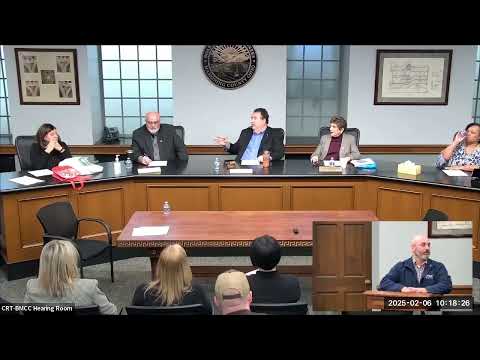
Robert Santos, an Austintown trustee and representative of the Mahoning County Township Association, told Mahoning County commissioners on Monday that township officials plan to oppose Senate Bill 56 because it would remove a promised share of recreational marijuana tax revenue for host communities.
Santos said voters approved Issue 2, which legalized recreational marijuana in Ohio and included a 10% additional sales tax on recreational marijuana sales, and that the ballot language envisioned that hosting communities would receive 36% of the revenue generated by that tax. "Now the state is once again trying to pull the rug out from under us to take that funding away," Santos said. "I think it is a travesty; it is disenfranchising the voters that voted for it."
The trustee urged coordinated testimony against Senate Bill 56 at an upcoming hearing and said the Ohio Township Association (OTA) and other local organizations are preparing comments. "Kyle Brooks, who is the OTA lobbyist, will let me know when the hearing next week is for the senate bill," Santos said. He said he planned to testify opposing the bill and to collect letters from local officials to deliver to legislators.
Why it matters: Santos and other speakers said the local share of the marijuana sales tax was expected to create a new revenue stream for townships and cities without raising property taxes or levies. Santos cited studies he said estimated individual dispensaries sell $10 million to $20 million annually and that a dispensary could generate roughly $250,000 to $700,000 in local tax revenue, figures he said would be meaningful for places such as Youngstown and Austintown.
Several public speakers repeated a common theme: local officials and residents planned and relied on the prospective revenue when deciding whether to allow dispensaries. "We laid down the foundation, the work, we get it put in place to have it completely stripped away from us," Santos said. He urged residents and elected officials to contact state senators and representatives and said the change may also be being proposed in the state operating budget.
Reverend Charles Ellis, who spoke during the same public-comment period, said he supports the townships' push to oppose the bill and urged commissioners to join the effort. "We got to take it to them," Ellis said, adding that coordinated testimony and public pressure could influence legislators.
Audrey Morales, speaking as part of the public-comment period and later identified on the agenda as affiliated with Jobs and Family Services, said county and township officials should press the state to return funds to local governments in ways that ensure money goes to the local programs that planners and officials have identified. "When you receive it, you directly know where you need to put it in your township," Morales said. "Let us keep the money that is our money."
Speakers repeatedly compared the proposed change to prior state actions that redirected funds away from local governments, citing losses of the local government fund and other allocations. Santos described prior reductions in local aid to emergency responders and said townships have limited revenue options other than seeking additional levies from residents.
No formal county action on SB 56 was recorded during the meeting. Commissioners acknowledged Santos and other speakers and said they would consider correspondence or a formal letter of support if the board chooses to act. Several public commenters urged immediate, coordinated testimony and written letters to state lawmakers.
The public-comment record in this meeting shows township leaders and community members are preparing to appear at or submit testimony for a senate hearing and to seek coordination with county- and city-level lobbyists. Specific hearing dates and any formal county resolution or letter of opposition were not specified in the record.