Get Full Government Meeting Transcripts, Videos, & Alerts Forever!
Get email alerts on the State Legislation Education topic
No spam. Unsubscribe anytime.
Board hears legislative update; trustees warned lab-school, capital and other bills could cost the district
Summary
District staff and trustees reviewed several pending state bills — including a lab-school funding bill, vouchers and a constitutional capital-construction amendment — that district leaders said could reduce local flexibility and create budget shortfalls if adopted in current forms.
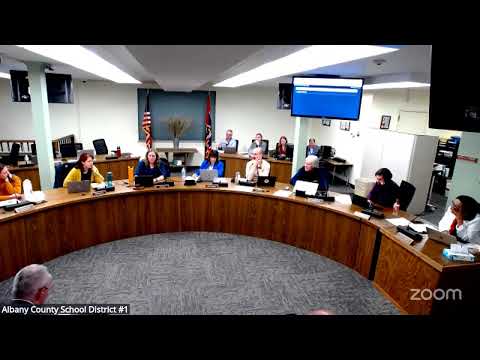
Albany County School District #1 trustees spent a substantial portion of their February work session reviewing several pending bills at the Wyoming Legislature that district staff said could materially affect district finances, staffing and governance.
Tristan Green, district staff, summarized the district's concerns about language in a proposal to reconstitute the lab school as a separate school on the University of Wyoming campus (current bill reference discussed in the meeting: Senate File 126). Green said the bill's funding mechanics would be "a net zero to the state" but not to the district. He estimated that, under provisions discussed at the time of the meeting, the district could lose roughly $3 million in revenue associated with the lab school ADM calculation while continuing to carry roughly $2 million in related school-level expenses — producing an estimated roughly $1 million shortfall in the district's operating budget if the bill were enacted in current form.
Green explained the driver: state funding for schools uses a formula including a three-year rolling average of average daily membership (ADM). If a school's ADM is diverted to a new state-authorized charter or lab school on another campus and the district continues to provide central administrative functions, the district loses revenue tied to those students while retaining some fixed district-level expenditures. Green and fellow administrators told trustees that the proposed bill, as written, would change how that money flows and reduce the district's budget flexibility.
Other bills covered and trustee responses: - Gun-free-zone repeal and concealed-carry changes (House Bill 172, House Bill 174, and related proposals). Counsel and trustees noted one likely outcome would be allowing some concealed firearms on school property; trustees urged amendments to explicitly prohibit K-12 students from carrying firearms on school grounds and at school events. Trustee comments focused on safety and enforcement uncertainty. - Teacher-tenure and personnel rules (Senate File 188): The bill would eliminate continuing-contract status and permit districts to use shorter-term contracts (up to four years in the bill language discussed). Counsel noted districts could create local policies to preserve some due-process protections, but district leaders warned the overall shift would reduce employment stability for teachers. - Alternative certification and uncertified personnel (House Bill 100 and Senate File 86): The bills would permit hiring certain K-12 personnel without standard PTSB certification or allow alternative pathways to licensure. District staff flagged questions about federal compliance, student-teacher practicum requirements and maintaining quality controls. - Voucher/Homeschool funding proposals (House Bill 199 ' Wyoming Freedom Scholarship Act): The bill would create a scholarship mechanism to direct public funds to families who choose private or homeschool instruction (the meeting referenced a $7,000 per-student figure in discussion). District staff and trustees expressed concerns about oversight, recordkeeping, special-education obligations and constitutionality; staff noted litigation is likely if broad voucher provisions pass. - Capital construction and local taxation (S.J. 006 and related bills): Trustees heard that a proposed constitutional amendment would require or shift more capital-construction funding responsibilities to localities, a change that could be especially harmful to counties with a limited tax base. The board discussed the risk that major maintenance and enhancement projects might no longer be funded in current ways. - Calendar/change of student days (Senate File 72): A proposal to reduce student contact days from 175 to 165 and teacher contract days to 170 was described; staff warned that condensing required instruction into fewer days could create practical challenges and would not by itself address fiscal pressures.
Trustees and staff urged community engagement. Several trustees urged constituents to contact legislators. The board asked district staff to continue monitoring the bills, to provide updated cost estimates as amendments arrive, and to prepare possible policy responses (such as alternative-calendar applications and employment-policy reviews) should the Legislature adopt certain provisions.
Ending: No formal board action was taken at the work session. District leadership said the financial estimates rely on bill text that may change, and warned that amendments could alter both cost and operational impacts. Trustees asked for monthly updates as bills proceed through the Legislature.