Get Full Government Meeting Transcripts, Videos, & Alerts Forever!
Get email alerts on the Housing Workforce topic
No spam. Unsubscribe anytime.
City, chamber propose workforce housing on former Slade school site; trustees raise fiscal and governance questions
Summary
City staff and Laramie business leaders presented a proposal to convert the former Slade school property into deed-restricted workforce homes for employees of participating organizations. Trustees pressed the presenters on deed restrictions, proceeds to the district and long-term governance; no decision was made.
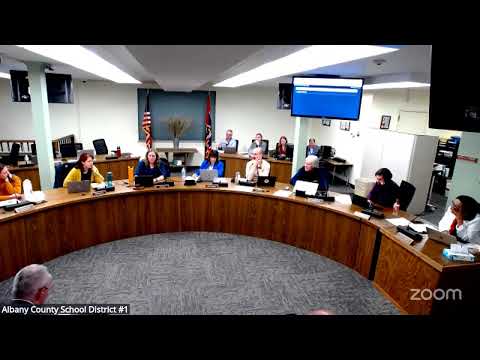
Todd Feazer, assistant city manager for the City of Laramie, presented a concept to the Albany County School District #1 Board of Trustees to redevelop the former Slade school site into owner-occupied, deed-restricted workforce housing during the board's February work session.
Feazer said the site comprises about 3.22 acres with roughly 141,000 square feet and is presently platted for 17 residential lots under R-2 zoning; he described a preferred development concept of twin homes (two units per lot) arranged with rear access from an alley. "The vision is rear load off an alleyway, twin homes," Feazer said, describing 1,300- to 1,500-square-foot units targeted at employees of participating organizations.
Project concept and partners: Feazer described a public-private partnership model that could include Albany County School District #1, the City of Laramie, the Laramie Chamber Business Alliance (LCBA), Ivinson Memorial Hospital and Workforce Innovation organizations. The project team's stated goals are to create 34 attainable, owner-occupied homes for households earning roughly 80% to 120% of area median income (AMI), to pilot a replicable model and to provide staff housing to help recruitment and retention.
Financing and deed restrictions: Feazer said partners would negotiate a development agreement outlining each entity's contributions and expectations, with potential components including a partial land donation, upfront funding for design and engineering, conventional financing and Urban Renewal Agency support for public improvements. He suggested deed restrictions and limited resale increases to preserve long-term affordability; as an example he said resale caps might allow small, fixed appreciation (he cited a hypothetical 2.5% return after a short holding period). Feazer also outlined a potential per-lot return to the district on first sale in the range discussed at the meeting ("If it's $15,000 per lot, that's $510,000; if it's $10,000 a lot, that's $340,000").
Trustee concerns and fiduciary questions: Several trustees raised financial and governance concerns. Trustee Janice Marshall said district facilities-sale proceeds would be restricted to capital projects and maintenance and cautioned against long-term administrative commitments that could divert staff time from education. Trustee Goetzner asked whether partners could instead purchase the property outright without the district participating; Feazer replied that a direct sale was possible but that the partnership model aims to secure staff housing and other community goals, and that sale-structure options (including staged receipts) were under consideration.
Clarifications and constraints discussed at the meeting: - Site and zoning: The property is zoned R-2 and currently platted for 17 lots; Feazer noted that R-2 zoning could be built up to higher densities (four units per lot), but the proposed plan favors a lower-scale twin-home model for neighborhood compatibility. - Unit counts: Feazer used several figures in the presentation: 17 platted lots, an initial stated goal of "37 doors" in one part of the presentation, and later described the project as aiming for 34 workforce-occupied units (two units per lot). Trustees requested these numbers be reconciled and confirmed in future documents. - Resale restrictions: The proposal would use deed restrictions to limit resale profit and control buyer eligibility (for example, prioritizing employees of participating organizations), but the exact duration of restrictions (examples discussed ranged from 7 to 15 or more years) and the resale formula remain to be negotiated in a development agreement. - Organizational structure: Feazer said the LCBA and partner organizations are considering creating a non-profit or similar entity to develop and operate the project; he said the group is not currently structured as a 501(c)(3) and emphasized the desire for a locally driven model rather than bringing in a regional nonprofit like Habitat for Humanity.
Next steps and board process: Feazer said the proposal is at the concept stage. A development agreement would be drafted among participants and would return to each partner's governing body for approval; Feazer said he expects the partnership will need to remain involved through initial sales and to address unforeseen issues. School district leaders said they would consider whether to contribute the land, sell it, or decline participation; district staff noted proceeds from any sale would be restricted to facilities use under current state rules.
Ending: Trustees did not take action at the meeting. Several board members asked staff to return with more precise financial analyses, a reconciled unit count, proposed deed-restriction language and an appraisal of the site. Feazer said he would be available to meet with trustees and staff as the concept evolves.