Albany County School District updates Slade dual-language immersion program and explains lottery process
Summary
Trustees heard a presentation on the district's K'5 dual-language immersion (DLI) at Slade Elementary, student experiences, middle- and high-school pathways and detailed how the program's yearly lottery is run to broaden access and prioritize Spanish-speaking students.
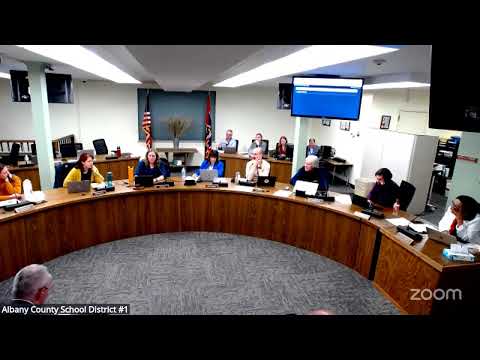
Trustees of Albany County School District #1 heard an update on the district's dual-language immersion program at Slade Elementary during their February work session, including presentations from program staff, current DLI students and district administrators about enrollment, the lottery system and plans for a high-school pathway.
The DLI presentation explained program goals and daily structure. Miss Morrow, the DLI presenter, described the program as aiming "to be bilaterally bilingual and biliterate" and to maintain academic achievement in both Spanish and English while raising students' "sociocultural competencies." At Slade, students spend parts of the day with an English-speaking and a Spanish-speaking teacher and receive core instruction in both languages; math and Spanish language arts are major Spanish-language components in the lower grades, while the balance shifts in fourth and fifth grades.
Students who attend Slade's DLI spoke to trustees about their experience. "Learning two languages is going to help me in the future," said Sarah, a current DLI student. Tristan, a fourth grader, said the program lets him "compare the languages" and learn about Spanish-speaking countries, and fifth grader Lucas Mason described using Spanish to help new Spanish-speaking classmates. Middle-school students also addressed the board; Cash Ati said nine years in DLI built "confidence, perseverance and dedication."
Why it matters: District presenters framed the program as a multiyear investment in language proficiency and cultural competence, and trustees pressed staff on access and fairness. The board discussed how the lottery and placement rules affect representation, ELL supports and classroom composition as students advance into middle and high school.
How the lottery and placement work: Lottery slots for DLI are calculated each year to reflect the district's enrollment by home-school area rather than a single pooled drawing. As Miss Morrow explained, the district first allocates slots proportionally by home-school area (for example, Linford received 21% of slots in the most recent distribution, nine slots in that example). After building-level draws, leftover names are combined and assigned a master wait-list order by random sequence.
Key operational details and clarifications provided by staff: - The district reported 65 applications in last spring's cycle; 40 initial invitations were issued, seven families declined or did not respond, and the district filled remaining openings from the wait list. Current class sizes in the two K sections are about 22 and 23 students. - The program reserves four kindergarten slots to admit incoming Spanish-speaking English-learner (ELL) students; staff said that structure has resulted in nearly all Spanish-speaking ELLs who applied being placed in kindergarten DLI when they sought that placement. - The district does not collect or consider Individualized Education Program (IEP) status when placing students in the lottery and said it cannot ask about IEPs in the application process. - The district intentionally does not grant sibling preference in the DLI lottery; staff said that policy is intended to avoid generationalizing access and to keep annual access as equitable as possible, even though it leads to difficult outcomes when one sibling gets in and another does not.
Funding and staffing notes: Tristan Green, district staff, told trustees, "We don't fund DLI through Title 3." He said Title 3 federal funds are strictly limited and cannot be used for salaries; the district treats DLI as a general-fund program by trading what would be an English section for an equivalent Spanish section. Green also noted an initiative to increase certified ELL staff: 19 district teachers had received scholarships to obtain ELL certification, and several DLI-pathway teachers planned to pursue certification over the summer.
Pathway into high school: Presenters said the district has a partnership with the University of Wyoming to offer concurrent and dual-enrollment Spanish courses beginning in ninth grade for current DLI students. "Students who are leaving eighth grade and entering ninth grade are entering having tested out of 1010 and 1020 and will enter into a pathway toward credits that accumulate toward a minor," Miss Morrow said, describing the intent to provide on-site concurrent-enrollment toward a high-school credential in Spanish.
Next steps and board direction: Staff said they will continue outreach and communications to broaden application awareness across home-school areas, hold required informational nights for families, and recalculate slot distributions annually to reflect enrollment. No board action was taken at the work session; trustees asked staff to continue reporting enrollment, lottery and staffing metrics as the program grows.
Ending: The board did not vote on any DLI-related motions. Trustees asked staff to return with additional data on outreach outcomes, enrollment trends and the high-school course progression as the district rolls the program forward.
AI generated
The text on this page is AI generated. Summaries, highlights, analysis, and video transcripts are all produced from the original source material.
AI can make mistakes, so if you spot one, and we will fix it for everyone.
Note: the source content is unaltered by us. Any content source we link to, be it a video, an audio recording, or a document, is presented exactly as its publisher released it. That publisher is usually a government body, sometimes an individual official or another organisation.