
Senate hearing advances bill directing Ecology to test biosolids for PFAS and report to Legislature
Get AI-powered insights, summaries, and transcripts
Subscribe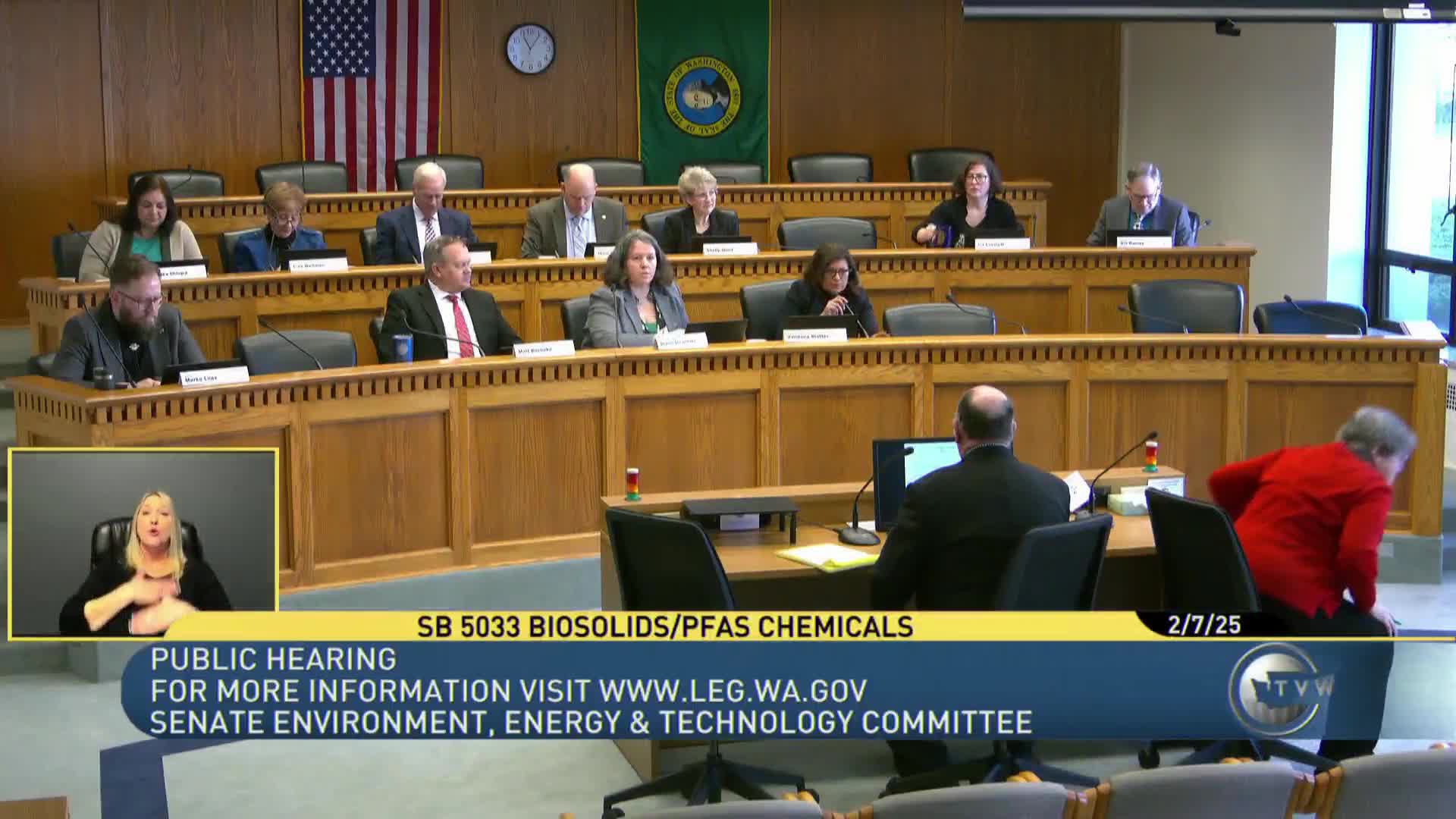
Summary
A Senate Environment, Energy & Technology Committee hearing heard wide public testimony on Senate Bill 5033, which would require the Department of Ecology to convene an advisory group, set PFAS sampling/testing requirements for biosolids and deliver multi‑year analyses and a legislative report.
The Senate Environment, Energy & Technology Committee on Jan. 31 heard testimony on Senate Bill 5033, a measure that would require the Department of Ecology to develop PFAS sampling and testing requirements for biosolids and to report findings and recommendations to the Legislature by late 2028.
Committee staff described biosolids as nutrient‑rich organic material from wastewater treatment that can be applied to land as a fertilizer and said the bill would convene an advisory group and set deadlines for Ecology’s work. "By 07/01/2027, after consulting with the advisory committee, Ecology must establish a PFAS sampling or testing requirement for biosolids regulated under the program," staff told the committee.
Why it matters: PFAS (per‑ and polyfluoroalkyl substances), also known as "forever chemicals," do not break down in the environment and have been regulated in other media such as drinking water and firefighting foam. The bill seeks to quantify how much and which PFAS compounds are present in Washington biosolids before lawmakers consider regulatory action.
Sponsor Sen. Jeff Wilson (R‑19) told the committee he brought the bill to create a deliberative, science‑based process. "Biosolids are incredibly important to Washington State farmers," Wilson said. "Biosolids with question mark levels of forever chemicals may not be good." He described the work as intended to let a diverse advisory group recommend thresholds and testing methods.
More than a dozen stakeholders testified. Local governments, wastewater utilities and statewide utility associations generally supported the bill’s focus on science but asked for technical changes and extra time for labs and implementation. Scott Hazelgrove of the Washington Association of Sewer and Water Districts said the bill "is a great first step" but requested additional time and urged that Ecology be the single regulator to avoid a patchwork of local rules.
Environmental and public‑health advocates and some residents urged stronger action, including an outright ban on land application of biosolids. Darlene Shanfold of the Olympic Environmental Council said land application "must stop," citing PFAS, microplastics and other contaminants. Several speakers urged including septage and historically applied areas in any testing regime and asked for faster timelines than those contained in the bill.
Department of Ecology staff said the bill will produce data needed to inform policy decisions but noted the agency’s interpretation of a section of the bill could authorize local restrictions on biosolids application, which may create regulatory inconsistency. Ecology also provided a fiscal estimate: a net fiscal impact of about $770,000 over the four‑year outlook charged to the biosolids account, with no general‑fund impact, according to committee staff briefing the bill.
Committee discussion focused on scope — whether to include septage, historically treated sites and small treatment works — and on timelines for sampling, analysis and reporting. Multiple presenters recommended aligning regulated analytes and methods with U.S. EPA methods that are already in development or use.
The bill does not propose immediate restrictions; rather, it establishes a process for Ecology and an advisory committee to develop sampling/testing requirements, complete an analysis of PFAS in Washington biosolids and report recommendations to the Legislature by Dec. 1, 2028.
Stakeholders asked the committee to clarify statutory authority and to consider whether Ecology or local governments should retain certain authorities. The hearing record includes technical comment letters and offers from utilities and Ecology to help draft amendments.