Get Full Government Meeting Transcripts, Videos, & Alerts Forever!
Get email alerts on the Municipal Hearing Officer topic
No spam. Unsubscribe anytime.
Holyoke council creates municipal hearing officer, tightens vacant‑building fees and approves multiple transfers
Summary
The City Council on Feb. 4 approved an ordinance creating a part‑time municipal hearing officer, adopted a tiered vacant‑building fee schedule, passed a measure to notify council of group‑home applications, and approved several budget transfers and a small emergency management grant.
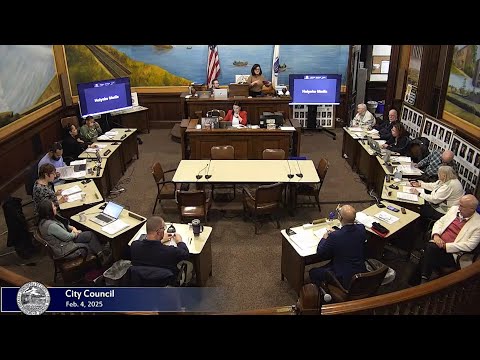
The Holyoke City Council on Feb. 4 voted to create a part‑time municipal hearing officer position to hear certain local code appeals, adopted a tiered fee schedule for vacant properties, and approved several budget transfers and a small emergency management grant during its regular meeting at City Hall.
The council passed the municipal hearing officer ordinance after an amendment that added a maximum three‑year term for the officer. Council members described the position as a lower‑cost local alternative to repeated court hearings for code and nuisance disputes. Councilor Israel Rivera said the intent was to provide quicker, more affordable local resolution options for residents. Councilor Bacon said she would “be voting in favor of this tonight” after committee discussion that narrowed the stipend to $2,500 a year.
The council agreed to an amendment to the ordinance that set a maximum term of three years for the municipal hearing officer; that amendment passed 11–2. The ordinance itself then passed on final reading by unanimous roll call.
Council members discussed funding sources. Attorney Jeffrey Bissonnette told the panel that under state law fines collected by code enforcement can be used to fund the position’s stipend; the council also filed a related order asking the mayor and law department to examine permanent funding from the vacant‑building reserve.
On vacant buildings, the council adopted a tiered fee schedule intended to push property owners toward rehabilitation. Under the adopted framework cited in committee, properties vacant one to two years face a $1,500 annual assessment; for properties vacant two years or more the ordinance applies escalating annual assessments tied to building square footage (for example, buildings under 3,000 square feet were discussed with a $3,000 annual assessment, and the 3,001–8,000 square‑foot tier was discussed at $6,000). The ordinance also includes a path for owners to avoid higher fees by submitting an accepted rehabilitation plan. Councilor Israel Rivera said the tiers were designed to be “fair and equitable.”
The council also adopted an order requiring that the council be notified when entities apply to open group homes inside city limits; the language does not ban group homes but requires council notice so members and the public can be informed.
In other business the council accepted a $9,500 Fiscal Year 2024 emergency management grant from MEMA (50 percent in‑kind match), and approved a series of budget transfers, including a $350,000 transfer to the police overtime line to cover personnel shortfalls through June 30, 2025; and a $293,439.63 transfer from stabilization to highway capital outlay to fund replacement plow trucks. A transfer of $24,780 from the vacant‑building revolving fund to property maintenance (demo supervisor) also passed. A smaller transfer of $9,981.52 to cover three firefighters’ injured‑on‑duty costs passed under suspension of rules.
Votes at a glance
- Municipal hearing officer ordinance (Item 22): Amendment adding a maximum three‑year term — passed, 11 yes, 2 no; final ordinance adoption on second/third reading — passed by unanimous roll call. Stipend set at $2,500 (language in ordinance). Council also filed Item 47 to explore permanent funding from the vacant‑building reserve (referred to ordinance).
- Vacant‑building fee ordinance (Item 23): Adopted; establishes tiered annual assessments tied to vacancy duration and building square footage (examples discussed in committee: $1,500 for vacant 1–2 years; $3,000 for <3,000 sq ft; $6,000 for 3,001–8,000 sq ft). Forward‑looking only (not retroactive).
- Group‑home notice order (Item 24): Adopted; requires council notification when group‑home permits are filed (does not ban group homes).
- Police overtime transfer (Item 27): $350,000 transfer to cover overtime through June 30, 2025 — passed.
- Highway capital outlay / plow truck transfers (Items 29 and 58): $293,439.63 transfers from general/capital stabilization to highway capital outlay to replace plow trucks — passed.
- Vacant‑building revolving fund transfer (Item 30): $24,780 to property maintenance/demo supervisor — passed.
- MEMA emergency management grant (Item 28): Acceptance of $9,500 (with 50% in‑kind match) — passed.
- Injured‑on‑duty transfer (Item 53): $9,981.52 from captain/lieutenants to injured on duty (covers three firefighters) — passed under suspension of rules.
What happened next
Several orders were referred to committee for follow‑up, including the mayor’s proposal on funding and an auditor referral for certain finance items. Councilors also asked the auditor to provide up‑to‑date balances for the general and capital stabilization accounts and for the vacant‑building revolving fund to clarify any remaining available balances before additional transfers.
Ending
The City Council’s actions create a new local mechanism for resolving certain code disputes, increase financial penalties to encourage owners to remediate vacant properties, and moved forward a set of transfers largely aimed at equipment replacement and personnel coverage. The council referred a funding path for the municipal hearing officer to the ordinance committee for legal review and to the mayor for budget discussions.