Get Full Government Meeting Transcripts, Videos, & Alerts Forever!
Get email alerts on the Deepfakes Legislation topic
No spam. Unsubscribe anytime.
Public Citizen presents state-level model bills on deepfakes, intimate-image abuse and bot disclosure
Summary
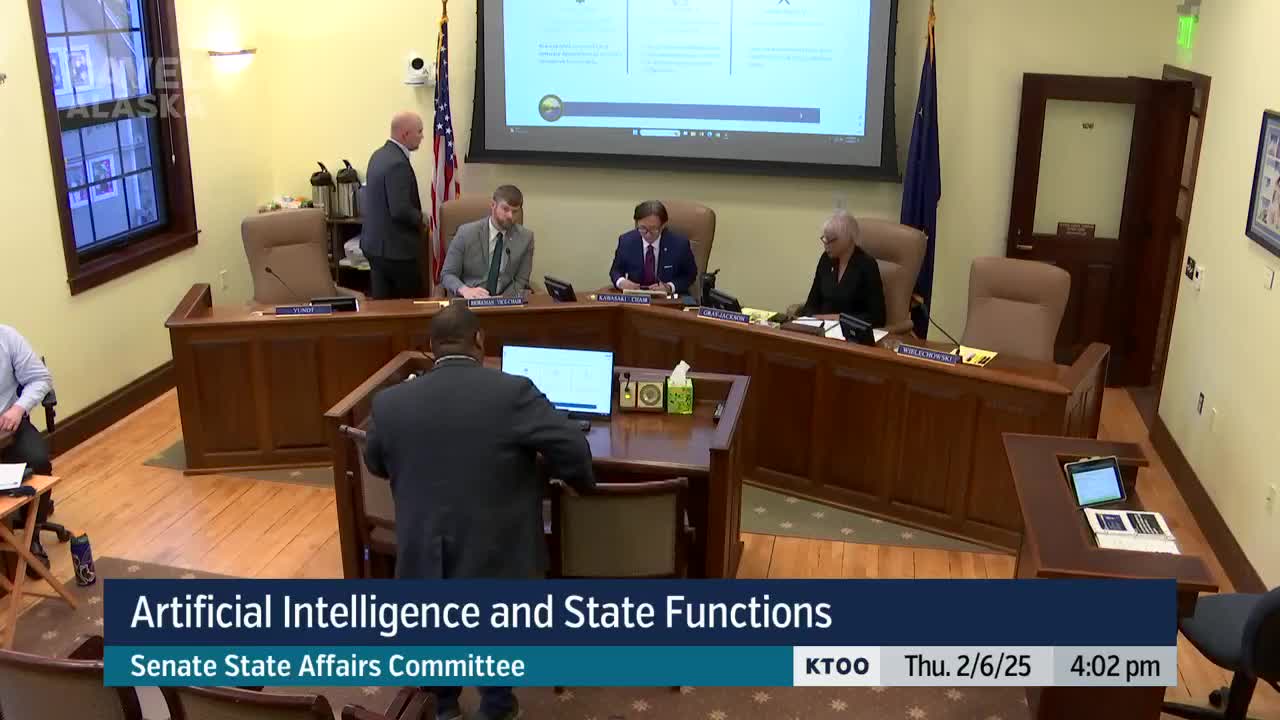
Alana Belair, organizing manager for the Democracy team at Public Citizen, told the Alaska Senate State Affairs Committee that many states have enacted similar laws addressing election deepfakes, nonconsensual intimate-image deepfakes, and bot disclosure.
Alana Belair, organizing manager for the Democracy team at Public Citizen, told the Alaska Senate State Affairs Committee on Thursday that many states have adopted similar bills to regulate deepfakes in elections, to criminalize nonconsensual intimate deepfakes, and to require disclosure when consumers interact with chatbots.
Belair defined a deepfake as “content that is fabricated using technology” that depicts “someone doing or saying something that they never actually did or said in real life,” and she said the rapid improvement and accessibility of the tools is driving legislative urgency.
The nut of Belair’s presentation was threefold: election deepfakes, nonconsensual intimate-image deepfakes, and bot-disclosure laws. For election deepfakes, she said 21 states had enacted laws to regulate deepfakes in election communications by the end of 2024 and that nearly every state has considered such measures. For intimate-image deepfakes, Belair said 30 states have passed legislation addressing nonconsensual explicit synthetic media and that 45 states have introduced similar bills. She said the underlying harms differ between the categories: election deepfakes threaten electoral integrity and public trust; nonconsensual intimate deepfakes disproportionately harm women and minors and cause acute personal harm.
Belair described typical elements in successful election-deepfake bills: a clear definition of deepfake, a disclosure requirement rather than an outright ban (which she said raises First Amendment concerns), a "knowingly" standard to avoid penalizing unknowing reposts, a limited time window before an election (commonly 90 days), injunctive relief to remove content quickly, and penalties aimed at deterring distribution. She said a model definition should focus on fabricated speech or conduct that "appears to a reasonable person to depict a real individual saying or doing something they did not actually say or do in reality." "We highly recommend that folks require disclosure rather than a complete ban," Belair said.
Belair gave international and U.S. examples. She cited a case in Slovakia where an audio deepfake circulated within 48 hours of an election and depicted a major-party leader falsely saying he would rig the vote; she also cited a 2024 New Hampshire incident where a deepfake of President Joe Biden's voice was used in robocalls and a North Carolina congressional primary where a PAC circulated a deepfake of a candidate.
On intimate-image deepfakes, Belair said these account for roughly 98 percent of deepfakes discovered online and that about 99 percent of victims are women and girls; she cited studies showing minors express high concern about becoming victims and that some victims have reported suicide-related consequences in extreme cases. She recommended criminal and civil remedies, carefully defined consent language, and that disclaimers or labeling are not an adequate defense because they do not mitigate the harm to victims.
Belair recommended that liability focus on distributors of deepfakes rather than only creators, noting it is often difficult to identify a creator and that creators may not intend distribution. She also described common exemptions in state laws for bona fide news reporting, satire and platforms that make reasonable preventive efforts, and noted FCC preemption language sometimes appears for broadcasters.
Finally, Belair described a newer wave of proposals focused on bot disclosure: several states require that consumers be told when they are interacting with a chatbot, and some proposals extend to sales bots and bots imitating licensed professionals. She said four states had enacted such rules and several more have introduced them this year.
Committee members noted Alaska has had prior bills on deepfakes introduced by Senator Hughes and Representative (now Senator) Mike Cronk, and Chair Kawasaki said more questions and follow-up are expected as the committee evaluates draft language and practices from other states.