Get Full Government Meeting Transcripts, Videos, & Alerts Forever!
Get email alerts on the Complex Care Residential Homes topic
No spam. Unsubscribe anytime.
Senate hearing introduces bill to license small "complex care residential homes" for patients with co-occurring needs
Summary
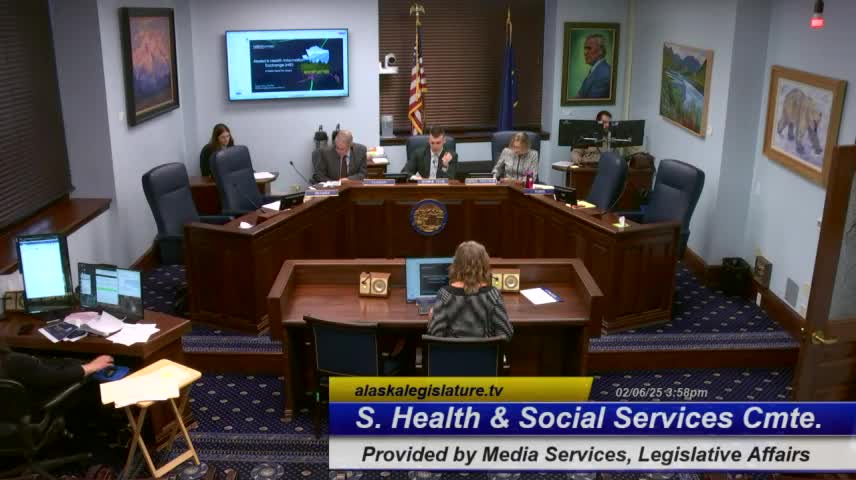
Department of Health and Department of Family and Community Services officials told the Senate Health and Social Services Committee that SB 76 would create a new license type for small, home-like residential facilities to serve people with complex behavioral health and co-occurring medical needs. The bill would allow facilities of fewer than 15
Heidi Hedberg, commissioner of the Department of Health, told the Senate Health and Social Services Committee that Senate Bill 76 (introduced at the governor's request) would create a new statutory license type to house and treat Alaskans with complex behavioral health and co-occurring needs in small, community-based settings.
"This bill is a result of the collaborative work between the Department of Family and Community Services and the Department of Health to address gaps in the Alaska system of care for individuals with complex behavioral health and other co occurring needs," Hedberg said at the committee's Feb. 6 hearing in Butrovich Room 205.
What the bill would do
- License type: SB 76 would add a statutory category called complex care residential homes to allow state licensing and regulation of small, home-like facilities designed for residents with combined mental, behavioral, medical or disability-related needs.
- Size and scope: The bill would permit homes treating fewer than 15 residents; presenters said the 15-bed limit reflects a federal Medicaid-related prohibition and the Medicaid exception that applies to facilities of 15 beds or fewer.
- Services: Homes would provide 24/7 staffing and access to multidisciplinary teams, include specialized monitoring and interventions, and be more supportive than assisted living while less restrictive than psychiatric hospitals.
- Statutory changes: Presenters said the bill would exclude the new homes from assisted-living and hospital definitions in statute to emphasize their home-like character and clarify regulatory requirements.
- Medicaid and financing: Section 5 would authorize the Department of Health to seek Centers for Medicare & Medicaid Services approval to cover services in the setting under Medicaid; presenters said funding and service definitions would be developed in regulation and other workstreams after statutory authority is in place.
Why lawmakers are considering it
Deputy Commissioner Emily Ricci (Department of Health) and Deputy Commissioner Clinton Lasley (Department of Family and Community Services) described the proposal as a response to a small but high-need population who cycle between acute inpatient settings and less appropriate community placements because current options either lack the clinical intensity or are too restrictive.
Dr. Robert Lawrence, the department's chief medical officer, said the license type is intended to be adaptable across ages and conditions and gave examples including children returning from out-of-state inpatient care, seniors with dementia who cannot be safely served in large facilities, and adults with severe persistent mental illness.
Committee questions and department responses
- Staffing: Senator Sherman asked where the staff would come from. Emily Ricci replied that staffing is a challenge across Alaska health services and that the department intends to align payment and service definitions to better reflect the acuity of residents. She said many people with these needs already receive care in other parts of the system; the bill creates an appropriate home-like setting and the work to define services and funding will follow.
- Federal funding and rates: Senator Giesel noted federal Medicaid would cover roughly half of personnel costs per the fiscal note; Ricci said community behavioral health rate rebasing took effect this year and the department is conducting a rate-methodology review to align payment with service needs.
Committee disposition
Chair Dunbar said the committee would "set this bill aside" for public testimony and asked members to consult with his office and the Department of Health on amendments. No formal vote was taken during the introductory hearing.
Ending
Presenters emphasized that the statutory authority sought by SB 76 is the second step in a multi-step process: it creates a place where services can be offered, while detailed service standards and financing mechanisms would be worked out subsequently in regulation and budget processes.