Get Full Government Meeting Transcripts, Videos, & Alerts Forever!
Get email alerts on the Artificial Intelligence State topic
No spam. Unsubscribe anytime.
State CIO outlines pilots for AI tools, says state has no written bias policy
Summary
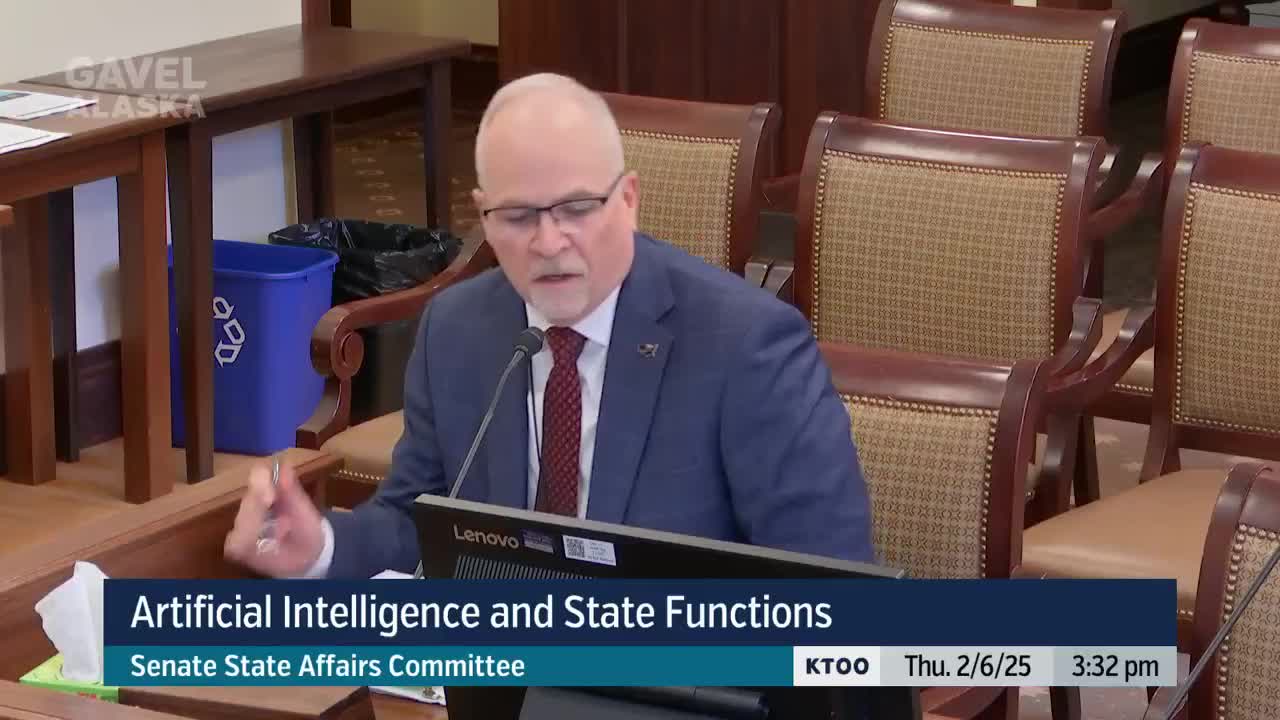
Bill Smith, the State Chief Information Officer, told the Alaska Senate State Affairs Committee on Thursday that the executive branch is testing a series of artificial intelligence tools for internal use and public-facing services while prioritizing data protection and compliance.
Bill Smith, the State Chief Information Officer, told the Alaska Senate State Affairs Committee on Thursday that the executive branch is testing a series of artificial intelligence tools for internal use and public-facing services while prioritizing data protection and compliance.
Smith said the state will pilot an Office Software Assistant — an AI feature embedded in licensed office products that can summarize email and meeting transcripts and draft messages — and use Copilot Studio building blocks in the cloud to create targeted services. "We are getting ready to start releasing in a small pilot way," Smith said of the Office Software Assistant, adding the state will measure returns on investment over the next several months.
The nut of Smith's presentation was that the state is focusing first on use cases that solve clear problems and on tools that operate inside Alaska's cloud environment and security controls. "AI is really good at solving problems and puzzles. It's not good at solving mysteries," Smith said, describing the technology's limits and the need for correct, controlled data.
Smith described three categories of AI work the Office of Information Technology is pursuing: end-user AI embedded in third-party software, developer AI composed from cloud building blocks, and more complex custom-built models that the state has not yet requested through its investment review process. He said no large custom-built models have come through the state's investment review board — which evaluates IT investments above about $25,000 — and the board's review process is being adjusted to ask appropriate questions if and when such requests arrive.
Smith said security and compliance are the first test points for any AI deployment. "Number 1 is the data. Is the data protected? Is the data safe?" he said, adding that many of the current projects reuse environments that already host sensitive state data and therefore inherit preexisting compliance controls. He said an updated acceptable use policy is near completion and that agencies are being educated about responsible handling of custodial data when interacting with AI tools.
Examples Smith gave included cybersecurity platforms that use AI to flag abnormal network behavior, Copilot Studio prototypes that answer staff questions by pointing to authoritative security policies, and a DMV chatbot deployed last year. "Our DMV chatbot is AI driven... that's an example where we deployed that last year and got a lot of good results," Smith said. He also described early efforts to point natural-language chatbots at state websites and the need to tune them to prefer recent, accurate sources.
Committee members asked about practical uses. Senator Bjorkman asked whether an AI tool exists to compare two legislative documents for changes; Smith said he did not know of a specific tool offhand but would query his teams. When Bjorkman asked whether AI could detect and propose fixes for slow performance in the Alvin system, Smith said the state does not yet have an AI tool for that use case but is interested in exploring it.
On policy around bias, Smith told the committee, "We do not have a a policy about bias." He explained that because many deployments rely on vendor-built large language models running inside the state's secure cloud subscriptions, the state has not yet needed a separate statewide bias policy, but acknowledged that custom-built models in the future would require more formal controls and testing.
Smith emphasized testing and tuning as critical steps: model answers must be checked against authoritative references and systems tuned to weight more recent documents or explicitly dated sources. He said the state is preparing leaders with guidance on where the AI features are most valuable and where they are not, and will conduct internal pilots to measure benefits before wider rollout.
The presentation closed with committee members thanking Smith and noting the need to balance rapid technology adoption with legislative oversight. The committee recessed to connect with the next presenter; Smith remained available to answer follow-up questions.