Get Full Government Meeting Transcripts, Videos, & Alerts Forever!
Get email alerts on the Health Information Exchange topic
No spam. Unsubscribe anytime.
Healthy Connect Alaska tells Senate panel HIE reduces tests, speeds care and can support social needs outreach
Summary
Kendra Sticker, executive director of Healthy Connect Alaska, told the Senate Health and Social Services Committee that the state's health information exchange gives clinicians fast access to patient records, reducing duplicate tests and speeding treatment.
Kendra Sticker, executive director of Healthy Connect Alaska, told the Senate Health and Social Services Committee that the state's health information exchange gives clinicians fast access to patient records, reducing duplicate tests and speeding treatment.
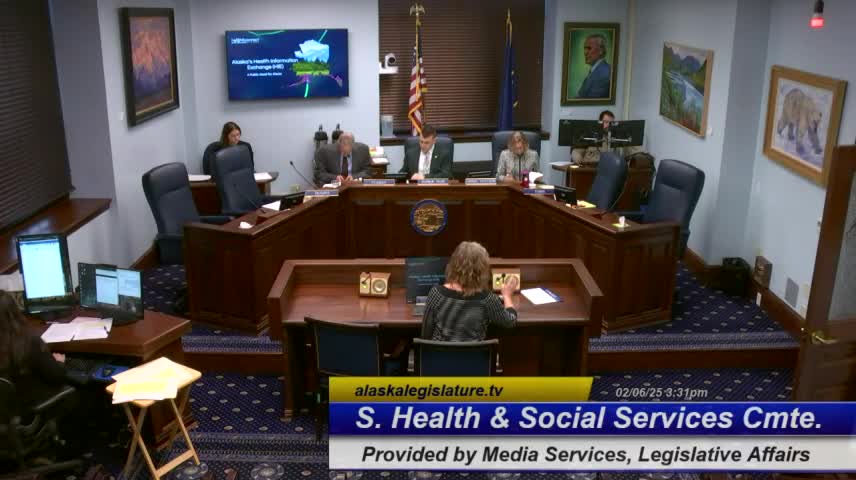
"We are simply a data repository for protected health information that is protected by HIPAA standards," Sticker said during the committee's Feb. 6 hearing in Butrovich Room 205 in Juneau.
Sticker said the nonprofit HIE, created by legislation in February 2009 and governed by a board whose composition is set in statute, accepts direct feeds from electronic medical records and makes medication lists, lab results, encounter histories and care summaries available to participating providers. In an illustrated video shown to the committee, Healthy Connect described scenarios in which immediate access to records allowed clinicians to treat stroke, coordinate follow-up care and match patients to social services.
Why it matters: Committee members were told the HIE can reduce clinical costs and improve patient safety — for example, by helping emergency departments decide whether to give clot-busting drugs — and that it can be used proactively to address health-related social needs.
Key details and examples
- Scope and governance: Sticker said the HIE was formed by statute and is governed by a board that includes hospitals, primary-care providers, tribal health organizations, federal health programs, insurers and consumers.
- How it works: Data flows from providers' electronic medical records into a secure repository and can be accessed through a portal or integrated into an EMR. Sticker said the HIE follows HIPAA privacy and security standards.
- Illustrative cases: The HIE's video described four fictionalized patient stories used to show value: an emergency stroke response in a rural village, faster access to hospital discharge summaries in a clinic, outreach to a patient with housing or food insecurity, and coordinated follow-up after repeated emergency visits.
- Use for social needs: Sticker described a pilot with Mat-Su Health Services that used hospital "Z codes" for social-determinants-of-health screening to identify patients for proactive outreach by a clinic outreach worker.
- Participation and cost: Sticker said some organizations still face technical barriers connecting EMRs to the HIE; however, "at this point there is no cost to [providers] for connecting to us," though an individual practice's EMR vendor may charge. She said Healthy Connect's funding is about 90% from a contract with the Department of Health and that the department has committed funding through fiscal year 2026.
- Sustainability concerns: Sticker and committee members noted the Department of Health funding relies in part on federal Medicaid match dollars; the HIE and the committee discussed the need to consider long-term state support if federal funds change.
Committee exchange
Senator Clayman asked whether smaller physician practices should ask providers whether they are on the HIE and what prevents practices from joining. Sticker said technical limitations in some smaller EMRs are a common barrier but that Healthy Connect has been reengaging providers and working through onboarding.
Senator Giesel and others asked about costs; Sticker reiterated the HIE does not charge providers at present and credited the Department of Health contract with increasing participation.
Ending
Committee members thanked Sticker for the presentation and noted that while the HIE appears to be expanding use, its primary contract funding is committed only through FY2026, an item the committee said it will watch in future budget and policy work.