Get Full Government Meeting Transcripts, Videos, & Alerts Forever!
Get email alerts on the Finance topic
No spam. Unsubscribe anytime.
Senate Finance review finds mixed compliance with FY25 legislative intent; Medicaid and corrections projections flagged
Summary
Legislative Finance reported mixed agency compliance with FY25 legislative intent language, highlighting completed work by the Alaska Gasline Development Corporation, significant Medicaid federal-authority shortfalls, incomplete fire-suppression forecasting, and limits in Department of Corrections projection work.
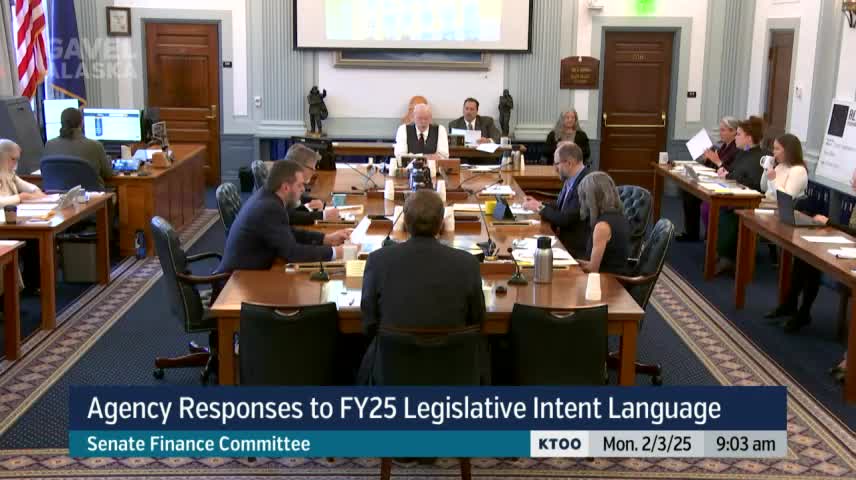
Senator Daniel Stedman called the Senate Finance Committee to order at 9 a.m. Monday and asked Legislative Finance analyst Alexi Painter to present the Legislative Finance Division’s FY25 legislative intent memo and agency responses.
Painter told the committee the memo reviewed 55 intent items (50 from FY25 and five carried forward) and found 33 compliant items, six items noncompliant because underlying appropriations were vetoed, four items with compliance pending because of reporting timing, and eight items judged noncompliant. "The qualifying language must be the minimum necessary to explain the legislature's intent regarding how the money appropriated is to be spent," Painter said, quoting the Alaska Supreme Court’s limits on enforceable intent language in Alaska Legislative Counsel v. Knowles.
Why it matters: legislative intent language provides guidance to agencies but does not carry the force of law; agencies can decline or be unable to comply if the underlying appropriation is vetoed, if reporting deadlines fall after fiscal-year close, or for operational reasons. The committee used Painter’s presentation to highlight areas where the administration delivered the requested products and where further follow-up is needed.
Major findings and agency-specific highlights
Alaska Gasline Development Corporation: The committee flagged intent item 5, which directed the Alaska Gasline Development Corporation to obtain an independent third-party review and present it to the legislature. AGDC contracted with Wood Mackenzie, submitted a report in November, and presented to the House Resources Committee later that month. Painter marked this item compliant because the corporation procured the requested third-party review and shared the results with the legislature.
Medicaid projections and federal-authority shortfall: Painter summarized a multi-year effort to improve Medicaid spending projections. The division received a December 15 projection that was not incorporated into the governor’s initial budget because of timing; an updated projection is expected with the governor’s amended budget. Painter said the projection work has shown that the FY25 federal-authority increase the legislature added last year (nearly $300 million in additional federal authority across budget sections) still leaves Medicaid about $230 million short in FY25 and roughly $250 million short in FY26 of expected federal receipts given recent tribal health (IHS) rate increases. Painter said those IHS rate increases are set federally and are sometimes issued retroactively or with unpredictable timing, which complicates state budgeting and has driven the legislature to request open-ended federal receipt authority for Medicaid.
Fire-suppression projections: The committee received an updated fire‑suppression projection on Jan. 19. That version documented year-to-date spending and showed unrestricted general fund spending had already exceeded budget authority, indicating a supplemental request will be necessary. Painter noted the January projection did not include estimates for the remainder of the fire season (unlike last year’s fuller projection), and turnover at the Department of Natural Resources may have hindered completion of a more comprehensive forecast.
Criminal-case backlog: Identical intent language placed in three appropriations (Department of Administration legal and advocacy services, Department of Law criminal division, and the judiciary trial courts) instructed relevant entities to take reasonable actions to reduce the criminal-case backlog. The public defender agency, the judiciary and Department of Law reported differing levels of detail: the public defender agency described training, mentoring and recruitment initiatives; the judiciary described court-management steps such as trailing calendars and limits on continuances; the Department of Law said it has ongoing efforts but provided fewer specifics. Painter marked the two agencies that provided explicit initiatives as compliant in part and noted differing levels of detail among respondents.
Department of Corrections: Items 9–16 asked DOC to develop projection models, examine cost savings from closing or consolidating institutions, report monthly on overtime and premium pay, and expand alternatives to community residential centers (CRCs). Painter told senators DOC provided monthly overtime reporting and is piloting programs (furloughs tied to residential substance-use disorder treatment and transitional housing pilots), and is renegotiating CRC contracts. However, DOC’s projection approach did not align with the Legislature’s model goal (starting from actuals and adjusting for known factors to reduce projection error); instead DOC produced a management-plan-based model that largely reflected its post‑veto budget and known adjustments. Painter also said DOC did not provide detailed fiscal analysis supporting its assertion that closing institutions would not yield significant savings. Painter noted payroll-processing delays sometimes cause overtime earned in prior years to post later, complicating quarterly or monthly reconciliation.
Salary study and workforce pay: The FY24 capital appropriation included $1 million UGF to commission a statewide salary study of executive-branch job classes to compare pay to the private sector and municipalities and to align pay to the 60th percentile including benefits. Painter said the administration delayed delivering a final report (originally expected June 2024) to adjust comparisons for FY25 pay increases and expand comparison sets; the administration now expects to deliver the study in March 2025, and the committee awaits that report before deciding budget adjustments.
Maintenance and operations accounting: The legislature directed clearer accounting for maintenance and operations (M&O) of state buildings and vehicles in FY25 to conform with a statute enacted in the 1990s that requires separate tracking of such costs. Painter said the governor’s budget largely implemented the requested structure, created new accounting object codes as of Jan. 1, and included several incremental maintenance funding increases (aircraft, vessels). He cautioned some agencies used interagency receipts rather than direct general‑fund allocations for maintenance, which preserves tracking but may not protect maintenance funding the same way an explicit general‑fund allocation would.
Alaska Permanent Fund Corporation — Anchorage office: The FY25 budget renamed and split APFC appropriations to create a separate Anchorage-office allocation and included $100 for decommissioning the Anchorage office; the governor vetoed the decommissioning increment. Painter said APFC reported FY25 Anchorage and Juneau expenditures but did not close the Anchorage office and continues to incur Anchorage costs. Senator Bill Keel characterized APFC’s response as incomplete and urged the committee to scrutinize the corporation’s justifications when subcommittees review the budget.
Items outside agencies’ control: Painter noted several intent items that were contingent on governor or future-legislative funding decisions and therefore are noncompliant by default this year. These include funding plans for renovation/replacement of the Fairbanks Pioneer Home, replacement of the ORCA child-welfare IT system (previously estimated at $52 million, approximately 50% general fund and 50% federal), and state support for child advocacy centers where federal funding has lapsed.
Committee reaction and next steps: Senators used Painter’s memo as a basis to ask subcommittees to follow up with agencies on modeling improvements, maintenance accounting, corrections’ overtime and staffing, and APFC spending. Painter and the committee agreed to update the Legislative Finance 10-year agency-growth spreadsheet when FY25 supplemental requests arrive and to re-circulate corrected figures where needed. The committee scheduled a presentation by the Office of Management and Budget on the FY25 supplemental request for 9 a.m. Tuesday.
Ending: The committee adjourned at 10:55 a.m.; members said they would review the full intent packet and return questions to Legislative Finance for clarifications and any numeric corrections.