Get Full Government Meeting Transcripts, Videos, & Alerts Forever!
Get email alerts on the Education Funding topic
No spam. Unsubscribe anytime.
House Education Committee holds over bill to inflation‑proof Alaska school funding
Summary
The House Education Committee on Feb. 3 heard testimony and fiscal briefings on House Bill 69, which would increase and inflation‑proof the base student allocation (BSA). Lawmakers debated the policy and cost; the committee held the bill over for further work.
Juneau — The House Education Committee on Monday heard sponsor testimony, legal and fiscal analysis and public comment on House Bill 69, a proposal to raise Alaska’s base student allocation (BSA) and add an inflation‑adjustment mechanism intended to stabilize school funding.
Representative Rebecca Hemshutt, the bill’s sponsor, told the committee that HB 69 is “responding to what I think is a clear crisis in education funding across the state.” The bill would increase the BSA from the current figure cited in the hearing ($5,960) and apply an annual inflation adjustment based on an average of recent consumer‑price measures; the proposal also adds a $1,000 one‑time increase to the BSA in its early years and phases further indexed increases in subsequent years.
Committee discussion focused on the policy tradeoffs, fiscal cost and practical effects for districts. Legislative Finance Division analyst Connor Bell described the bill’s mechanics and cost in testimony: the $1,000 add‑on would not be inflation‑proofed in FY 26 but the full BSA after that increase would be inflation‑proofed in FY 27, and the fiscal note projects end‑of‑FY‑28 BSA near $8,500 (up from $5,960). Bell estimated first‑three‑year costs of roughly $326 million in FY 26, $501 million in FY 27 and $646 million in FY 28 — about $1.4 billion cumulatively across those three years.
Legal counsel from Legislative Legal Services, Marie Marks, told the committee that the bill’s statutory indexing would not force the legislature to appropriate a specific dollar amount each year. “The legislature may appropriate whatever amount of money it wishes to appropriate for education funding each year,” Marks said, and added that formulas in statute are subject to annual appropriation decisions.
Members pressed the sponsor and department staff on several practical concerns: whether inflation‑proofing would make the state budget less predictable, whether the indexed increases would be affordable given current revenue projections, and how the measure would affect districts with declining enrollment. Hemshutt said the intent is to shift inflation risk from districts to the state, giving districts “predictability and stability” and helping them avoid layoffs and program cuts.
Witnesses and committee members also discussed the interaction of HB 69 with other initiatives. Witnesses noted the end of flexible ESSER (federal pandemic) funds and the Alaska Reads Act (referred to during the hearing) as reasons districts are now facing fiscal pressures while still implementing literacy and other programs. Several members stressed the need for targeted interventions — for example, sustained reading specialists and tutoring for early grades — in addition to any formula change.
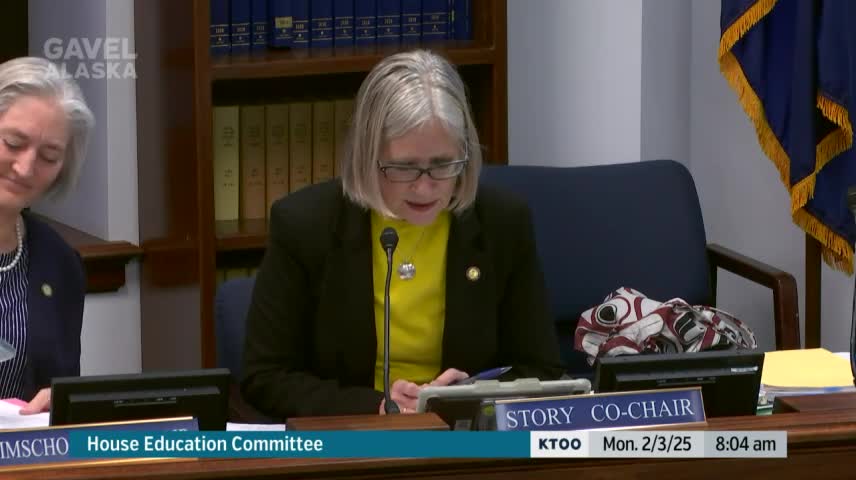
After roughly two hours of presentation and questions, Chair Representative Matt Story announced that House Bill 69 would be held over for further work; an amendment deadline was not set during the hearing. The committee chair also asked staff to make relevant studies and written testimony available on BASIS for members and the public.
The committee will continue education‑related hearings in coming days; HB 69 remains under consideration.