Get Full Government Meeting Transcripts, Videos, & Alerts Forever!
Get email alerts on the Land Use Pud topic
No spam. Unsubscribe anytime.
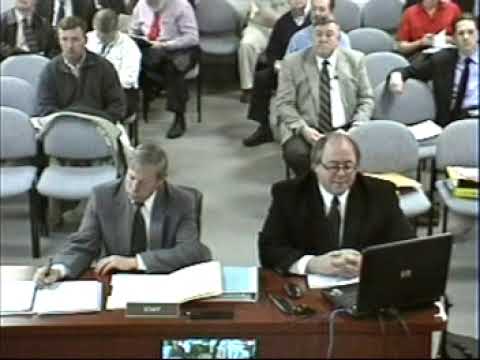
Planning Commission recommends denial of Saint Mary's Crossing PUD, citing traffic and environmental concerns
Summary
The St. Mary's County Planning Commission voted to recommend denial of the Saint Mary's Crossing planned unit development (PUD) to the Board of County Commissioners, citing unresolved traffic mitigation, road‑frontage and environmental concerns including proximity to the St. Mary’s River.
The St. Mary's County Planning Commission voted to recommend denial of the Saint Mary's Crossing planned unit development (PUD) after a prolonged public hearing and technical review that highlighted traffic safety, road‑frontage and environmental concerns.
The recommendation, made March 24, 2008, concerns PUD application ZPUD-06-14500004 from Saint Mary's Crossing LLC for a large mixed‑use residential project on property described in staff materials (the application materials identify multiple plan versions; staff recitation referenced up to 868 dwelling units). Planning Commission member Mary Guazzo moved to deny; the motion, seconded by Commissioner McNeil, passed with five in favor and one abstention (Commissioner Evans). The commission authorized the chair to sign a resolution transmitting the recommendation to the Board of County Commissioners.
The commission’s action followed a multi‑session review by county staff and technical agencies and a lengthy public record. Department of Land Use and Growth Management planner Bob Boles read a staff report that compiled 22 conditions intended to address transportation, utilities, phasing, school site donation and environmental controls. The conditions included requirements that the applicant construct a second access built to public standards and ultimately dedicated to the county, obtain MDE and U.S. Army Corps of Engineers permits before grading permits for later phases, extend water and sewer to the school site, and provide a minimum 26‑acre school site to the Board of Education.
A central point of contention was traffic where the development would connect to Maryland Route 4 (Saint Andrews Church Road). State Highway Administration (SHA) staff told the Planning Commission that the projected traffic would require significant mitigation at the Hunt Club Road/Maryland 4 intersection. SHA traffic engineer Mike Niederhauser said that, based on the materials reviewed, a two‑lane roundabout would be required by the time the first phase was open: "With phase 1 of development, it would absolutely need to be opened as a 2 lane roundabout," he said. SHA’s letter and verbal comments also asked for expanded traffic study limits (including intersections at MD‑4 with MD‑5 and MD‑235) and updated traffic counts.
Commissioners raised two interrelated concerns: (1) whether road frontage and a disputed private right‑of‑way could be upgraded and dedicated in a way that legally and practically insulated the county from future maintenance and liability, and (2) whether the county and SHA had adequate assurances that intersection mitigation (signalization or a roundabout) would be in place early enough to protect existing traffic operations. County counsel and staff repeatedly asked for either a deed and dedication of the secondary access or a binding road‑maintenance agreement among affected property owners.
Commissioner Guazzo grounded her denial motion in public‑health, safety and welfare findings required for approval under Chapter 44 of the zoning ordinance. In remarks recorded in the hearing she said a large number of added dwelling units and associated impervious area pressed between the main branch of the St. Mary’s River and a tributary would not "maximize the conservation and efficient use of open space and natural resources," a PUD purpose clause she cited. Guazzo also flagged concerns that the phasing plan proposed adding several hundred units in the first two years, which she said would exacerbate failing traffic conditions.
Developer representatives and the project owner, Steve Kacirzyk, urged the commission to forward the application to the county commissioners even if not all points were resolved. Kacirzyk said the project would provide workforce housing, a school site and net county revenue, and asked the commission to finalize comments so the Board could act. County staff noted that the donation of a school site would reduce, but not eliminate, requirements for transfer‑of‑development‑rights (TDR) credits and mitigation fees; staff’s rough arithmetic in the hearing placed combined per‑unit mitigation and impact costs (TDR equivalent plus traffic mitigation and impact fees) in the low‑to‑mid five‑figure range per unit at the building‑permit stage.
Following the vote the commission’s recommendation and the SHA letter will be part of the administrative record transmitted to the Board of County Commissioners. The Board will consider the Planning Commission’s recommendation and all evidence in a separate decision process.
If the Board receives the Planning Commission’s recommendation, it may accept, modify or reject that recommendation and impose its own conditions or requirements.
Votes and next steps: The Planning Commission vote was a formal recommendation only; final approval or denial of rezoning and PUD plan lies with the Board of County Commissioners.