Get Full Government Meeting Transcripts, Videos, & Alerts Forever!
Get email alerts on the Policy Education topic
No spam. Unsubscribe anytime.
Board hears first readings of revised violence-prevention and service-animal policies; middle-level course update presented
Summary
The board received first readings on revised policies for violence prevention and service animals (MSBA-guided edits) and heard a report on middle-level (grades 6–8) course offerings, including new AI literacy and an expanded allied rotation sequence.
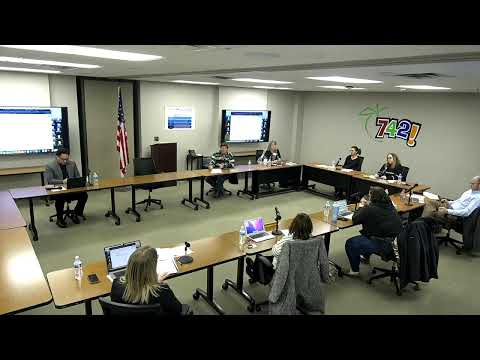
The St. Cloud Public School District board on Feb. 5 listened to first readings of two revised policies and received an update on middle-level course offerings for grades 6–8.
Assistant Superintendent Shannon Avinson summarized proposed revisions to policy 05/25 (violence prevention) and policy 05/35 (service animals in schools), saying the updates follow Minnesota School Boards Association (MSBA) guidance. Revisions to the violence-prevention policy emphasize moving from developing to implementing curricula and training, expand recommended training to include school-board members and staff on recognizing abuse and violence, and propose creating a curriculum committee to ensure consistent instruction districtwide. Avinson said MSBA guidance recommends teaching critical viewing and listening skills and analyzing mass media as part of prevention instruction.
On the service-animals policy, Avinson said the draft narrows some location language to school property and aligns definitions with MSBA and federal guidance. The draft clarifies the legal distinction for service animals (typically dogs and miniature horses trained to perform tasks for a person with a disability), removes an annual flea-and-tick-treatment requirement for animals, and recommends that care-and-supervision disputes be handled by the superintendent or designee rather than solely by a building administrator. The draft also preserves the district's obligation not to charge a person with a disability for the presence of a service animal and notes required vaccination documentation. Board members asked about allergies, facility dogs versus service dogs, and where therapy/volunteer dogs fit; staff said therapy teams are handled through separate contracts and liability arrangements and could be examined further if the board desires.
Separately, Assistant Superintendent Jason Harris and Director Hilary Johnson presented an overview of middle-level course offerings. Officials described a teaming model in which students keep the same advisory, math, language-arts and science teachers to ease transitions. Highlights:
- Sixth grade: transition year with allied rotations that include robotics, art, physical education and LifeSmarts 1 (social-emotional and introduction to health and careers). Students choose one of band, choir, orchestra or C4 (college, career, community, citizenship).
- Seventh grade: continuation of the teaming model with allied rotations (PE, health, art, and a new Energy and Machines course that introduces machines, tools and problem solving). Honors options become available in core subjects; an introduction to AI literacy is planned for next year.
- Eighth grade: students can take honors in core subjects and have the broadest elective choices, including LifeSmarts 2 (personal finance, business and entrepreneurship) and Tech Ed, where students build a shed or play structure that can be sold to support the course.
Administrators said registration for incoming sixth-graders begins in late January with master schedules finalized in April–May; counselors visit elementary schools to assist students and families with selections. Board members asked whether AI literacy should be integrated across content areas; administrators said the district is piloting a stand-alone unit, partnering with the Center for Curriculum Redesign, and intends to scale curriculum and teacher supports over time.
Both revised policies were presented for a first reading and will return for further consideration in a future meeting; no policy adoptions were voted on Feb. 5.