Get Full Government Meeting Transcripts, Videos, & Alerts Forever!
Get email alerts on the Neurology Hospital topic
No spam. Unsubscribe anytime.
USC presents $350 million plan for specialized neurological hospital and rehab center
Summary
University of South Carolina officials asked the Healthcare Subcommittee to support a proposal for a stand‑alone neurological hospital and rehabilitation center in the state, requesting one‑time capital and recurring operating funds and describing timeline, services and projected statewide impact.
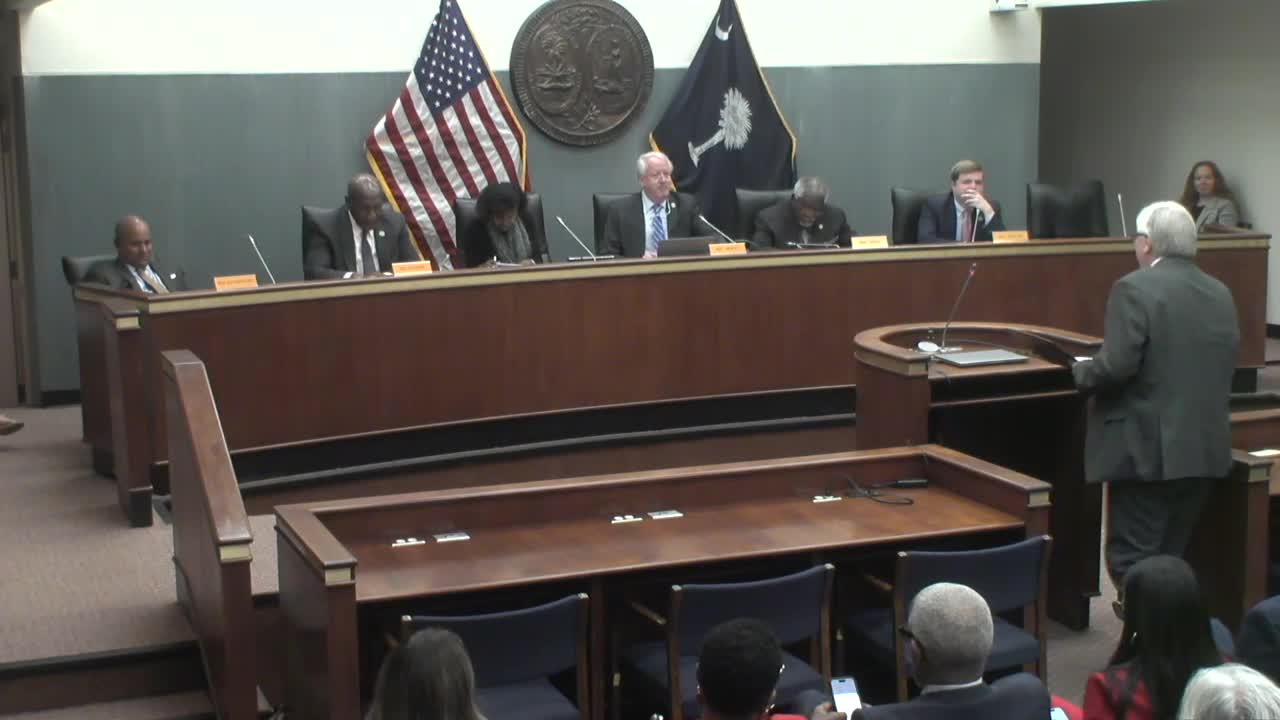
University of South Carolina officials told the Healthcare Subcommittee that they are seeking state support to build a $350 million neurological surgery and rehabilitation center in central South Carolina.
The facility would be a standalone academic hospital and an attached rehabilitation center focused exclusively on brain health, officials said. President Amiritis, the university presenter, said USC has secured $10 million for initial project design and is requesting $150 million in one‑time state capital funding and $30 million in recurring state funds for operations and capital renewal.
The request matters, officials told the subcommittee, because South Carolina ranks near the bottom nationwide on death rates from brain trauma and stroke, and the state lacks a specialized tertiary neurology referral center. “We cannot accept that South Carolina will continue to be in the bottom 5 and 10 states in the country when it comes to death rates from brain trauma and stroke,” President Amiritis said, citing CDC data and national Alzheimer’s Association rankings.
USC described the proposed center as combining advanced neurosurgery (including robotic techniques), complex neurology care and on‑site world‑class rehabilitation under one roof. Project proponents said the facility would house cutting‑edge diagnostic equipment, including funding already secured for a 7‑Tesla MRI unit — equipment they said is not currently available in South Carolina and exists at only a few sites in the Southeast.
The university framed five primary state benefits: addressing needs tied to an aging population, expanding access to highly specialized care, improving patient outcomes, attracting and retaining specialist clinicians and researchers, and generating economic growth through jobs and biomedical innovation. President Amiritis said the state’s population aged 65 and older is growing about 2.8% annually and that roughly 70% of South Carolina’s residents aged 65+ live within a two‑hour drive of Columbia, making the proposed site centrally located for much of the state.
USC officials described workflow expectations: patients requiring complex surgery would receive critical care and then transfer directly to the attached rehabilitation facility, reducing barriers to immediate post‑acute care. The rehabilitation model would be informed by the Shirley Ryan AbilityLab in Chicago, a leading U.S. facility that USC said it studied.
Asked about schedule, USC said design work is underway; if the General Assembly and governor include and approve the requested funding, construction could begin quickly and the facility could open in late 2027 or early 2028, the university estimated.
Funding details the subcommittee heard: total project cost $350,000,000; $10,000,000 already secured for design (from Health and Human Services as design funding was referenced later in the hearing); requested $150,000,000 one‑time state capital; requested $30,000,000 recurring for operations and capital renewal, with the expectation, USC said, that the hospital would become financially viable after two to three years of operation.
USC also emphasized workforce and research benefits: proponents said specialty clinics already reduced neurologic clinic wait times in areas served by USC’s brain health network from as long as nine months to about four weeks in some locations, and they argued a specialized center would support training of residents and attract nationally recognized neurosurgeons, neurologists and clinical trial activity to the state.
President Amiritis closed by noting Governor McMaster had listed the project as a priority in the executive budget and called it a “once in a generation opportunity,” and asked for the committee’s support.
Ending: Committee members offered largely supportive remarks and asked follow‑up questions about timeline, collaboration with other state universities, and funding sources. No formal vote on funding occurred in the hearing; USC’s request was presented for the subcommittee’s consideration during the budget process.