Get Full Government Meeting Transcripts, Videos, & Alerts Forever!
Get email alerts on the Social Services Budget topic
No spam. Unsubscribe anytime.
Department of Social Services seeks $114.6 million to expand child welfare, modernize benefits system
Summary
Acting DSS director Tony Catone told the Healthcare Subcommittee the agency requests $114.6 million overall to expand child-welfare supports, child care scholarships, prevention services and to modernize the SNAP/TANF mainframe, citing recent improvements in hiring, SNAP timeliness and compliance with federal adult-protective-services rules.
The Department of Social Services asked the Healthcare Subcommittee for recurring and nonrecurring funds to expand child-welfare services, boost child-care scholarships and modernize its benefits computer system.
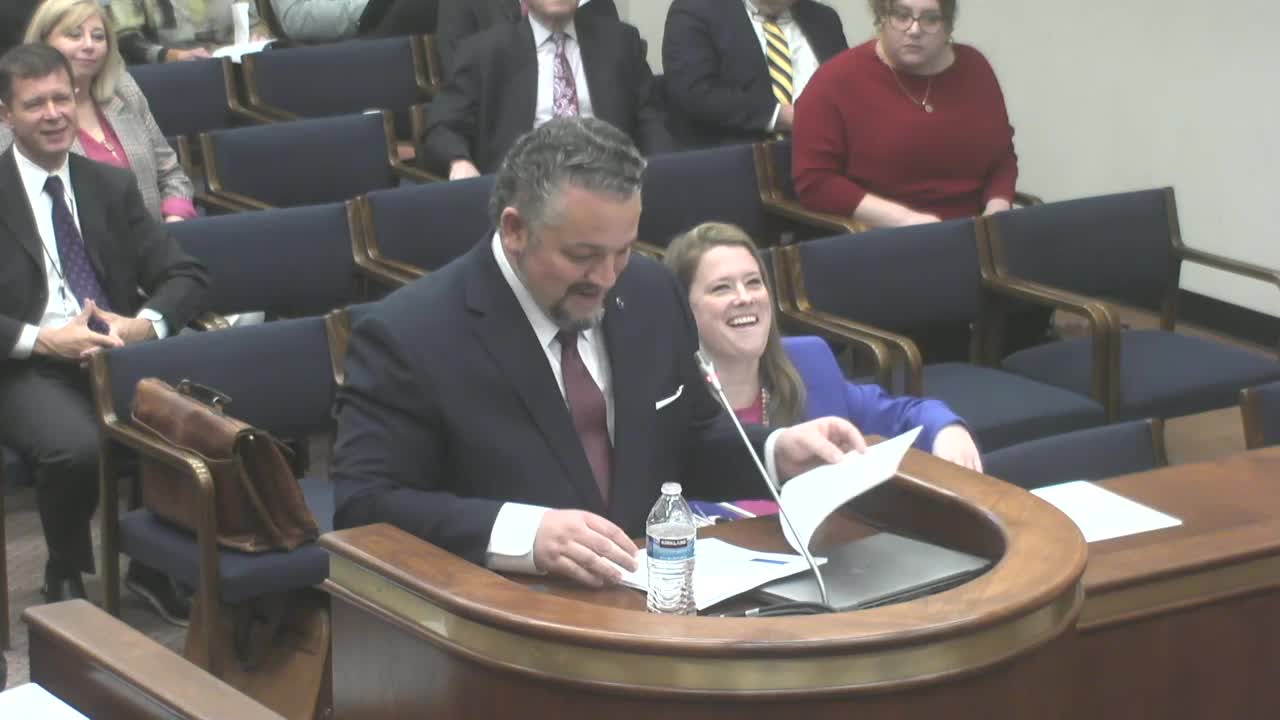
Tony Catone, acting state director for the Department of Social Services, said the agency’s “mission is clear. We fight against hunger, poverty, abuse and neglect,” and outlined a budget request he described as $114,600,000 in total, including $68,100,000 in recurring state general funds and $18,600,000 in nonrecurring state general funds.
Catone said the agency has posted measurable improvements that inform the request. “Our child support portal has surpassed 5,000,000 total visits,” he told the committee, and DSS has exited parts of the Michelle H. consent decree after meeting measures on out-of-home abuse-and-neglect investigations and placements. Catone also cited a fall in foster-care population from a high of 4,716 in April 2010 to 3,252 in January 2025 and an increase in SNAP application timeliness to “a little over 89%” from 81% in January 2024.
Why it matters: Catone said the money would support five “essential areas” in FY26: child and family services (including foster- and kinship-care rate increases and prevention-program expansion), domestic-violence shelter support and emergency adult stabilization placements, early care and education (child-care scholarships and tri-share pilots), IT and security for agency systems, and nonrecurring funding to modernize the agency’s 36-year-old economic services system (called eSam).
Planned child-welfare investments include a monthly maintenance payment for kinship caregivers for about 460 children already in kinship care, rate increases for child-placing agencies, and funds to implement workload requirements from the Michelle H. settlement agreement. Catone said the governor’s executive budget included $25,000,000 in recurring funds for the child-welfare salary plan.
On child care, Catone said the agency requests $3,100,000 in recurring state funds to draw down $10,600,000 in federal CCDF dollars so more low- and moderate-income families can receive scholarships. He said the requested state money would allow DSS to provide child-care scholarships to an estimated 250 children per year in programs participating in the voluntary ABC quality program, and asked for $1,000,000 for a tri-share pilot in which employers, employees and the State each pay one-third of childcare costs.
On technology, Catone described eSam as a 36-year-old mainframe serving more than 300,000 households and 630,000 individuals and processing nearly $1,500,000,000 in annual benefit payments. He requested $18,600,000 in nonrecurring state matching funds this year for a multiyear modernization project that the agency expects to continue to FY27 and said the federal government would cover about half the project cost.
Committee interchange: Representative Newton asked whether the federal authorizations cited were always matched by state funds. Susan Roben, DSS chief financial officer, replied, “For the majority of our requests, yes. . . . For most of it, the majority of our funds, we are required to, match with state dollars.” Representative Clyburn asked whether ARPA restrictions or recent federal memos might affect funding; Catone and staff said most ARPA funds have been spent and that, based on current guidance, they did not see an immediate risk to the federal funding streams supporting DSS programs.
Background and next steps: Catone framed many requests as investments to reduce long-term social costs—citing research and federal incentives such as the Family First Prevention Services Act and new federal rules for adult protective services—and said the agency will ask for additional state matching funds in future phases of the eSam modernization. DSS said it was already compliant with 94% of new federal adult protective services regulations as of Oct. 9, 2024 and averaged about 109 new hires per month over the prior 12 months, with an agency vacancy rate near 11%.
The committee took the presentation and asked questions; no formal vote was recorded at this hearing.