Get Full Government Meeting Transcripts, Videos, & Alerts Forever!
Get email alerts on the Budget topic
No spam. Unsubscribe anytime.
House passes revised biennial budget, HB 1600, after votes on committee and floor amendments
Summary
The Virginia House of Delegates adopted House Bill 1600, the revised biennial budget for fiscal years ending June 30, 2025 and June 30, 2026, after voting through committee amendments, rejecting several floor amendments and dispensing with the third reading. Final passage was 79–18.
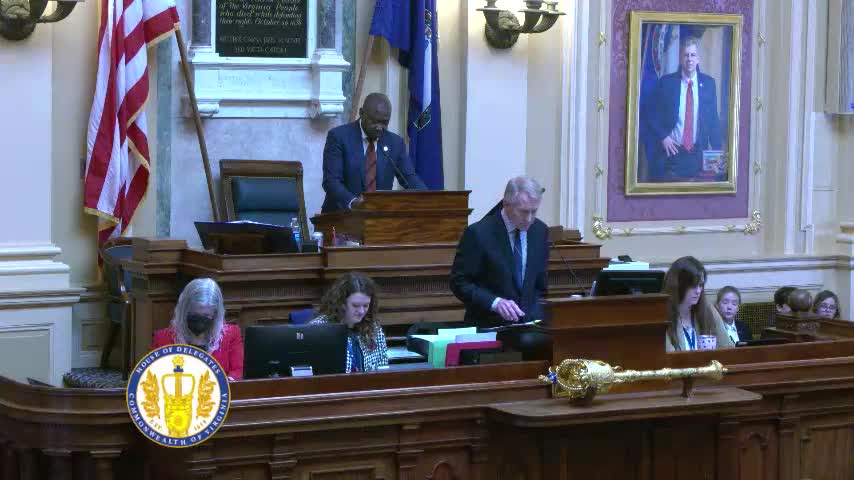
The Virginia House of Delegates on Feb. 6, 2025, passed House Bill 1600, the biennial budget amendment package for fiscal years ending June 30, 2025 and June 30, 2026, after a full day of committee-amendment votes and debate.
Delegate John Torrey, the lead mover speaking to the bill, said the package used surplus revenue to provide tax relief, expand education funding and address housing and childcare shortages. “At its core, our job, our one job as legislators, is to do what we can to improve the lives of Virginia’s citizens,” Torrey said while describing the amendment package.
The amendments described by Torrey include a $1.1 billion package of tax relief measures (a $200 individual and $400 joint filer rebate to be issued by Oct. 15, 2025, an increase in the standard deduction to $8,750 for individuals and $17,500 for joint filers, and an increase in the refundable portion of the earned income tax credit to 20 percent of the federal credit), $774 million in additional state support for K–12 public education including a $1,000 teacher bonus with no required local match, funding intended to eliminate the child-care subsidy waiting list, targeted housing investments, and additional higher-education supports. Torrey also said the budget expands waiver slots for developmental disability services that had been included in prior work.
The clerk read a long list of committee-amendment objections (59 items) that required separate consideration; the House agreed en bloc to the committee amendments that had no objections (vote: 97–0) and then proceeded through the contested items individually. Multiple committee amendments were agreed to on recorded votes ranging from narrow margins (for some items 50–47 or 51–46) to unanimous 97–0 approvals recorded in the transcript.
Debate on specific contested amendments highlighted several recurring policy flashpoints:
- Tax relief and fiscal prudence: supporters said the package balanced immediate relief with long-term fiscal caution; opponents argued some elements would shortchange lower-income Virginians or redirect priorities.
- Education and targeted grants: speakers clashed over specific line items that allocated or redirected funds for school construction, lab schools, and locality-targeted aid. For example, a proposed move to cut $25 million for lab-school expansion prompted arguments that the targeted funds either had not been requested by named universities or should be returned to localities for broader uses.
- Locality-specific line items: several members pressed for or objected to small locality allocations (for example, $25,000 items for Fredericksburg and for local agricultural partnerships) and questioned the fairness of directing one-time funds to certain jurisdictions rather than a statewide formula.
- Mental-health/crisis-response funding: members debated changes to the governor’s proposed funding for programs aimed at reducing law-enforcement time spent guarding people in hospitals and for alternative transport and custody options. Supporters of the cuts said they wanted a phased, conservative expansion; opponents warned the cuts would keep officers tied up in hospitals.
The House rejected two offered floor amendments and otherwise declined to adopt changes the sponsors sought. A floor amendment offered by Delegate Milday (stafford-related coca adjustment; floor amendment item 125 number 1H) failed on final recorded division (final tally recorded in the transcript: 48–49 against the amendment). A second floor amendment offered by Delegate Gilbert (item 476 number 1H) was laid aside after a successful motion to “pass by” (the House agreed to pass by the amendment, recorded vote 50–47), which removed it from further consideration on the floor.
Procedural votes: the House voted to dispense with the third constitutional reading of HB 1600 (vote to dispense: 96–1), then voted on final passage of the bill. Final passage of House Bill 1600 was recorded as 79 yeas to 18 nays; the clerk announced “The budget passes.”
Votes at a glance
- Committee amendments en bloc (non-objected items): agreed to en bloc (97–0). - Contested committee amendments: multiple individual roll calls; several passed by narrow margins (examples recorded in the transcript include 51–46, 50–47, 48–47, and other tallies shown in the official roll calls). - Floor amendment — item 125, number 1H (offered by Delegate Milday): failed (recorded final tally in the transcript: 48 yea, 49 nay; amendment not adopted). - Floor amendment — item 476, number 1H (offered by Delegate Gilbert): motion to pass by (remove from consideration) agreed (50–47); amendment not adopted. - Motion to dispense with third reading (HB 1600): agreed (96–1). - Final passage of House Bill 1600: passed (79–18).
What the House decided to do next
The House concluded the special and continuing order on HB 1600 and returned to the regular order of business. Calendar and committee announcements followed; the chamber adjourned to reconvene the next day.
Sources and attribution
Unless otherwise specified, quotations and positions are taken from floor remarks recorded in the House session transcript for Feb. 6, 2025. Direct quotes in this article are attributed to Delegate John Torrey, who spoke on the bill during the appropriations presentation.