Senate passes budget with $200/$400 tax rebate, teacher bonuses and disaster funding
Loading...
Summary
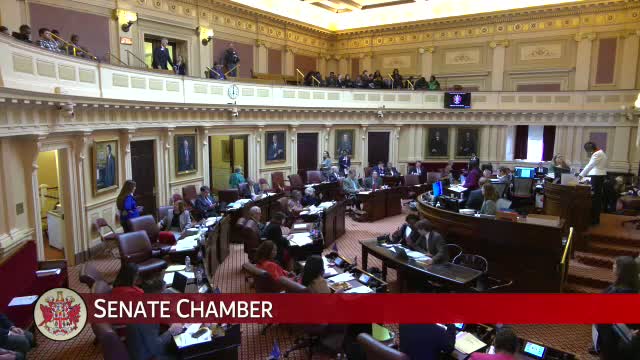
The Virginia Senate approved Senate Bill 800 on Feb. 6, 2025, adopting a budget package that includes a working-virginians tax rebate, one-time bonuses for educators and state employees, and new spending for disaster mitigation, housing and higher education supports.
The Virginia Senate voted to approve Senate Bill 800, the biennial budget bill, after a day of committee explanation and floor debate that included amendments on tax relief, education funding and limits on executive actions.
Senator Lucas, the senator from Portsmouth and chair of the Senate Finance and Appropriations Committee, described the measure on the floor as “a wonderful and structurally balanced budget that supports a strong Virginia.” The bill passed on final passage by a vote of 38-2.
Why it matters: the budget package packages nearly $1 billion in targeted tax relief and one-time spending intended to address inflationary pressures for working families while funding ongoing needs in education, health care and disaster resilience. It also contains policy language on taxation, data-center exemptions and other enactments that affect state priorities for the next two years.
Key provisions and totals explained on the floor included a working-virginians tax rebate of $200 for single filers and $400 for joint filers (estimated cost about $978,000,000) to be delivered as early as Oct. 15 for most filers. The budget extends recent increases to the state standard deduction for two years and adds an extra $250 for single filers and $500 for joint filers for that period. It also raises the refundable portion of the state Earned Income Tax Credit from 15% to 20% of the federal credit and raises the estimated-payment liability threshold from $150 to $1,000.
On education, the bill includes roughly $134.4 million for a $1,000 bonus for teachers and school support staff (one-time, no local match), roughly $53 million for special-education add-ons in K–12, $50.5 million over the biennium to help higher-education operational costs and $20 million for historically Black college and university partnerships. The budget also funds a $13 million math initiative and supports a statewide learning-management system.
Health and human resources accounted for large mandatory forecast-driven increases; the presentation noted roughly $632.2 million in forecast-driven Medicaid spending. Other HHR items include $25 million for drinking-water grants, $10 million for increased nursing-home rates, about $7.8 million for crisis co-response programs and $15 million in year two for need‑based undergraduate financial aid.
The package also includes new one-time capital and resilience funding: $50 million in year one for disaster mitigation in qualified communities and $50 million for community-scale flood protection and resiliency; $25 million for an employer cost-share pilot to expand early-childhood slots; and $15 million for a rental‑assistance pilot to encourage housing stability.
Floor debate produced several contested amendments. Senator Sarravel moved to reject roughly $277,000 in general funds that would have funded additional attorney‑general staff for ratepayer advocacy; after debate the Senate approved the amendment to remove that appropriation. In opposing the cut, Senator Soudelai said the attorney general’s office “stands up for the ratepayers,” adding that rate cases require legal resources; Senator Sarravel argued those resources could be reprioritized within the attorney general’s office or through the Commission on Utility Regulation.
A separate amendment removed language in the introduced budget that would have allowed the governor to withhold certain funds from local law-enforcement entities that did not comply with federal immigration notification requests (ICE). The amendment to strike the governor’s withholding authority was offered by Senator Eban, described on the floor as removing “the governor’s proposal to withhold funding from local sheriffs and local police if they don't comply with federal directives from ICE,” and it passed on a recorded vote, 21-19.
Lawmakers also approved language to allow the presiding officers of the two chambers (the president pro tempore of the Senate and the speaker of the House) to intervene in litigation to defend the constitutionality or application of Virginia law if the governor and attorney general do not defend the statute; that amendment was adopted on the floor. Senator Sarravel framed the change as a backstop to ensure the legislature could defend laws it enacted if the executive declined to do so.
Senators repeatedly praised Senate Finance staff for briefing members and preparing amendment language. “They have been very accessible to all of our members,” said Senator McDougall, who thanked staff for responding to member questions. Chair Lucas emphasized the committee’s effort to return one-time funds to taxpayers and to prioritize one-time uses to avoid growing ongoing obligations.
What’s next: the bill passed the Senate and, following standard budget reconciliation processes, will be returned to conference with the House and negotiated with the governor’s office where differences remain. Several provisions in the Senate package explicitly extend or pause provisions tied to pending federal action, including temporary extensions tied to the federal Tax Cuts and Jobs Act expirations.
Votes at a glance
- Senate Bill 800 (biennial budget): Motion to pass (moved by Senator Lucas). Tally: Yeas 38, Nays 2. Outcome: approved.
- Amendment (Item 51, #1 S) — remove ~$277,000 GF for additional Attorney General ratepayer advocacy staff (moved by Senator Sarravel). Outcome: agreed to (voice vote; recorded as adopted on the floor). Note: opponents warned the cut reduces legal capacity for utility rate cases; proponents cited internal reprioritization and recent settlement costs.
- Committee amendment (Item 377, #1 S) — remove governor’s authority to withhold certain local law-enforcement funds related to ICE notifications (moved by Senator Eban). Tally: Yeas 21, Nays 19. Outcome: agreed to.
- Amendment (Item 4‑14, #5 S) — authorize the speaker of the House and president pro tem of the Senate to intervene in litigation defending Virginia law if the governor/attorney general decline (moved by Senator Sarravel). Outcome: agreed to (adopted on the floor).
Reporting details and context in the session record: the Senate Finance chair delivered a slide presentation summarizing revenue adjustments, tax-relief language and major spending items, including capital outlay totaling about $1.3 billion in general‑fund cash for capital projects (no additional tax-supported debt in the summary). The floor debate included multiple members voicing support for tax rebates and one-time relief, and others warning about long-term affordability and the need to protect local public safety funding and the legislature’s ability to defend enacted laws.
The Senate recorded several abstentions under Rule 36 on specific line items; those abstentions were entered before the final passage vote on the bill as a whole.