Get Full Government Meeting Transcripts, Videos, & Alerts Forever!
Get email alerts on the Prison Budget topic
No spam. Unsubscribe anytime.
Department of Corrections seeks recurring funding for staffing, contraband-cellphone program and facility repairs
Summary
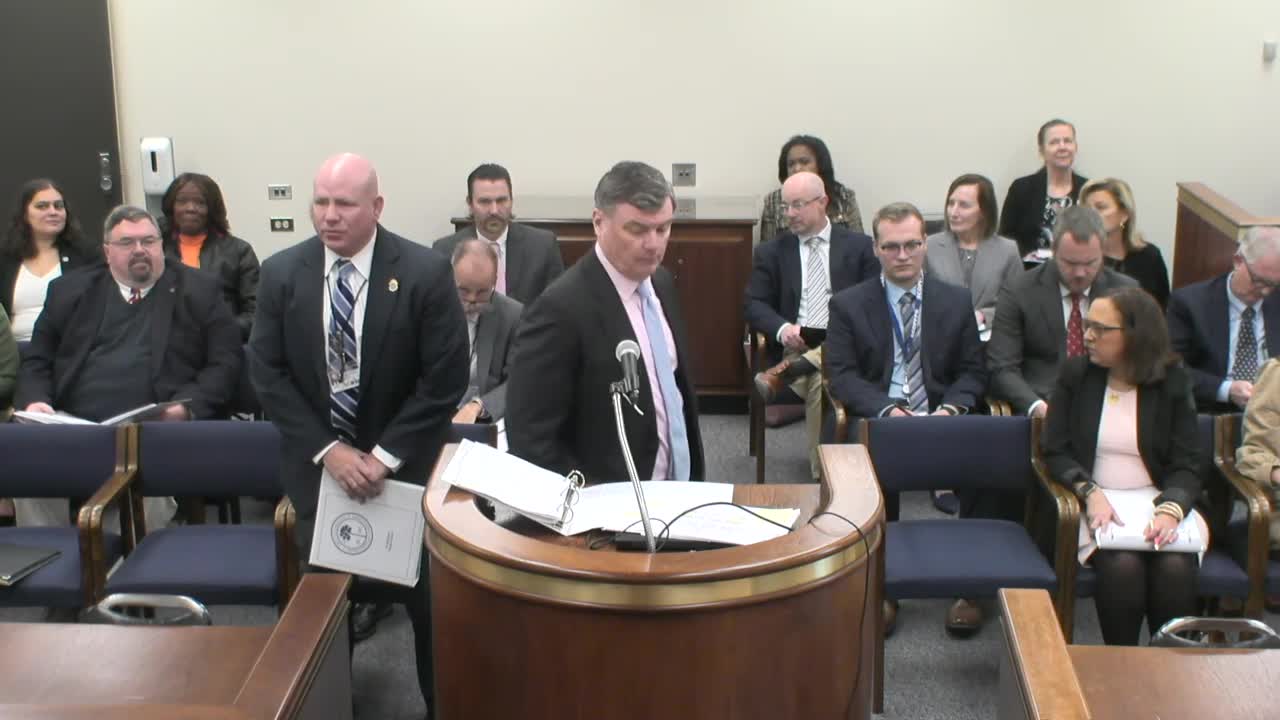
Brian Sterling, director of the Department of Corrections, told the Criminal Justice Budget Subcommittee the agency requests roughly $57.6 million in recurring increases and a slate of nonrecurring funds to cover step pay increases, workers’ compensation, medical and security needs and an expanded contraband-cellphone identification program.
Brian Sterling, director of the Department of Corrections, told the Criminal Justice Budget Subcommittee that the department is asking for substantial recurring and nonrecurring budget increases to address staffing, medical costs, facility upkeep and a contraband-cellphone program.
"Prison population is 16,460, give or take," Sterling said, citing the agency’s population and describing the range of requests. He said the department is seeking a total recurring increase of about $57,600,000 and nonrecurring funding of roughly $53,000,000 (Sterling said he would confirm the exact nonrecurring total later).
The request covers multiple categories the department described as urgent. Sterling listed a step-pay implementation tied to a state compensation study, a workers-compensation hit described as about $15,000,000, medical and IRF premiums, and maintenance needs across 21 institutions. He said the department is also asking for money to expand and operate a contraband-cellphone identification and managed-access program.
Why it matters: Department officials said contraband cellphones inside prisons are linked to crime outside correctional facilities and to inmate-on-inmate schemes. Sterling said the department has placed managed-access devices in some facilities and is asking for additional recurring and nonrecurring funds to expand the program. "So we're asking for 9,000,000 reoccurring and 10,000,000 non reoccurring," he said, describing the need to set the system up and pay ongoing monthly costs.
Sterling and other department witnesses described the scale of other needs. He reported having roughly 5,000 employees and said increases in ordinary goods and services — "milk and gas" — are magnified across a large agency. He also highlighted staff shortages on shifts: when he visited Richland Correctional, he said a night shift with about 1,300 inmates had only four officers on duty.
The department outlined components of the request in greater detail: the step-pay plan (Sterling cited a roughly $910,000 recurring item tied to implementing a compensation study), specific step-pay amounts for correctional officers and other classes, a $15,000,000 package to cover workers compensation, IRF and medical supply increases, and capital requests including $16,500,000 for statewide roofing and other infrastructure and security work.
On contraband phones and jamming: Sterling described managed-access and identification systems now in pilot at several facilities and said the department has negotiated contracts that allow phased rollouts. He warned that jamming remains restricted by federal law and referenced the Communications Act of 1934 as the legal barrier states face. "The federal law says that the feds can do it and the states can't," Sterling said. He noted the Bureau of Prisons has been able to take different technical approaches and that when jamming has been permitted in special circumstances it required federal approvals.
Sterling connected contraband phones to broader public-safety concerns, citing examples from other jurisdictions and asserting a relationship between contraband phones and outside crimes. He also said the cell-phone program money provided in July had largely been spent and that the department had about "a hundred thousand dollars" left from that allocation.
What was discussed but not decided: Committee members asked for totals and clarification of recurring versus nonrecurring requests; Sterling said he would confirm any figures that were uncertain. There were no formal votes or committee actions recorded during the presentation.
Sterling closed by inviting members to visit facilities that use the managed-access systems and by describing workforce and education efforts inside the department, including a trade-school pilot for youthful offenders intended to reduce recidivism. "If someone comes to the Department of Corrections and they wanna turn their life around, they have every opportunity to do that," Sterling said.
Ending: The subcommittee heard the department’s budget priorities and asked questions; the presentation closed without action, and Sterling offered to provide additional documentation and facility tours to committee members.