Lifetime Citizen Portal Access — AI Briefings, Alerts & Unlimited Follows
Senate Judiciary Hearing: Witnesses Urge Congress to Make Fentanyl-Related-Substance Scheduling Permanent
Loading...
Summary
At a Senate Judiciary Committee hearing, bereaved parents, physicians and law enforcement urged passage of the HALT Fentanyl Act to permanently classify fentanyl-related substances (FRSs) as Schedule I, arguing class scheduling prevents new deadly analogs from entering the market.
Senate Judiciary Committee members and witnesses at a hearing on fentanyl said Congress should permanently classify fentanyl-related substances as Schedule I under the Controlled Substances Act to stop drug manufacturers from creating new, lethal analogs.
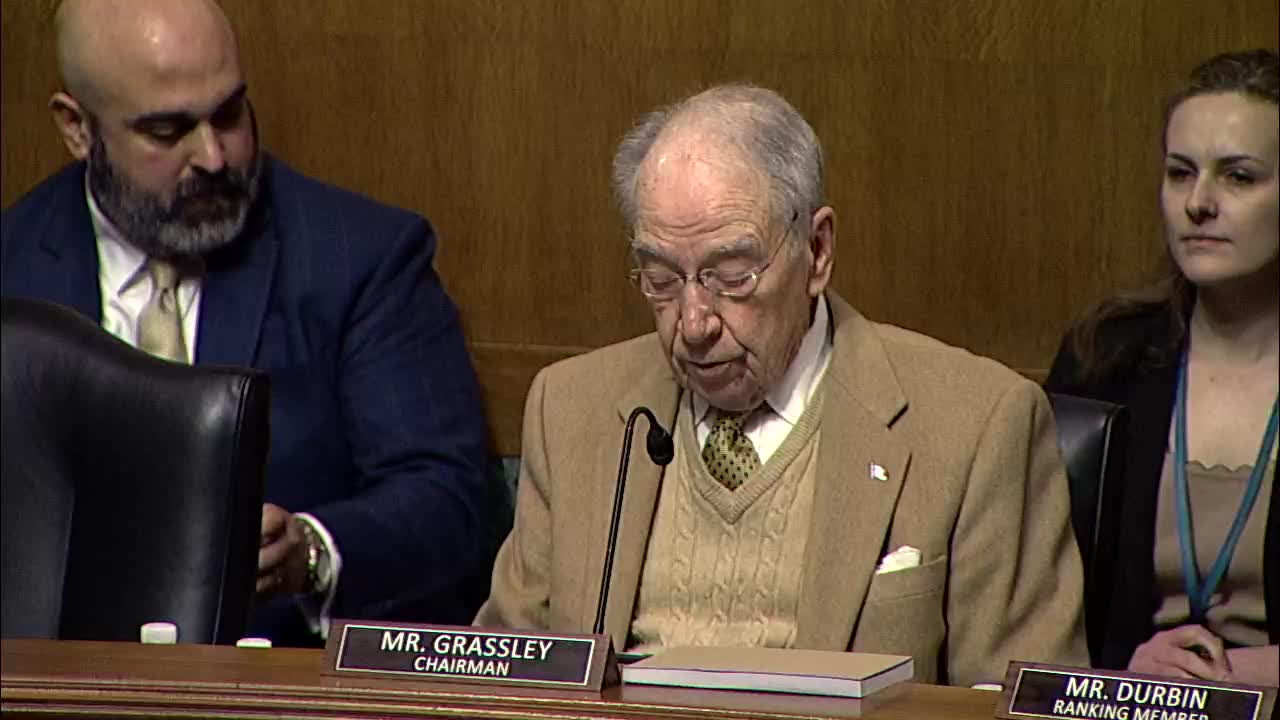
The push for permanent class scheduling was led in testimony and remarks by family members who lost children to illicit fentanyl, emergency physicians who helped draft FRS scheduling language and law enforcement officials. Chairman Chuck Grassley told the committee, "It's time to make this temporary scheduling permanent so that the drug cartels do not have the opportunity to flood our country with even deadlier versions of fentanyl."
The argument for permanent scheduling centers on prevention: Dr. Tom Westlake, an emergency physician who described himself as the architect of Wisconsin's FRS law, said class scheduling removes the incentive for legal chemical manufacturers to create novel fentanyl analogs. "FRS scheduling does not address illicit fentanyl. It was never designed to do so," Westlake said. "It only removed the incentive for legal chemical companies to create new FRSs, thus stopping them from ever existing in the first place."
Family witnesses framed the proposal as urgent. Jaime Puerta, president and co-founder of Victims of Illicit Drugs (VOID), described his son’s death after taking a counterfeit blue pill that lab testing showed contained illicit fentanyl and urged Congress to pass the HALT Fentanyl Act. "My son's death is just one of countless tragedies caused by this epidemic," Puerta said.
Senators on both sides of the aisle and witnesses cited statistics and technical details repeatedly during the hearing: multiple speakers referenced a lethal fentanyl dose as about 2 milligrams; panelists cited recent national overdose counts in the tens of thousands per year and described how small quantities of fentanyl can produce many lethal doses. Dr. Westlake noted the original FRS scheduling approach he promoted in Wisconsin and its adoption by the DEA as a temporary federal policy, and told senators that making the approach permanent would close a regulatory loophole.
Testimony also addressed concerns raised about the impact of class scheduling on research. Westlake and other witnesses said research accommodations have been negotiated and that agencies including NIH, HHS and FDA support the legislative language in the version of the bill before Congress. "While theoretical, it has been addressed with stakeholder input and is supported by the very agencies and organizations representing academic scientific research," Westlake said.
No committee vote on the HALT Fentanyl Act occurred during the hearing. Senators and witnesses urged rapid action: Grassley said the temporary scheduling was set to expire and that Congress must "get this done." The hearing included requests for complementary measures — border enforcement, interdiction, and treatment expansion — but witnesses characterized permanent FRS scheduling as a direct, narrowly targeted policy fix that would prevent some classes of deadly substances from ever reaching markets.
Ending: Committee members signaled bipartisan support for legislation on class scheduling while noting it is only one of multiple steps they said are necessary to address the broader fentanyl crisis.