Get Full Government Meeting Transcripts, Videos, & Alerts Forever!
Get email alerts on the Vehicle Fleeing Owner Liability topic
No spam. Unsubscribe anytime.
Police chiefs back bill to fine vehicle owners when drivers flee traffic stops; supporters say it gives investigators leads
Summary
House Bill 1229 would allow police to issue a civil traffic fine to the registered owner of a vehicle that flees a stop; supporters say it helps investigate dangerous driving when officers deliberately limit high-speed pursuits.
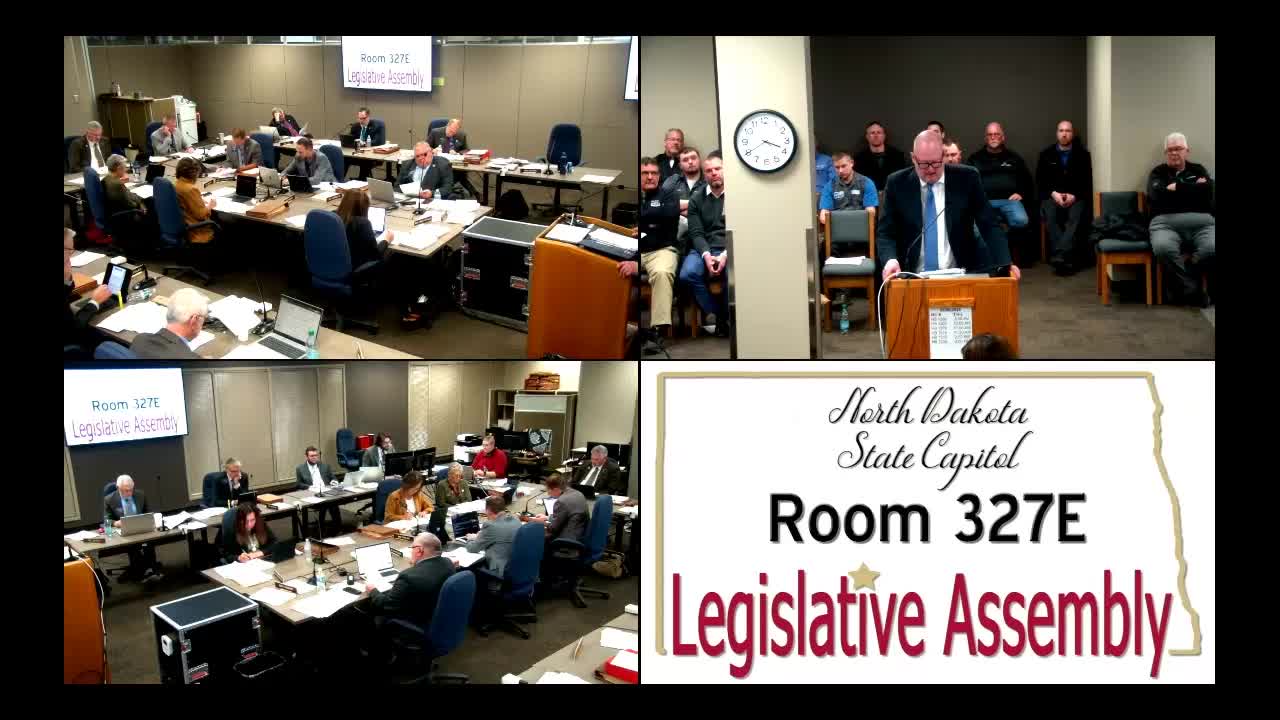
Rep. Austin Schauer introduced House Bill 1229 to the House Transportation Committee as a tool for law enforcement to address drivers who flee traffic stops. The bill would allow officers, after giving a visual or audible signal to stop, to issue a civil traffic citation to the vehicle’s registered owner if the driver fails to stop. The proposed sanctions are a $50 fine for a first violation and up to $1,000 for subsequent violations; the statute would be a traffic offense rather than a criminal charge.
Chiefs from Fargo and Bismarck and other law-enforcement witnesses urged passage, saying the measure addresses a rising public-safety problem created in part because agencies generally avoid high-speed pursuits in populated areas. Fargo Police Chief Dave Zawalaski told the committee Fargo recorded 290 fleeing-vehicle incidents in 2024, up from 101 in 2019. He said 86% of fleeing vehicles were not stolen and that officers use squad cameras and license-plate captures to identify registered owners; roughly 71% of fleeing cases in Fargo went unprosecuted because officers could not reliably identify the driver.
“Fleeing from an officer and lots very often related to dangerous driving…this has led to an exponential increase in vehicles that flee during traffic stops,” Chief Zawalaski said. He described the measure as modeled on a Wisconsin statute and emphasized exceptions in the bill: the citation would not apply if the vehicle were stolen, if the owner cooperates in identifying the driver, for leased vehicles in specified circumstances, or where another code section applies.
Committee members raised questions about legal presumptions and insurance consequences. Representative Casper asked why the bill presumes the registered owner “has violated this section,” citing constitutional concerns about presumption of innocence; sponsor Schauer and supporting witnesses answered that the statute mirrors existing owner-liability provisions in other traffic statutes and provides defensible exceptions and a path for owners to identify the actual driver. Representative Koppelman asked whether citations would be reported on driving records and possibly affect insurance rates; sponsor Schauer said he had not confirmed insurance-reporting consequences and initially characterized the citation as similar to a speeding ticket.
Bismarck Police Chief Dave Dreyovich emphasized that license-plate-reader data helps find vehicles but does not by itself reveal who was driving at the time of flight. He asked the committee to read his written testimony and consider the operational benefits of giving officers a follow-up investigative tool.
The committee held the bill’s hearing and did not record a committee vote in the captured transcript. Supporters asked lawmakers to move the bill forward; no opposition witnesses were recorded in the transcript.
Why it matters: Law-enforcement witnesses argue the bill would give officers a usable investigatory lead when officers avoid entering high-speed pursuits for safety reasons. Critics — including some committee members — questioned whether presuming owner responsibility is consistent with due-process protections and raised the potential for insurance consequences.
Quote
"The number of fleeing vehicles in Fargo has drastically increased from 101 in 2019 to a staggering 290 fleeing vehicles in 2024," Fargo Police Chief Dave Zawalaski said.
Ending
The hearing closed without a recorded committee action in the transcript. Chiefs and the bill sponsor asked the committee to consider the measure; lawmakers requested additional information on legal presumptions and how citations would be reported.