Get Full Government Meeting Transcripts, Videos, & Alerts Forever!
Get email alerts on the Wild Horses Conservation topic
No spam. Unsubscribe anytime.
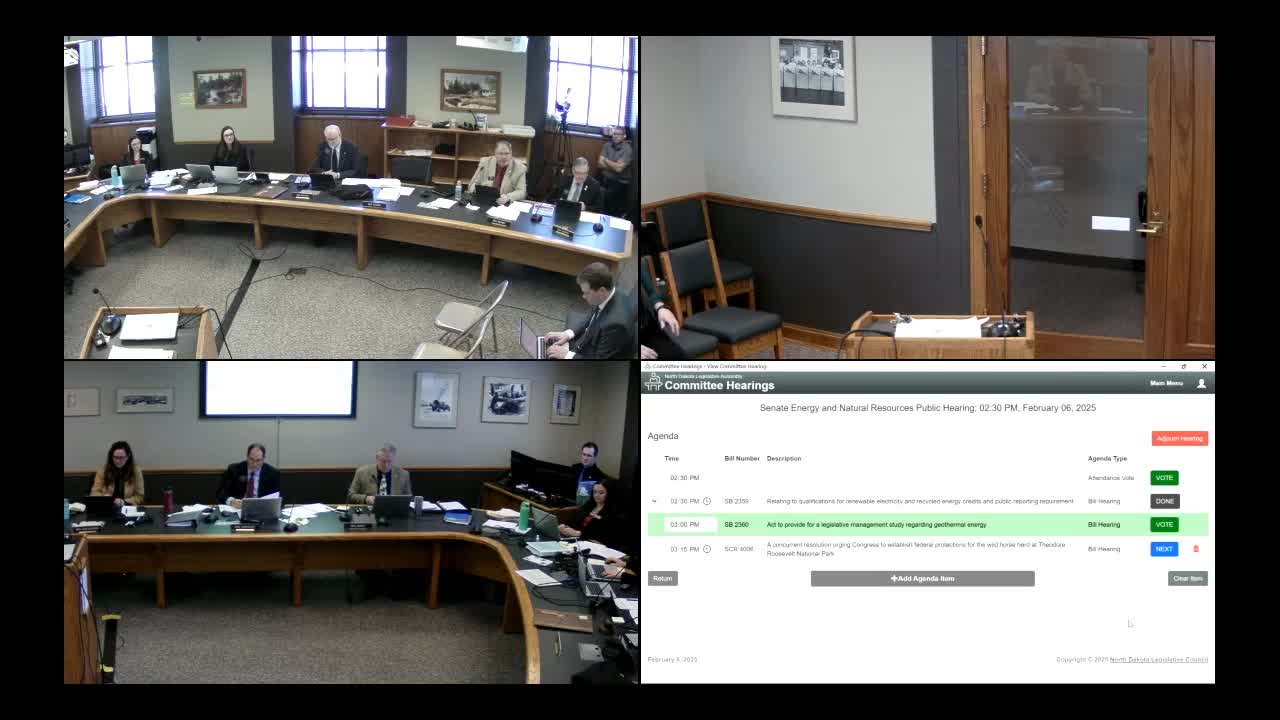
Committee hears advocacy for federal protections for Theodore Roosevelt National Park wild horses
Summary
Senate Concurrent Resolution 4,006, which urges Congress to enact federal protections for the wild horse herd at Theodore Roosevelt National Park, drew extensive supporting testimony from residents, advocates and experts who described historical value, tourism contributions and concerns about recent park management practices.
Senate Concurrent Resolution 4,006, which urges Congress to enact federal protections for the wild horse herd at Theodore Roosevelt National Park, drew extensive supporting testimony from state residents, nonprofit advocates, scientists and filmmakers at a Senate Energy and Natural Resources Committee hearing.
Josh Bocher, sponsor of the resolution and senator from District 44, said the resolution is intended to supplement earlier state advocacy and to support a companion bill that would create a state advisory board to consult with the park. "The goal of that legislation is to create a state advisory board made up of a number of different stakeholders, to help provide support to the park and to create a consultation entity," Bocher said, adding the state has offered resources — including scientific and institutional expertise — to assist the park.
Witnesses described a pattern of management decisions they contend threaten the herd's long‑term viability. Christine Kamann, cofounder and president of Chasing Horses Wild Force Advocates, testified the park gave two weeks' notice before an October 2024 helicopter roundup, during which DNA sampling and GPS collars were used and park officials proposed injecting mares with an immunocontraceptive. Kamann said a March 2024 report showed the park already had DNA on 98 percent of the horses in 2022 and that observers view the aggressive use of the contraceptive (referred to in testimony as GonaCon) as a potential method that could render mares infertile if overused. "The park's actions over the last 3 years have rightfully sparked anger from the general public," Kamann said.
Other witnesses described historical, cultural and economic reasons to protect the herd. Christine and others offered a $37 million annual statewide tourism figure tied to the horses cited from an external analysis; James and other local supporters recounted the herd's historical ties and local advocacy actions by city and county governments.
Experts from national animal‑welfare organizations also supported the resolution. Joanna Grossman, equine program director for the Animal Welfare Institute, noted that federal legislation has established protections for other National Park Service‑managed herds, including the Corolla and Cape Lookout animals, and said congressional action could help secure the Teddy Roosevelt herd.
Supporters emphasized they do not oppose reasonable population management but object to what they described as a lack of transparency from park management and aggressive fertility control approaches that, they argue, risk eliminating the herd's genetic viability. They urged the legislature to pass both the concurrent resolution urging federal protections and companion state legislation to create a stakeholder advisory board.
No opposition testimony was recorded in the hearing. Committee members did not take final action on SCR 4,006 at this session; the chair said action would be taken when more committee members are present.