Get Full Government Meeting Transcripts, Videos, & Alerts Forever!
Get email alerts on the Geothermal Energy topic
No spam. Unsubscribe anytime.
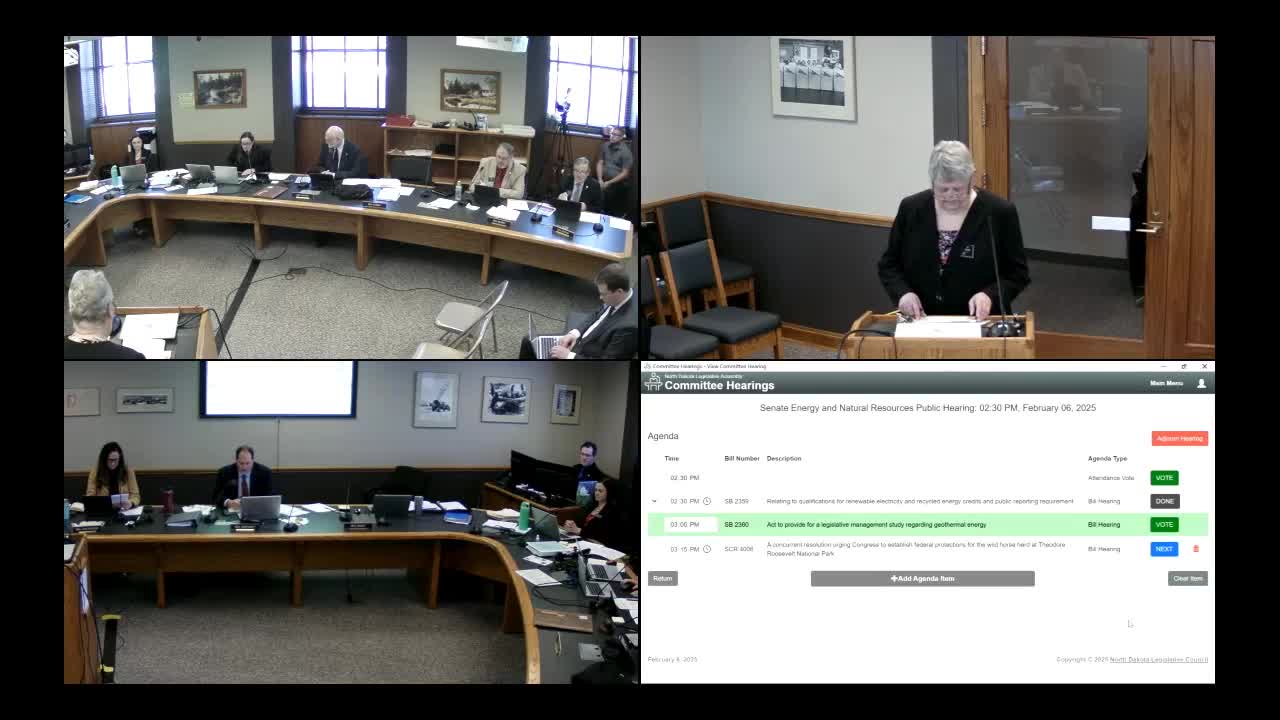
Senate hears proposals to study geothermal potential; experts cite high temperatures in Williston Basin
Summary
Senate Bill 2,360, a bill to request a legislative management study on geothermal energy in North Dakota, drew testimony from geologists, the state geological survey and private developers who cited favorable temperatures in parts of the Williston Basin and suggested a modest feasibility study to quantify opportunities and costs.
Senate Bill 2,360, which would direct a legislative management study on geothermal energy in North Dakota, drew multiple supporters at a Senate Energy and Natural Resources Committee hearing who urged the state to quantify geothermal potential and study how existing oil‑field expertise and infrastructure could be repurposed.
Senator Kathy Hogan, who introduced the bill, said the measure was requested by a constituent and neighbor and described geothermal as a possible complement to the state's "all of the above" energy approach. "There is a lot of information around geothermal," Hogan said, and she provided links and materials to the committee.
Jessica Eagle Bluestone, a geologist and member of the Mandan, Hidatsa and Arikara Nation, testified in support and urged changing the bill language from "shall consider studying" to "shall conduct a study" to ensure the work proceeds. She said geothermal is a reliable baseload power source and can support district heating and direct thermal applications.
Ned Krueger of the North Dakota Geological Survey described the survey's existing regulatory and permitting role under North Dakota Century Code chapter 38‑19 and related administrative code. He said the survey has issued permits for many shallow ground‑source loop installations (permitting more than 41,000 holes and over 8,600,000 drilling feet of loop depth for residential and commercial systems) and that the survey in 2020 adopted a new administrative chapter to anticipate deep geothermal production permitting; no permits have yet been issued under that chapter. Krueger noted that nearby projects in Saskatchewan have measured temperatures as high as 261 degrees Fahrenheit in the Deadwood formation and that the survey has recorded temperatures near 297–299 degrees Fahrenheit at depths of roughly 13,000 feet in McKenzie County in the Interlake and Stoney Mountain formations.
Private sector testimony included Munessa Lamuti, identified as CEO of Jotema Energy Development, who said North Dakota's tens of thousands of inactive oil and gas wells could reduce development costs and that co‑production of minerals such as lithium from geothermal brines could improve project economics. Paul Jensen of Greenway Energy and other witnesses urged the committee to fund a modest feasibility study (Lamuti proposed $5–10 million as a reference point) to produce actionable cost estimates that could unlock federal tax credits and loan programs.
Committee members asked technical and economic questions about resource renewal, drilling methods and costs. Krueger described closed‑loop designs and said deep geothermal development under consideration in nearby Canada was being tested and engineered, with an initial planned facility of about 5 megawatts and potential expansion to about 25 megawatts.
No parties testified in opposition at the hearing; multiple written testimonies were filed and the committee closed the hearing to consider next steps. The bill would authorize the legislature to commission a study; the committee did not vote on the measure during this hearing.