Get email alerts on the Energy And Natural Resources topic
No spam. Unsubscribe anytime.
Senate committee backs removing long‑exceeded renewable objective from state code
Summary
The Senate Energy and Natural Resources Committee voted unanimously to advance an amended Senate Bill 2,359 to remove an obsolete renewable energy objective and a related utility reporting requirement, with supporters saying the statute has been used to justify out‑of‑state transmission costs for North Dakota ratepayers.
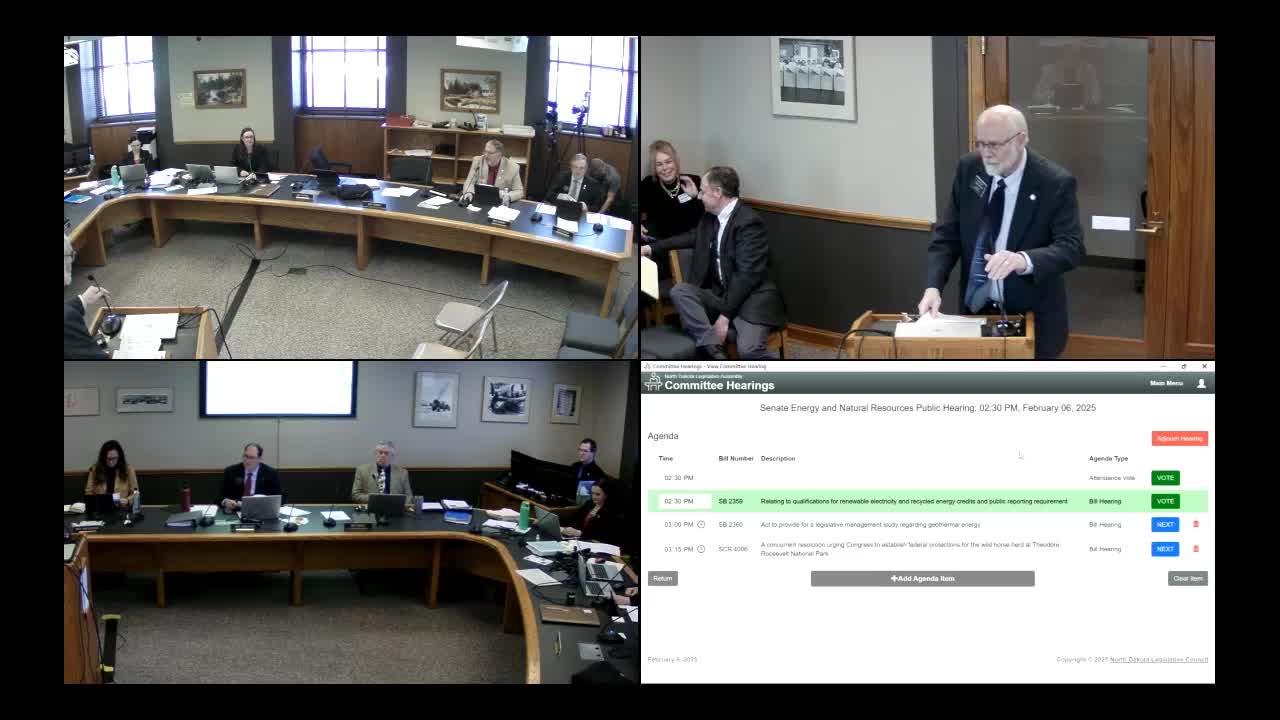
Senate Bill 2,359, which would remove a long‑exceeded renewable energy objective from state law and strike a narrow reporting requirement, won committee approval after proponents argued the language is outdated and has been used to justify shifting transmission costs to North Dakota customers.
Senator Dale Patton, sponsor of the bill and a Republican from District 26, told the Senate Energy and Natural Resources Committee that "we have far exceeded that objective, and so the code is unnecessary" and introduced an amendment (25.1343.01001) to eliminate a reporting requirement.
The bill's key supporter, Randy Christman, chair of the North Dakota Public Service Commission, told the committee the state's 10 percent renewable objective — adopted in 2007 with a target of 2015 — was met and exceeded years ago. Christman said regional transmission organizations, including the Midcontinent Independent System Operator (MISO) and the Southwest Power Pool (SPP), are now proposing large transmission packages that allocate most costs to all customers in a footprint rather than assigning costs to those who cause and benefit from the projects.
Christman described MISO's first tranche as "18 transmission projects totaling $10,300,000,000" and said the projected cost to the average residential Otter Tail Power customer from tranche 1 would be about "$5.75 a month for 40 years." He said MISO recently approved roughly $30,000,000,000 of additional projects and plans multiple further tranches. Christman told the committee courts have cited North Dakota's renewable objective as one reason to accept tariffs that socialize high‑voltage transmission costs, and he argued removing the objective would strengthen the state commission's position when contesting what he characterized as "inequitable cost shifts." He said the commission "strongly oppose[s] forcing North Dakota ratepayers to cover the costs of transmission projects that are driven by other states' renewable energy mandates and corporate decarbonization goals."
Committee members asked technical and drafting questions, including whether an emergency clause was needed (Christman said he did not believe so) and why language relating to a separate renewable energy certificate (REC) program and a hydroelectric exception appeared in the same statutory section; Patton and Christman said legislative council had identified and recommended removal of some redundant language.
The committee voted first on the amendment to remove the reporting requirement. Senator Dale Patton moved "a due pass on amendment 25.1343.01001." The clerk recorded 6 ayes, 0 nays and 1 absent not voting; the amendment passed. Later, Senator Inghitt moved a "do pass" recommendation on the amended bill; the motion was seconded by Senator Behm and the clerk recorded 6 ayes, 0 nays and 1 absent not voting. The committee passed the amended version of Senate Bill 2,359.
Supporters emphasized they are not opposed to transmission expansion that delivers demonstrable reliability or economic benefits to North Dakota customers, but repeatedly pressed that costs driven by other states' policies should not be socialized to North Dakotans. Opponents or neutral agency testimony were not recorded during this hearing.
The committee chair closed the hearing and the bill will proceed according to the legislative process. The record shows the committee adopted Patton's amendment and gave a do‑pass recommendation on the amended bill.
AI generated
The text on this page is AI generated. Summaries, highlights, analysis, and video transcripts are all produced from the original source material.
AI can make mistakes, so if you spot one, and we will fix it for everyone.
Note: the source content is unaltered by us. Any content source we link to, be it a video, an audio recording, or a document, is presented exactly as its publisher released it. That publisher is usually a government body, sometimes an individual official or another organisation.