Get Full Government Meeting Transcripts, Videos, & Alerts Forever!
Get email alerts on the Performance Audit Commerce topic
No spam. Unsubscribe anytime.
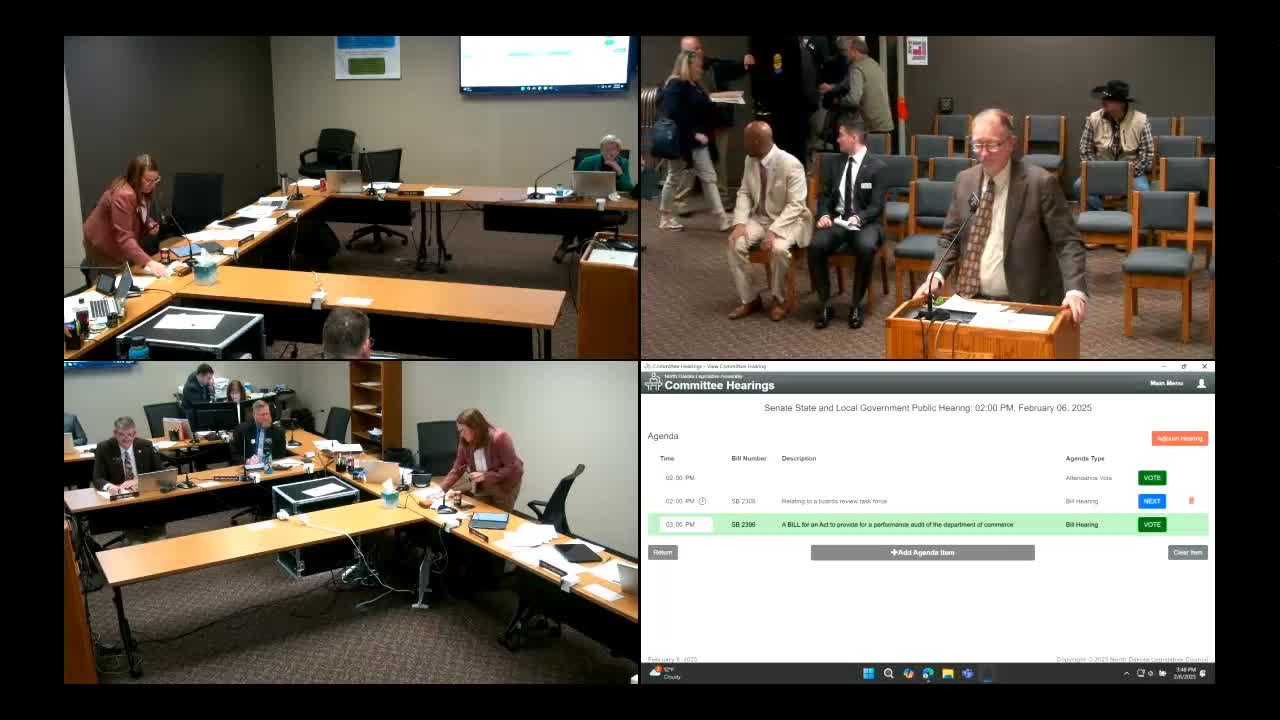
Senate panel backs performance audit of Commerce and Development Fund after concerns about department conduct
Summary
The Senate State and Local Government Committee approved an amendment and recommended a due-pass for Senate Bill 2396, ordering an independent performance audit of the Department of Commerce and the North Dakota Development Fund following concerns raised about department actions.
The Senate State and Local Government Committee voted to adopt an amendment and recommended a due-pass on Senate Bill 2396, a measure authorizing an independent performance audit of the North Dakota Department of Commerce and the North Dakota Development Fund.
Senator Kent Weston, sponsor of SB2396, told the committee the bill was prompted by concerns that the Department of Commerce publicly alleged a North Dakota startup had misused funds, a claim he said created conflicting public signals and raised questions among legislators and business stakeholders. Weston said the audit would “bring transparency and policies that will serve the people of the state.”
The committee adopted Amendment 2004, which added the North Dakota Development Fund to the bill and included an appropriation to pay for the work. Reid Johnson of the governor’s office provided neutral testimony that the governor’s office supports independent audits and that the bill would authorize the Legislative Management Committee to contract with an out-of-state, independent third party to examine Commerce and the development fund’s policies, procedures and results for the 2020–2024 period.
State Auditor Josh Gallion appeared and said the auditor’s office routinely performs performance audits and could do the work, but acknowledged that some lawmakers prefer an outside contractor for independence. Gallion said the performance audit of the auditor’s office itself had previously cost $2.85 million, and he estimated the amendment’s $3.35 million appropriation was “probably not out of line” for a multi-year performance audit of the agencies named in the bill. The original fiscal note on the bill, prior to the amendment, had been $500,000.
After debate the committee approved a motion to report the bill as amended with a due-pass recommendation and to refer it to the appropriations committee. The roll-call recorded the committee recommendation as passing 5–0–1. The committee will forward the bill to appropriations for funding consideration.