Get Full Government Meeting Transcripts, Videos, & Alerts Forever!
Get email alerts on the Waterfowl Hunting Boat Blinds topic
No spam. Unsubscribe anytime.
Senate committee backs bill allowing hunters to shoot from motorized boats once engines are off
Summary
The Senate Energy and Natural Resources Committee voted 6-0 to give Senate Bill 2245 a due-pass recommendation after testimony said the bill would allow hunters to hunt from watercraft that are not motor-propelled at the moment of the shot and to motor to retrieve crippled birds provided the motor is shut off before firing.
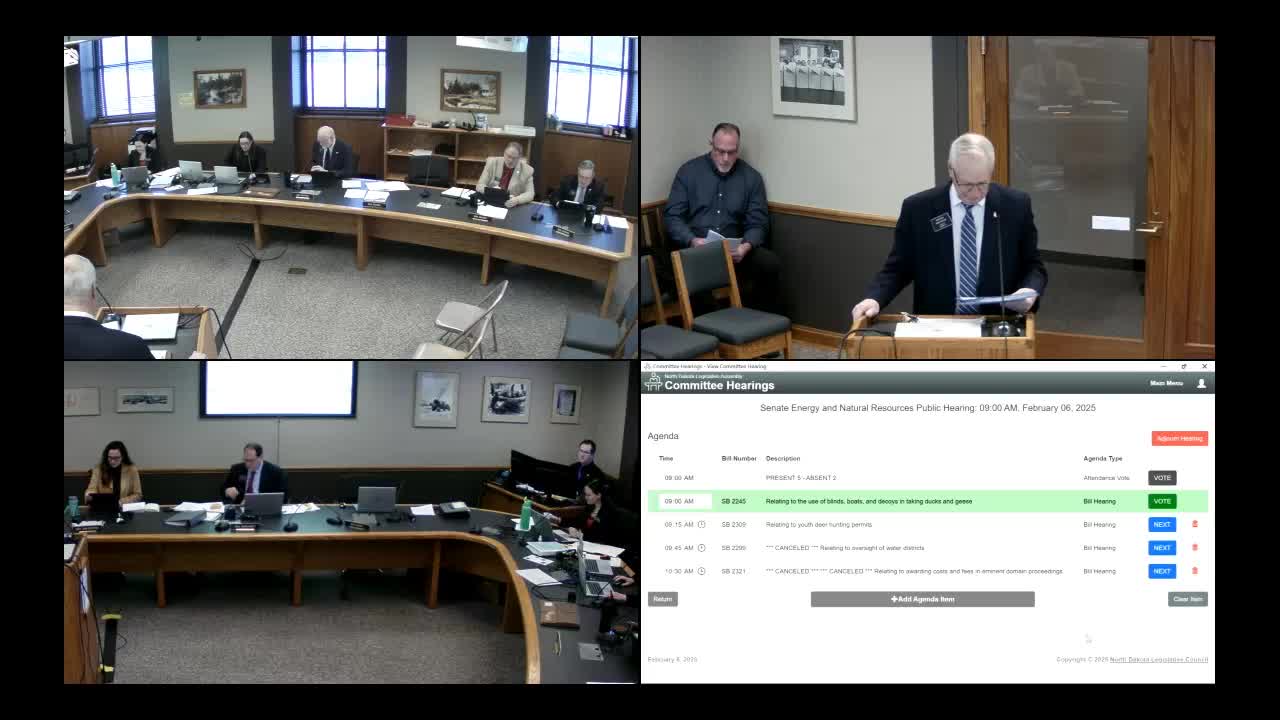
The Senate Energy and Natural Resources Committee on Wednesday voted 6-0 to recommend Senate Bill 2245, which would change state law to allow hunters to use watercraft as blinds when the craft is at rest and any motor has been shut off.
Senator Dwyer introduced the bill, saying it "adds hunting from a boat with a motor, and the motor has to be turned off," and noted the craft must be tied to or adjacent to a hunting blind if the blind requirement applies. The bill would also clarify that watercraft propelled exclusively by paddle, oar or pole may be used for waterfowl hunting.
Bill Haas, assistant chief of the Wildlife Division at the North Dakota Game and Fish Department, told the committee: "Yes, that boat could serve as a blind." Haas explained practical examples: a hunter who motors out to retrieve a crippled duck would have to bring the boat to rest and shut off the motor before taking a shot. "At this point in time, that duck, you cannot shoot at it to finish it, to retrieve that bird," Haas said, arguing the bill would make some recoveries realistic.
Rich Gross, a retired federal agent with the U.S. Fish and Wildlife Service who requested the bill, said the change would expand opportunities and reduce the loss of crippled birds. "All this is requesting to do is really two things," Gross said: to allow manually moving the craft (paddle/pole/row) while hunting and to permit motors to be used to reach a crippled bird so long as the motor is stopped before firing.
Committee members questioned enforcement and edge cases. Senator Gerhardt asked how the rule would apply on windy days when a craft may not come to a full stop; Haas replied enforcement would rely on wardens' discretion and pointed to the statute's use of the word "resting." The Game and Fish Department told the committee those finer rules would be shaped in the governor's proclamation and in department enforcement guidance.
The committee closed the hearing after hearing supportive testimony and no opposition. Senator Behn moved a due-pass recommendation; the clerk recorded 6 ayes, 0 nays, 1 absent. The committee asked for a carrier to carry the bill forward.
Votes at the committee were procedural and unanimous; no changes to the bill text were adopted during the hearing.