Get Full Government Meeting Transcripts, Videos, & Alerts Forever!
Get email alerts on the Boards Commissions Review topic
No spam. Unsubscribe anytime.
North Dakota hearing on bill to review and pare state boards draws support and resistance over soil, water and data governance
Summary
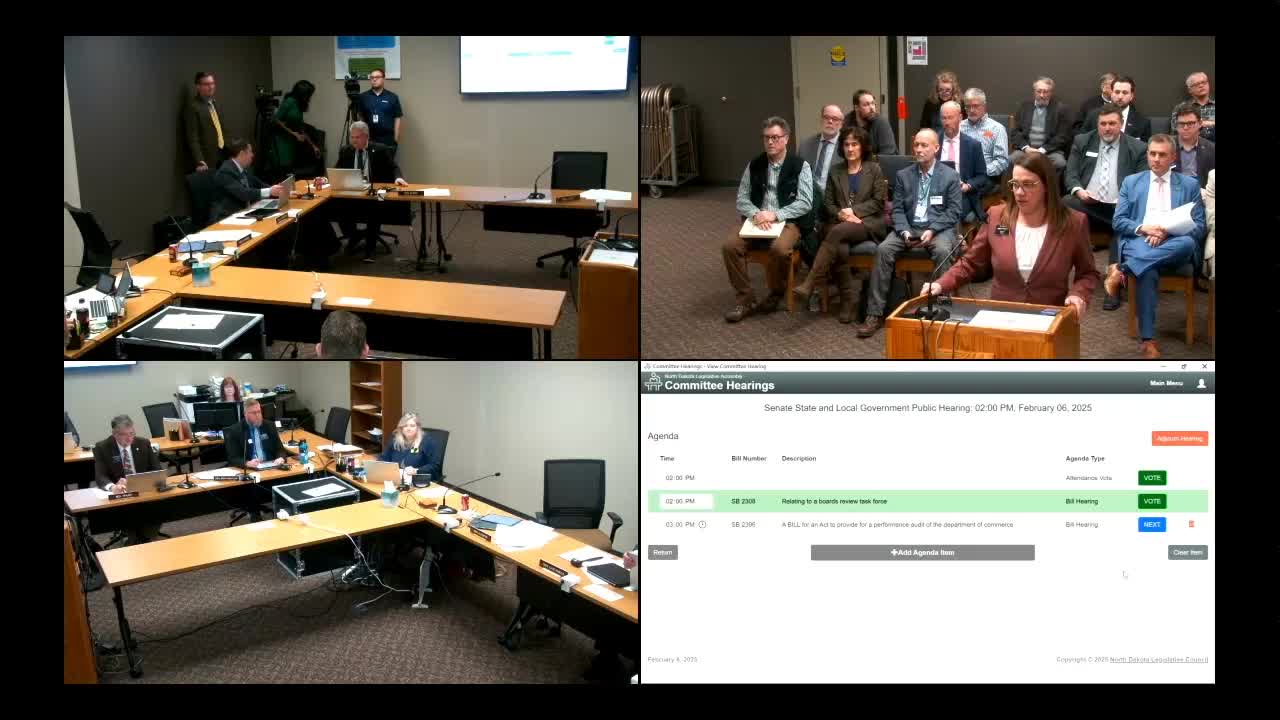
Senate State and Local Government Committee members heard more than three hours of testimony on Senate Bill 2308 on behalf of the governor's office, which would create a Board Review Task Force to evaluate state boards and repeal or transfer duties of dozens of statutory entities.
Senate State and Local Government Committee members heard more than three hours of testimony on Senate Bill 2308 on behalf of the governor's office, which would create a Board Review Task Force to evaluate state boards, commissions and councils and repeal or transfer the duties of dozens of statutory entities.
The bill’s sponsor, Senator Kristen Roars, District 27 of South Fargo, introduced the measure as a governor-backed effort to “right size” state boards. Governor Lehi Armstrong told the committee, “1 priority of our administration is to refocus our efforts in state government to be consumer driven,” and described the task force’s goal as finding boards that could be combined or dissolved to reduce duplicative work and administrative burden.
Proponents and state agency officials said amendments circulated during the hearing would preserve federal funding and move several advisory duties into state departments rather than eliminating programmatic functions. Allison Hicks of the attorney general’s office described an omnibus amendment that, among other changes, moves administration of the Statewide Longitudinal Data System (SLEDS) into the North Dakota Information Technology Department (NDIT); she said the change was intended to “preserve” interagency data-sharing agreements and maintain continuity for programs now housed in SLEDS.
Kirsten Basler, state superintendent for the Department of Public Instruction, and Corey Mach, chief information officer for NDIT, both supported the amended language shifting SLDS administration to NDIT. Basler gave a history of the data system’s federal-start funding and said North Dakota’s SLDS now contains K–12, higher education, workforce and other state data that is suited to neutral stewardship in an IT agency. Mach said the move would preserve technical capacity and provide flexibility for advisory groups to operate without statutory language that could limit adaptation.
Several state agency leaders — including Rhys Haas, director of the Department of Water Resources; Zachary Greenberg, interim commissioner of the Department of Labor and Human Rights; and the Department of Commerce’s and other representatives in support — told the committee that many advisory and technical functions could be absorbed into agencies to create efficiencies. Greenberg described a department backlog and supported moving staffing responsibility for the task force to the governor’s office so the Labor and Human Rights Department could keep focusing on enforcement work.
But public testimony opposing parts of the bill focused on proposed repeals that would eliminate the North Dakota Board of Professional Soil Classifiers and other licensing or advisory bodies. Chris Augustine, a professional soil classifier from Dickinson, said changing the statutory definition and eliminating the board would leave “no checks and balances on who or who is not qualified to do soil classification work in the state,” citing the board’s educational, experience and testing standards. Perry Sullivan, chairman of the North Dakota Board of Professional Soil Classifiers, told the committee the board has licensed 78 classifiers since inception and currently 28 hold licenses, adding that 21 remain active in private practice. He warned that removing statutory licensure could affect mining reclamation, DOT projects and other work that currently relies on certified soil classifiers.
Representatives of the Board of Water Well Contractors and well-driller groups also testified in opposition or urged caution, saying those boards are largely self-funded, meet infrequently and provide technical oversight the relevant departments may lack capacity to replicate quickly. Testimony from on-site wastewater and plumbing interests emphasized technical complexity and the safety implications of removing long-standing advisory committees.
Several trade and business groups urged targeted amendments rather than wholesale repeal. Eric Spencer, president and CEO of the Greater North Dakota Chamber, proposed a narrow amendment to preserve the nomination process for employer representatives to Workforce Safety and Insurance while removing the coordinating committee from statute; he said the existing process has worked and that retaining nomination steps would avoid unintentionally removing employer input.
Committee members asked multiple clarifying questions during testimony about which duties would be transferred, how federal funding or interagency agreements would be preserved, and which agencies would assume operational responsibilities. Reed Johnson, a legal intern from the governor’s office, provided a section-by-section overview of the original bill and identified multiple technical corrections and transfers (for example, moving certain early childhood and brain injury advisory duties to DHHS, and placing water-well contractor licensure under the state engineer or Department of Water Resources in the original draft). Allison Hicks described amendments that remove certain administrative burdens from the proposed task force, including deleting a requirement that the task force issue performance evaluations to all boards, saying that the task force’s primary role should be information gathering and recommendations.
No committee vote on Senate Bill 2308 was recorded at the hearing. Testimony was left in the record and several agencies indicated support for the bill as amended, while professional boards and industry groups urged either removal from the repeal list or statutory changes to preserve licensing and nomination processes.
The hearing record shows repeated requests to preserve federal funding-dependent functions and to avoid disrupting existing interagency data-sharing agreements; witnesses asked the committee to ensure that any transfers are accompanied by clear administrative support and capacity in receiving agencies.
The committee did not take final action on the bill at the hearing; members will have the bill, amendment text and submitted written testimony available as they consider next steps during future sessions.