Get Full Government Meeting Transcripts, Videos, & Alerts Forever!
Get email alerts on the Legal Recruitment topic
No spam. Unsubscribe anytime.
Committee backs bill to extend recruitment and retention slots for county attorneys, leaves eligibility to Supreme Court
Summary
The Senate Workforce Development Committee voted to give Senate Bill 2,211 a "do pass" recommendation after discussion about whether appointed and elected county attorneys would qualify for existing recruitment and retention slots.
The Senate Workforce Development Committee on a voice vote recommended Senate Bill 2,211 for passage after members discussed clarifying who may qualify for two remaining recruitment-and-retention slots available under an existing program.
Committee members said the bill’s stated purpose—adding “retention” to an existing recruitment program—appeared straightforward and aimed to make fuller use of the program’s eight total slots; testimony indicated six slots are already filled and two remain available. Members asked whether the bill’s language would cover attorneys who are appointed to fill vacancies as well as those who are elected.
Senator Kathy Hogan and other lawmakers referenced written testimony from a Wells County official and a court administrator that described uncertainty about whether the Supreme Court’s eligibility determination would include appointed attorneys. Several senators said they would be comfortable if the committee explicitly stated its intent that any attorney who meets eligibility criteria be considered, while others preferred leaving the definitive interpretation to the Supreme Court. The committee did not change the bill text to resolve the question; members said a statement of legislative intent might help inform the court’s interpretation.
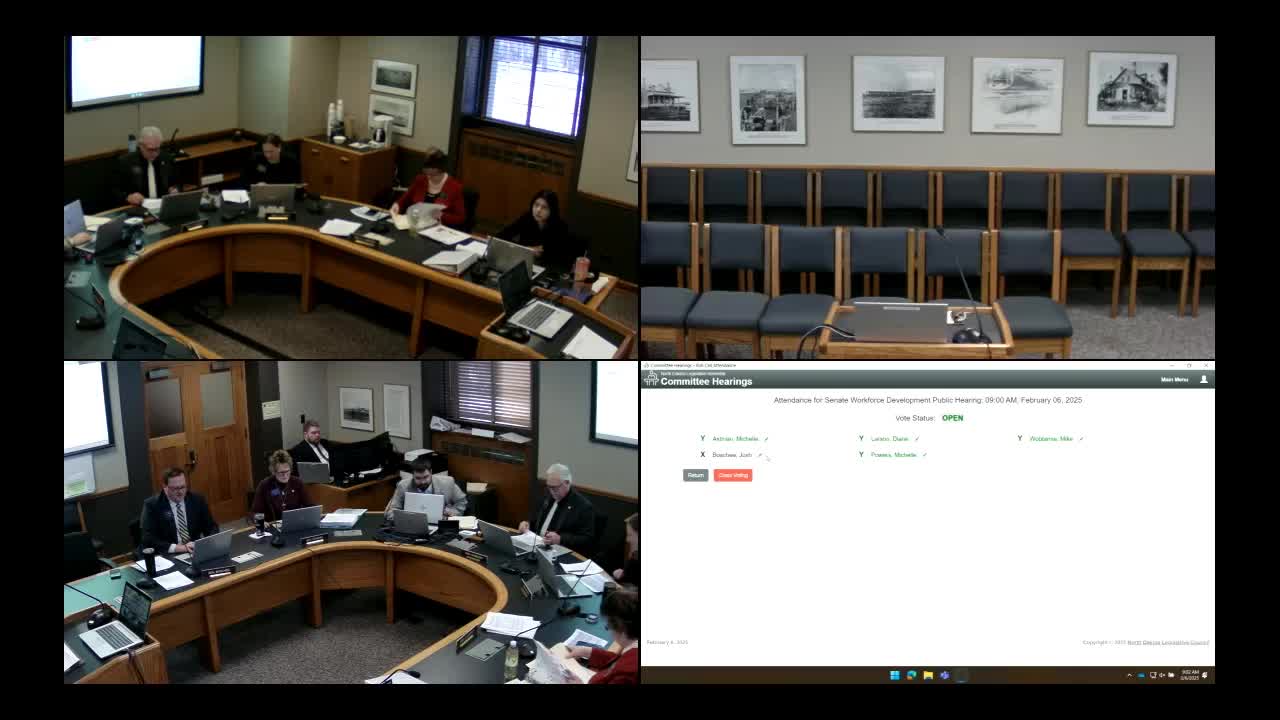
A motion recommending a "do pass" on Senate Bill 2,211 carried by recorded vote. The committee opened its electronic voting key and recorded unanimous assent from senators present. The bill will proceed from the committee with a favorable recommendation.
The discussion made a procedural distinction between the committee’s preference and the court’s formal eligibility decision; committee members stressed the difference between expressing an intent and imposing a statutory definition.
The committee also noted the bill carries no new appropriation; an incentive payment of $45,000 cited in testimony was described as current funding rolled into the judiciary’s budget rather than a new expense. Members said they understood retention aims to cover attorneys continuing in office, rather than creating a separate class of recipients.